








Most CI programs have a blind spot unrelated to analysis or distribution. It's detection.
The frameworks are solid. The battlecards are thorough. The newsletters go out on schedule. But the underlying assumption is that someone will notice when a competitor changes its website. Usually, nobody does. A pricing page restructures quietly. A feature gets deprecated without a blog post. A homepage headline shifts to a new value prop. By the time it surfaces, it's because a prospect mentioned it or a sales rep flagged it mid-deal.
This isn't just anecdotal. Crayon's 2025 State of Competitive Intelligence report found that 44% of companies lack competitor visibility in their CRM, and that 58% of CI professionals struggle to keep battlecards and competitive content up to date. The collection layer is where many programs lose signal.
Competitor web monitoring closes that gap. It's the CI layer that sits beneath analysis and distribution, catching changes as they happen so the rest of your program works with the latest information.
What their pages are telling you (that nobody's reading)
Competitor websites are among the richest public intelligence sources available. Most teams check a competitor's homepage from time to time. Few treat web pages as structured intelligence inputs.
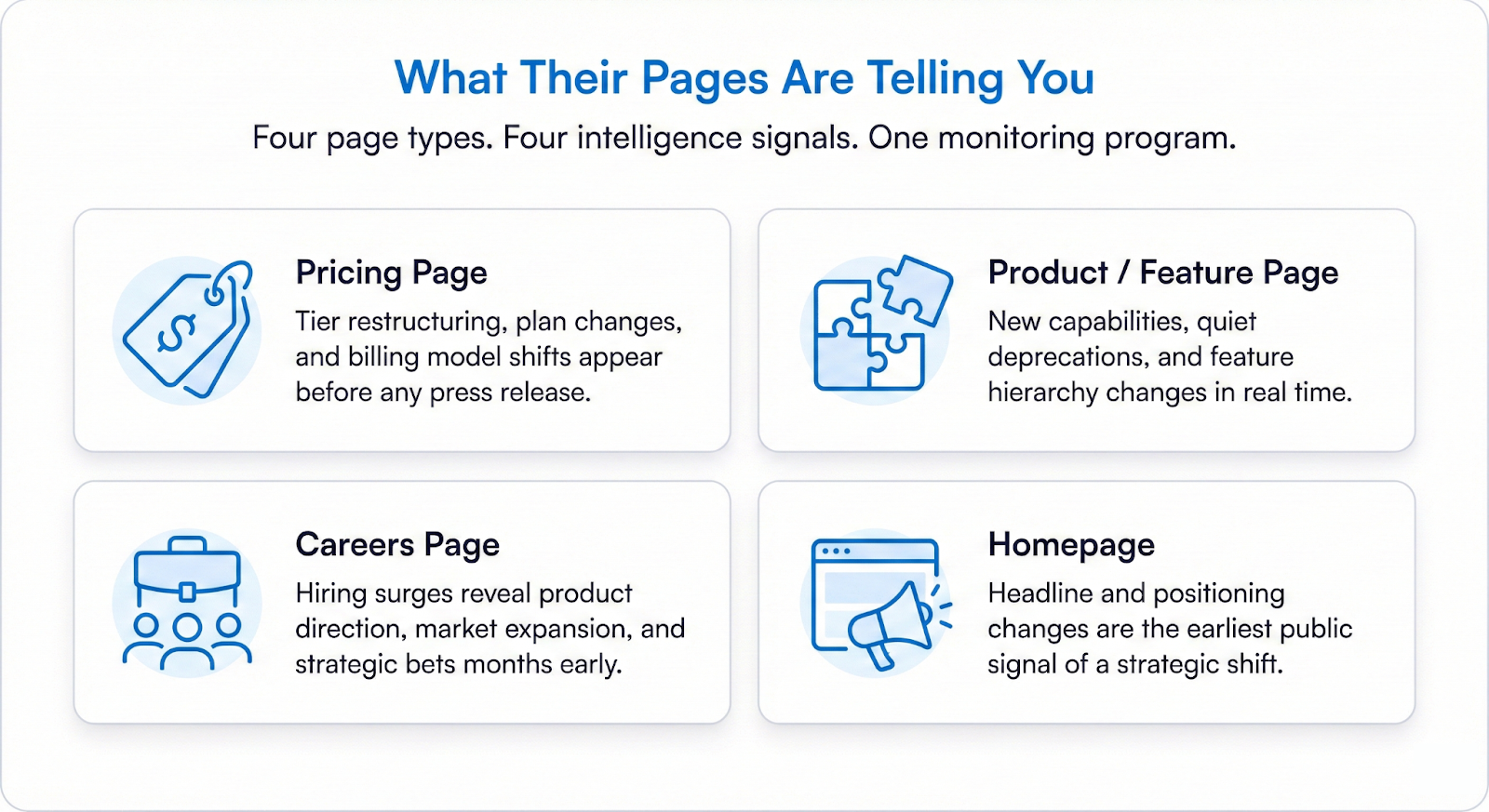
Pricing pages are the most obvious signal, but the intelligence runs deeper than dollar amounts. Tier restructuring, the removal of a free plan, and a shift from per-seat to usage-based billing are strategic pivots that often appear on the pricing page weeks before any press release or blog announcement.
Product and feature pages reveal capability investments in real time. What they've added, what they've quietly deprecated, and how they've reorganized their feature hierarchy. This feeds directly into battlecard feature comparisons, and it moves faster than quarterly reviews can keep up with.
Careers pages are strategic forecasting in plain sight. A burst of AI engineering hires signals a shift in product direction. A new office location hints at market expansion. A VP of Partnerships posting tells you an ecosystem play is coming. These are directional signals with months of lead time.
Homepage messaging is often the earliest public signal of a strategic shift. When a competitor changes their hero headline or repositions their value proposition, they're telling you what positioning they're testing in the market.
To make this concrete: imagine a competitor quietly folds their mid-tier plan into their enterprise tier and raises the entry price by 40%. No blog post. No press release. If you're monitoring that pricing page, the change lands in your Slack the same day.
By the next day, your sales team will have an updated battlecard and a new talk track for every open deal in which that competitor is shortlisted. That's a one-day response to a change that might otherwise have surfaced a week later through a prospect mention, or AI-style competitor trackers.
Based on data from more than 3,500 organizations using Visualping, most teams start with monitoring one page: the homepage. The most effective competitor monitoring operations, however, track four or five page types per competitor, building a composite picture rather than relying on any single signal.
How it fits your workflow (without adding noise)
The first objection I hear from product marketers is always the same: "I don't need more notifications."
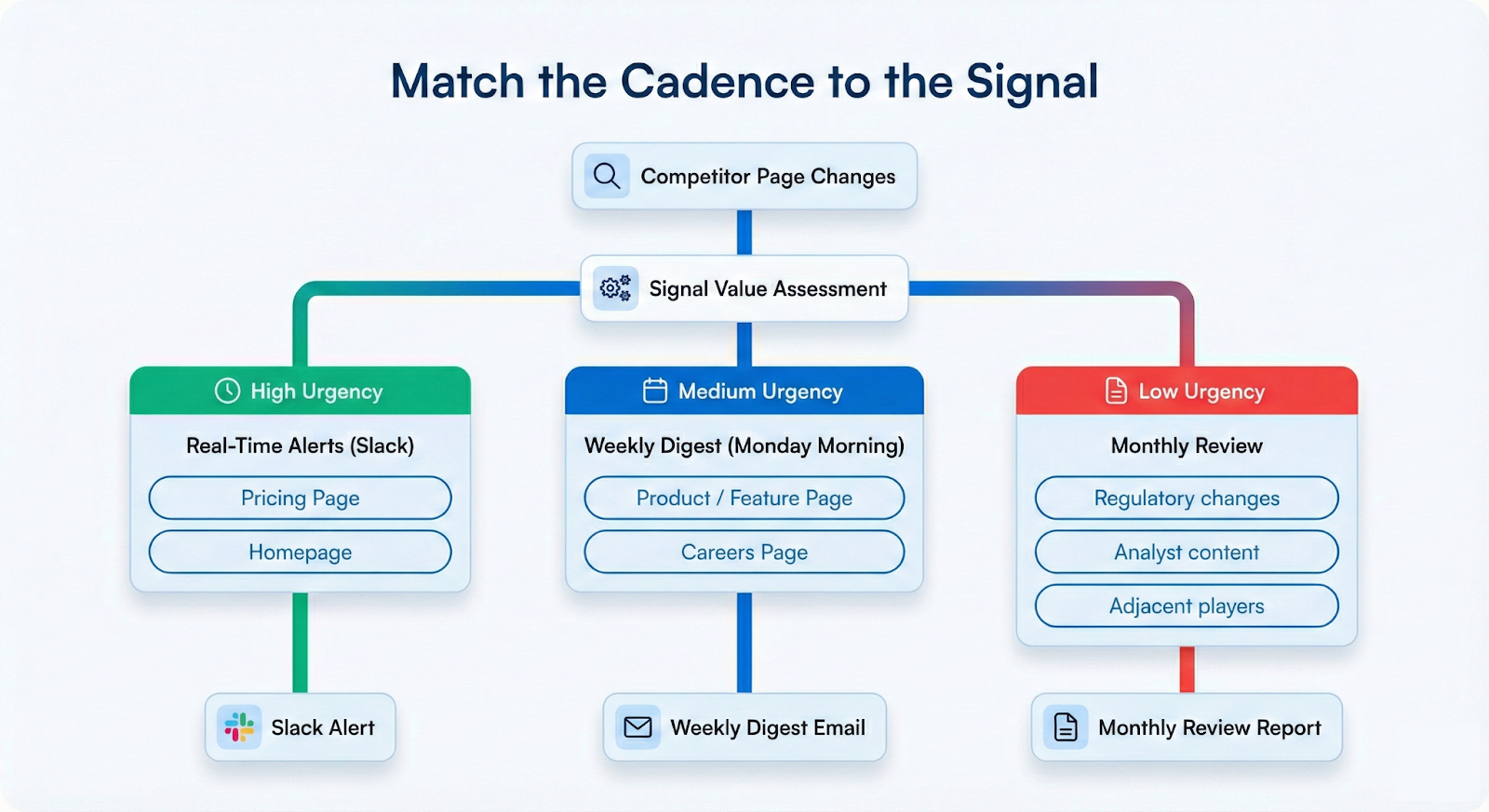
It's the right instinct. Real-time alerts are the wrong model for most CI. Pricing changes from your top three competitors? Yes, those should hit Slack immediately. But for everything else, the smarter approach is a periodic competitive digest.
Here's what that looks like in practice. You set monitoring on the pages that matter across the companies you track. Instead of processing individual alerts throughout the week, you receive a single consolidated summary on a schedule that matches your CI rhythm. Daily works for high-value pages (pricing, homepage); but weekly is fine for monitoring the majority of low or medium tier webpage types. Monthly works for broader market signals.
Monday morning: one digest lands covering everything that changed across your top rivals in the past week. Each change is summarized in a few sentences, not a raw diff of code. You scan it in five minutes. You flag anything that requires action. You feed the relevant changes into your next battlecard update, your next competitive newsletter, or your next sales enablement session. If you’re adventurous, build a workflow that automatically feeds the changes captured in the brief into an LLM and automates actions such as generating an in-depth report or conducting detailed research.
This aligns with the CI workflow most teams already use. PMA's own competitive intelligence toolkit describes periodic competitive newsletters and briefing documents as standard deliverables. The difference is what feeds them. Instead of a quarterly manual review that takes hours and goes stale within weeks, your digest is fed by continuous automated detection. The analysis and distribution layers of your CI program stay exactly the same. The detection layer continues to improve, becoming faster and more accurate.
At Visualping, we run our own monitoring on this model. Our weekly digest covers pricing, product, and careers pages across the companies we track, on top of the high-value alerts pushed immediately into Slack. It takes less than five minutes to review and feeds directly into our battlecard update cycle and into the Sales and Leadership channels. The time spent on our CI goes mainly toward analysis: determining what a change means and how to respond. That's where our intelligence adds the most value.
Match the cadence to the signal. Real-time alerts for home/pricing changes on direct rivals. Weekly digests for product pages, careers, and messaging. Monthly for broader market signals like regulatory changes, analyst content, or adjacent players. Not every page deserves the same urgency.
Start with nine monitors and one Monday morning
You don't need a full CI technology stack to begin; in fact, competitor monitoring is a great way for teams to get started in their CI journey. Start here:
Pick your top three rivals from win/loss data. Not the market leader. The three you actually lose deals to. As Bill Emmett argued in his PMA Summit talk on differentiating with CI: start with your CRM data.
Set up monitoring on three page types per rival. Pricing page, main product page, careers page. That's nine monitors.
Set your cadence. Route pricing changes to Slack in real time. Set everything else to a weekly digest. Review it on Monday morning. Share the first meaningful finding with your sales team within the first two weeks.
The principle holds regardless of how you implement it: systematic detection frees your CI time for analysis and action. That's the strategic thinking that wins deals and the work only a product marketer can do.


Product marketing insider
Thank you for subscribing
Level up your product marketing career & network with product marketing experts.
An email has been successfully sent to confirm your subscription.
 Follow us on LinkedIn


.svg)
Start the conversation
Become a member of Product Marketing Alliance to start commenting.
Sign up now