





Are you being asked to redo the sales deck, launch an AI product with zero context, and rejig your positioning based on "vibes,” all in the same week?
If your hands are up, you’re in the right place.
Product marketing is a craft we love, but it’s also a role that no one seems to 100% understand.
In this article, you’ll discover how to move from being "something for everyone" to "the thing for someone."
We’ll explore the PMM Edge Framework, a three-step process to help you identify your unique strengths, assert your value in a volatile market, and use AI as a tool to amplify your humanity rather than replace it.
By the end, you’ll have a clear roadmap for building a career that is both sustainable and uniquely yours.
The pressure to be everything for everyone
As product marketers, we are particularly vulnerable to the "do it all" trap.
We operate in a landscape where the ground is constantly shifting. Between the pressure to be "AI native" yesterday and the volatility of a market defined by budget cuts and layoffs, it’s easy to feel like you’re walking through quicksand.
We’re told to be data-led, technical, commercial, and customer-obsessed—all while moving at lightning speed. Someone in your company likely thinks you own everything from win rates and pipeline to product roadmaps and internal comms. But the best PMMs don't try to be everything for everyone.
They know what they’re great at, and they double down on it.
Why the "everything" approach fails
When you try to fill every gap, you lose your "edge."
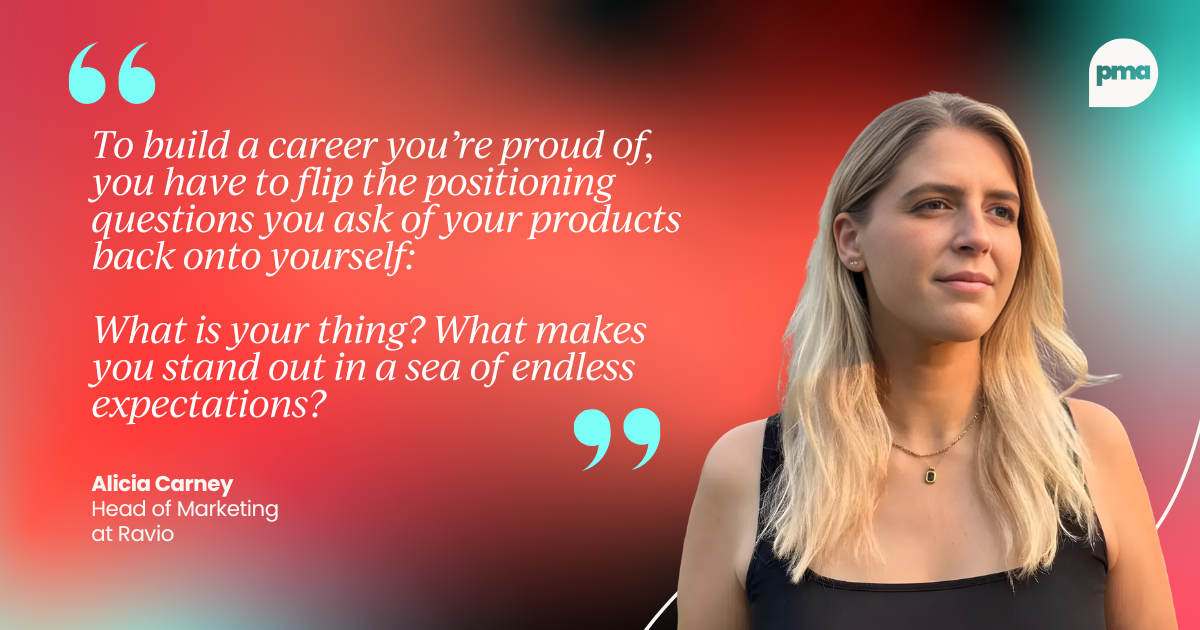
You become a general resource rather than a strategic driver. To build a career you’re proud of, you have to flip the positioning questions you ask of your products back onto yourself: What is your thing? What makes you stand out in a sea of endless expectations?
Defining your edge through the Ikigai lens
Confidence doesn’t come from being the loudest voice in the room. It comes from knowing what energizes you. Your edge is the intersection of your natural strengths and the moments where you create undeniable momentum for your business.
I like to use the concept of Ikigai, the Japanese "reason for being," to help PMMs find this balance.
Clues to identifying your unique value
To find your edge, look for these internal signals:
- The "Buzz": When do you feel most alive at work? Is it when you're digging into customer psychology or solving a complex technical problem?
- The "Magnet": What do people naturally come to you for? Maybe you’re the person who can "speak" five different departmental languages and make everyone feel heard.
- The "Flow": What projects do you lose time in? If you start a task at 4:00 PM and suddenly it’s 3:00 AM, you’ve likely tapped into your edge.
The PMM edge framework
Once you’ve identified those clues, you can use a structured framework to turn those personal strengths into professional impact.
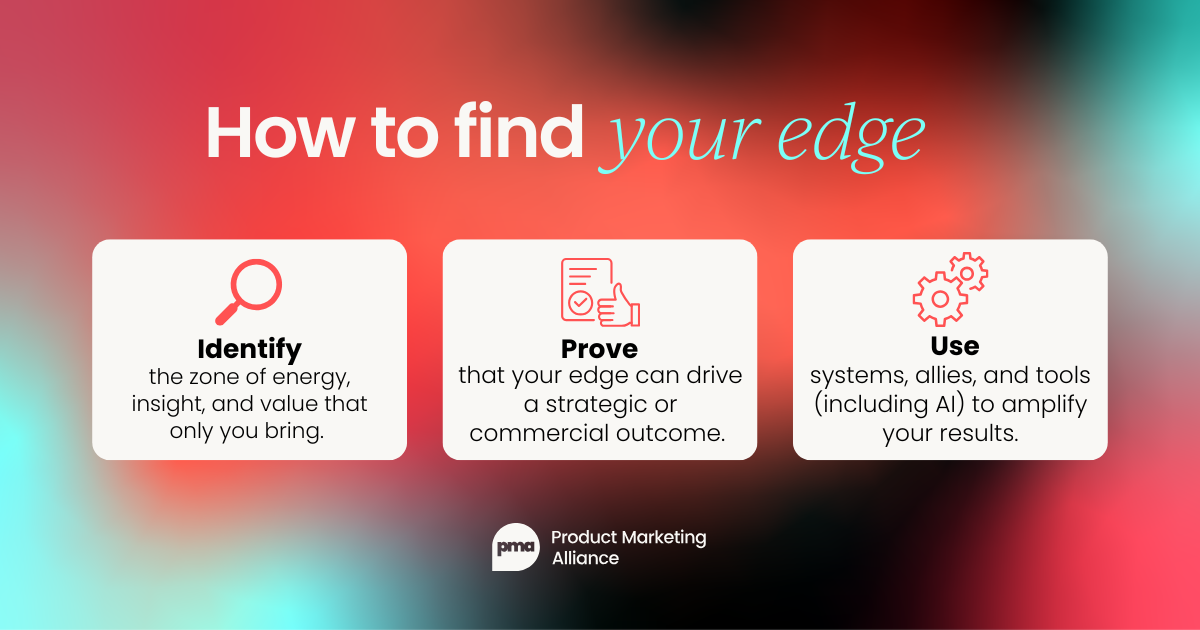
1. Find it
Identify the zone of energy, insight, and value that only you bring. This isn't just a skill set; it’s your unique way of approaching problems.
2. Assert it
Prove that your edge can drive a strategic or commercial outcome. It’s not enough to be "good at empathy" – you have to show how that empathy leads to better conversion or higher retention.
3. Scale it
Use systems, allies, and tools (including AI) to amplify your results. Your edge is the engine, tools are the fuel.
Case study: Turning detraction into 1 million orders at Deliveroo
When I joined Deliveroo to launch their restaurant ad platform, I was handed a sophisticated 20-page thesis on why the platform would work. But the reality on the ground was different. Product marketing had a "bad rap," trust was fractured, and restaurant satisfaction was low.
Choosing the "Right" someone over "Everyone"
The company wanted the platform to be a silver bullet for every segment across 14 global markets. Instead of deploying a top-down strategy, I leaned into my edge: empathy and customer investigation. I sat with mom-and-pop shops in Singapore and large chains in Milan.
I realized that while we had brilliant people with degrees in computational physics, no one had stopped to ask who we were building for.
I defined our Ideal Customer Profile (ICP) as "a restaurant who wants to grow." This narrow focus allowed us to delay the launch to build an automated feedback loop that actually served that specific need.
The commercial outcome of asserting your edge
By asserting this customer-centric view (even when it was scary to delay a launch) we achieved:
- A 70% repeat rate for the MVP.
- The conversion of our earliest detractors into our first case studies.
- 1 million incremental orders within the first 12 months.
Navigating the AI wave
We’re all using AI now, and it’s a powerful tool.
In the "olden days," we had to manually map out pain points from customer interviews. Now, tools like Grain, Gong, and Claude can analyze 18 months of conversations in seconds.
The 40% that AI can’t replace
While AI can take away 60% of the tedium, it will never replace the 40% that is "you."
- Contextualization: AI can't sense when a sales team isn't bought into messaging.
- Human Narrative: It can't take a founder's meandering story and coach them into a value-led narrative.
- Empathy: It doesn't "care" about the outcome.
Think of AI as a part of your cockpit: a tool to amplify your edge, not a competitor for your job.
The future belongs to those who know who they are
I've been doing this job since 2012 (quite a long time!)
Sometimes I open LinkedIn and wonder: Is there still a place for me here? Do I belong anymore?
Having conversations with PMMs over the last few weeks, I know I'm not alone. And I've realized that yes, more than ever, there's room for art and empathy and humanity and curiosity in product marketing. Actually, in marketing overall.
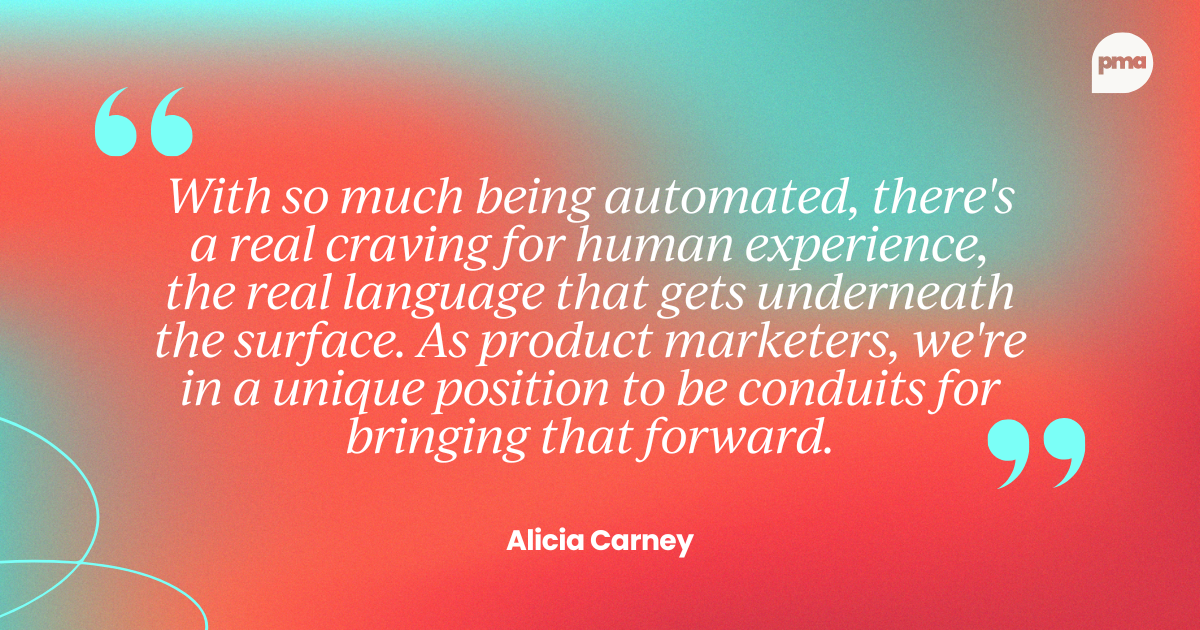
With so much being automated, there's a real craving for human experience, that rawness, that ugly insight, the real language that gets underneath the surface. As product marketers, we're in a unique position to be conduits for bringing that forward.
Don't compete with the robots. They're here to work for you and the human stories you can tell.
I believe the future of product marketing belongs to the ones who know who they are and why that matters. I'm looking forward to seeing how you all grow.


Product marketing insider
Thank you for subscribing
Level up your product marketing career & network with product marketing experts.
An email has been successfully sent to confirm your subscription.
 Follow us on LinkedIn


.svg)
Start the conversation
Become a member of Product Marketing Alliance to start commenting.
Sign up now