












Most conversations about win/loss analysis focus on the mechanics of running a good program. That's useful, but it skips over the hardest part: getting your executives to believe in your win/loss program enough to fund it, support it, and stay accountable to it.
This piece is about exactly that: how you sell win/loss, how you keep it alive, and how you connect it to the thing executives actually care about: revenue.
I've run five win/loss programs in my career across different companies. Three of them worked beautifully, one was okay, and one flopped completely. In short, I've got the battle scars to back up what I'm about to share.
What a win/loss analysis actually is (and isn’t!)
To make sure we’re all on the same page, let me briefly explain what win/loss analysis is.
Win/loss analysis is a structured way to do research. You interview buyers and prospects who didn't become buyers, and you get the validated truth about what happened, or didn't happen, on the path to a purchase decision.
It's decision intelligence pulled directly from the people whose behavior you're trying to understand. You're replacing speculation with truth.
It's also worth being clear about what win/loss is not. It's not a CRM dropdown. CRM data is where data goes to die. "Lost to a competitor." "Lost on price." That's not information, that's a label. A real win/loss program is a playbook for success, not a field on a form.
It's not sales anecdotes either. Now, your sales team is a valuable source of information, and you absolutely should listen to them. However, sales input alone isn't enough; I'll explain why shortly.
Win/loss analysis is also not a one-off survey. Surveys can help, but there's no real rigor behind a survey sent to 20 people after a deal closes. A proper win/loss program has structure, consistency, cross-functional support, and ideally, third-party interviewers.
What your executives are worried about
When you walk into a room to pitch a win/loss program, your executives are sitting there carrying a pile of concerns that have very little to do with your research methodology. They're worrying about things like:
- Why are we losing deals?
- How do we close the revenue shortfall we're staring at this quarter?
- What are our competitors doing that we're not?
- Why do customers actually buy from us?
- Are we making the right investments in product, sales, and marketing?
Every one of these questions is really a revenue question. And underneath each one is the same nagging worry: are we making decisions based on real, validated evidence, or are we just guessing?
That's the point you have to internalize before you walk into the room. Everything comes back to revenue. Not research, not insights – revenue.
For expert advice like this straight to your inbox every Friday, sign up for Pro+ membership.
You'll also get access to 30+ certifications, a complimentary Summit ticket, and 130+ tried-and-true product marketing templates.
So, what are you waiting for?
How to pitch a win/loss program to leadership
When you're selling a win/loss program to an executive, you have to think like the executive. They want to know why they should care. You have your reasons. They have theirs. And they control the budget.
So hammer on this: a win/loss program can and will drive measurable revenue impact. That's the sentence that gets a CEO to lean forward. That's what gets the CFO and the CRO to pay attention.
Clozd's State of Win-Loss Analysis Report found that 63% of companies report win rate increases thanks to win/loss analysis, rising to 84% for programs that have been running for more than two years. Put those numbers in front of an executive, and the conversation shifts.
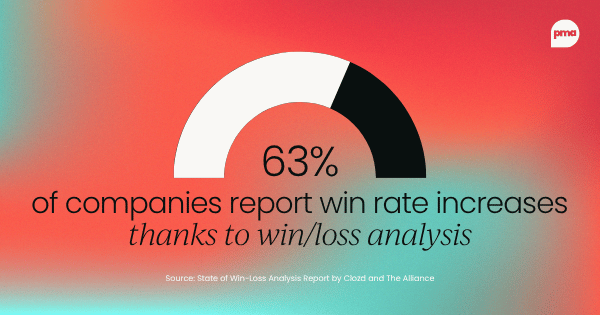
Win rate improvements compound into real pipeline impact, and that leads to the two words that matter most to any leader: pipeline predictability. Frame win/loss as revenue insurance; you're making a small investment today to make sure the pipeline you already have converts better.
Why validated buyer truth beats sales intuition
Sales teams are a great source of information. Don't knock them. You want to leverage everything they know. But research consistently shows sales reps are wrong more than half of the time when they explain why a deal was won or lost.
This isn't because salespeople are dishonest. It's because buyers aren't fully honest with them. If you didn't buy from a rep and they call you to ask why, you're likely to say something easy, like "the pricing was too high." You're probably not going to walk them through the real reasons. You want to be nice.
Here's the kicker. Pricing only shows up as the actual deal breaker in about 18% of cases. That means in roughly 82% of losses, the real issue is something else, often that the value story wasn't told effectively. So when your executive says, "We're losing because we're priced too high," the right response is, "How do we know that? Are we telling our story well enough?"


Product marketing insider
Thank you for subscribing
Level up your product marketing career & network with product marketing experts.
An email has been successfully sent to confirm your subscription.
 Follow us on LinkedIn



.svg)