














Let me start with a confession.
Five years ago, I walked into a leadership meeting and immediately sensed something wasn’t clicking. Sales and marketing were in the same room, but not quite on the same page. The goals were ambitious, the talent undeniable… yet there was a visible disconnect in how the teams approached growth.
Sound familiar?
Today, I want to share how we turned that misalignment into a unified revenue engine at FIS, a global fintech company.
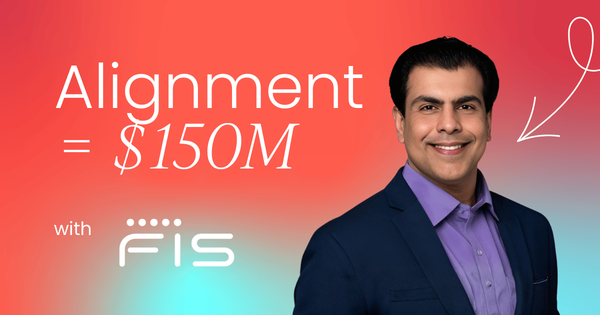
What began as a collection of high-performing teams working in parallel evolved into a cohesive go-to-market force – one that now drives $150 million in incremental cross-sell and upsell revenue.
And the leaders who once operated in separate lanes? Today, they co-present at quarterly business reviews, championing a shared strategy.
The reality of misalignment in complex organizations
When I joined FIS as Head of Go-to-Market, we faced a challenge that plagues many growing companies. We had over 300 disparate solutions spanning everything from treasury systems for airlines to payment processing for banks.
Our product marketers were distributed across these solutions like islands in an archipelago, each creating content in isolation.
The result? Chaos.
Picture this: A sales rep in London needs to pitch our treasury solution to Santander Bank.
They're searching through seventeen different SharePoint sites, three email threads, and a folder mysteriously named "Final_Final_v3_ACTUALLY_FINAL" just to find the right battlecard.
Meanwhile, product marketing has created beautiful new messaging that sits untouched because nobody knows it exists.
This wasn't just inefficient. It was expensive. Every minute our sellers spent hunting for content was a minute not spent with prospects. Every inconsistent message diluted our brand. Every missed cross-sell opportunity was revenue left on the table.
For expert advice like this straight to your inbox every Friday, sign up for Pro+ membership.
You'll also get access to 30+ certifications, a complimentary Summit ticket, and 130+ tried-and-true product marketing templates.
So, what are you waiting for?
Understanding what alignment actually means
I did something that might seem trivial, but it changed everything. I looked up "alignment" in the Oxford dictionary. The definition struck me: "sharing common goals and vision to form an alliance."
Alliance. Not just cooperation. Not just communication. An actual alliance where teams unite around shared objectives.
This definition became our North Star. We weren't trying to get marketing and sales to tolerate each other. We were building an alliance with a common enemy: inefficiency, missed opportunities, and poor customer experiences.
The first step: Defining go-to-market beyond buzzwords
Everyone talks about a go-to-market strategy. CEOs love it. CFOs demand it. But ask five people what it means, and you'll get seven different answers.
In our organization, go-to-market had become a catch-all term for anything remotely related to selling. We had a win-loss analysis team that didn't talk to the RFP support team.
Sales enablement created training materials without consulting product marketing. Product marketing crafted messaging without understanding what sellers actually needed.
Our first move was radical simplicity. We created a single go-to-market function that brought together all these disparate teams under one umbrella. No more silos. No more finger-pointing. One team, one mission: get the right content to the right people at the right time to drive revenue.


Product marketing insider
Thank you for subscribing
Level up your product marketing career & network with product marketing experts.
An email has been successfully sent to confirm your subscription.
 Follow us on LinkedIn


.svg)