








Features don't close deals, people do. And yet, many of us waste our time talking about exactly that: features, specs, and integrations.
I work at JPMorgan on our developer portal, which means I spend my days knee-deep in B2B developer marketing. It's a world where the temptation is to lead with technical detail. That approach gets you halfway there. The trouble is, halfway isn't where decisions get made.
The other half of the journey is emotional – and once you learn to tap into it, everything about your messaging changes.
Here are the three things I want you to take away:
- How to tap into the emotional drivers that influence buyer decisions to drive more compelling messaging.
- How to blend rational value with human storytelling to engage your audience’s hearts and minds.
- How to turn emotional resonance into measurable impact by tracking results and continuously improving messaging strategies.
Let's get into it.
Why the marketing funnel only gets you halfway there
I love a marketing funnel. Awareness, consideration, conversion, the whole thing. It's a useful framework, and most of us live inside it day to day.
However, many product marketers, especially those of us in technical spaces, treat the funnel as a vehicle for functional value alone. We talk about what the product does, what the features are, and what the integration looks like - and then we wonder why our messaging feels flat.
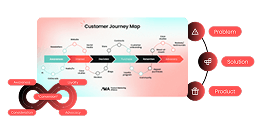
The thing is, the funnel is only half the journey. Stopping at functional value is like stopping at the last mile of a marathon. There's a parallel track running alongside it, and that's the emotional appeal. How does your customer feel when they use the product? What does it say about them? What kind of person does it make them when they choose you?
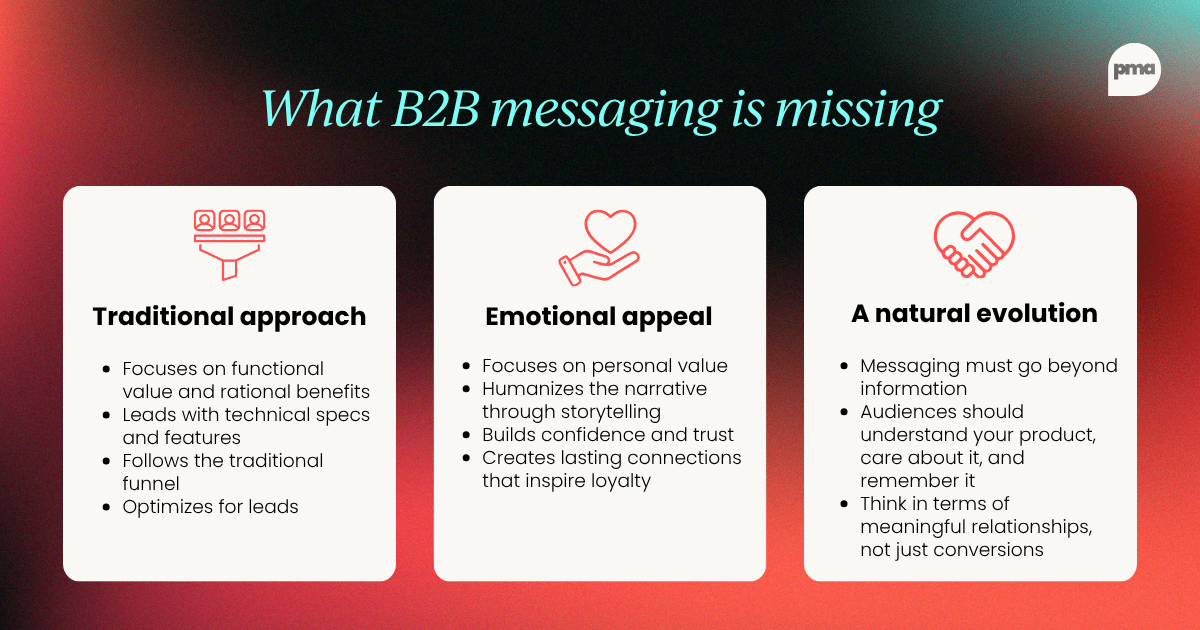
The real opportunity emerges when you combine features and feelings. Your messaging evolves beyond information dumps. You're no longer just asking whether someone understands the product. You're asking whether they care about it, and what it makes them feel when they do.
Why are feelings so important?
The numbers make a compelling case for leaning into emotion. Harvard Business Review found that emotionally connected customers are 52% more valuable than those who are simply satisfied, and Motista puts the lifetime value increase at 306%.
When you get your emotional messaging right, the payoff shows up in three distinct ways:
- Higher lifetime value and retention: Customers who feel emotionally connected to your brand buy more, stick around longer, and are less sensitive to price.
- Stronger loyalty and advocacy: Emotional bonds translate into customers who recommend you, advocate for you, and won't easily be tempted away by a competitor.
- Greater resilience: In B2B relationships, emotional connection is a competitive moat.
Of course, not all emotions are equal. The ones you want to create are curiosity, confidence, and a sense of accomplishment. The ones to avoid are anxiety, confusion, and frustration.
For expert advice like this straight to your inbox every Friday, sign up for Pro+ membership.
You'll also get access to 30+ certifications, a complimentary Summit ticket, and 130+ tried-and-true product marketing templates.
So, what are you waiting for?
What emotional resonance actually means
Emotional resonance is when a message, story, or experience evokes a deep, shared emotion and creates a real impact on an audience. It works in three tiers:
- It evokes feelings.
- It creates brand preference.
- It drives purchase decisions.
If that sequence sounds familiar, it should. It maps almost perfectly onto the traditional marketing funnel.
In the first stage, you're trying to make people feel something and understand what the product is. You and the customer are courting each other. Further along, they develop brand preference, attitudes about your brand, and reasons they'd consider using it. By the final stage, you've created enough of an emotional bond that influence, persuasion, and purchase decisions all line up.
In short, emotions aren't separate from the buying journey. They are the buying journey, running in parallel to the functional one.
Linking functional benefits to emotional values
It's all well and good to say emotions are important, but how do you translate that into your everyday marketing work?
As you're crafting messaging, you start by assessing the functional values of your product, and then you look at the emotional values or triggers associated with each one.
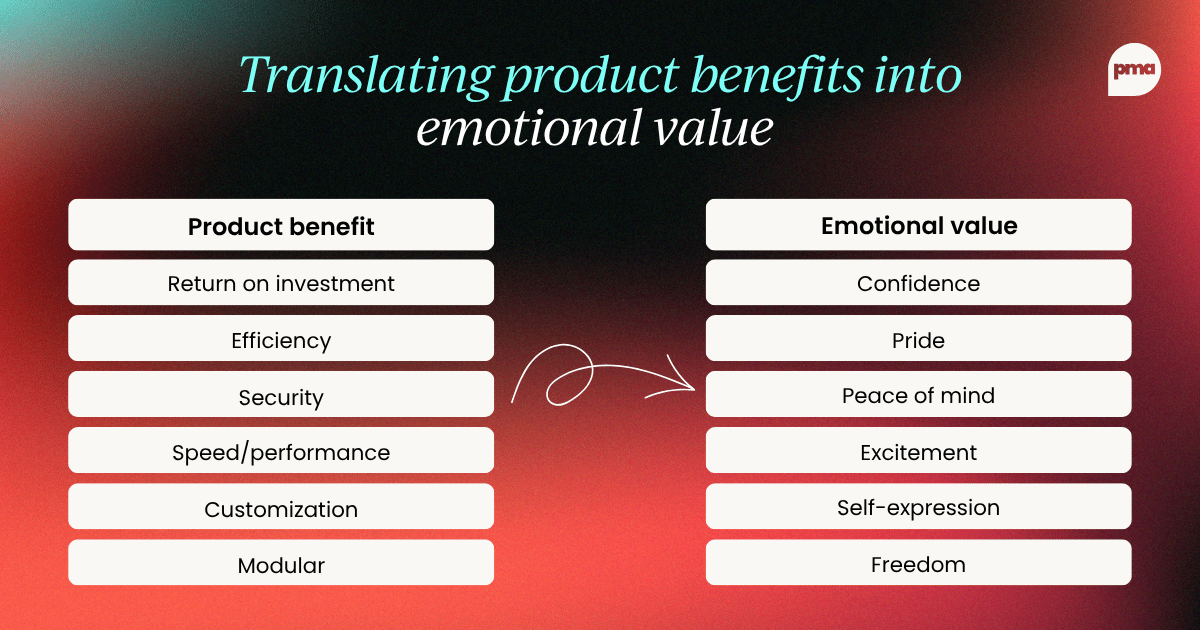
Take a customizable dashboard as an example. On the surface, it's a dashboard somebody can configure. The underlying emotional benefit is self-expression – you can create the dashboard that's right for you, and that feels great.
When a rational feature is translated into an emotional cue, it enhances customer engagement and, as they move down the funnel, their advocacy of your product. You're driving loyalty that goes beyond the specific benefits of the feature itself.
For those of us in technology and B2B, this is crucial. We're not just presenting features and waiting for someone to connect the dots. We're taking customers on a journey – one that starts with a problem they recognize and ends with a product they feel a connection to.
The benefits ladder
Once you've tied your features to emotional triggers, the question becomes how you bring your messaging to life. The answer is storytelling, and a useful tool for building that story is the benefits ladder.
The ladder runs from product features, up to a business outcome, up to a higher emotional payoff, and eventually to a kind of enlightenment for the customer.
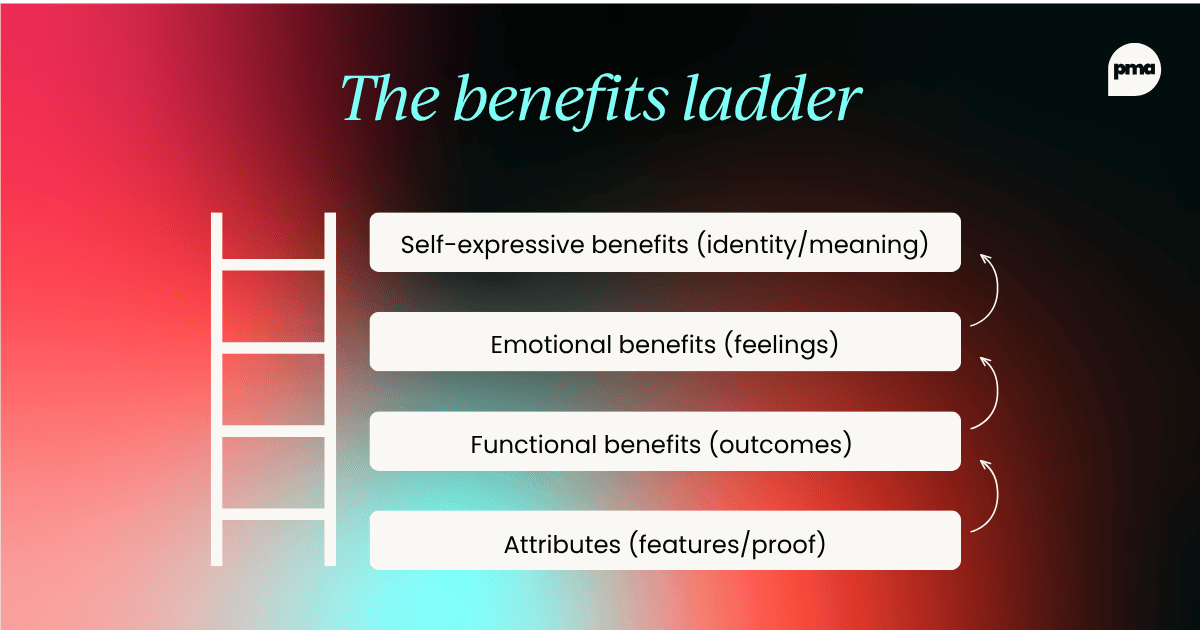
Let's make that real with a reporting dashboard:
- The feature is a customizable reporting template.
- The business outcome is saving roughly 10 hours of work for your team.
- The emotional payoff is knowing you're spending your time on anything but reporting. (Personally, the less time I spend wrestling with Adobe or Google or whatever the tool of the week is, the happier I am!)
- The self-expressive is being the person who found a smarter way to work – and freed everyone up to focus on what actually matters.
The work of the ladder is uncovering and articulating the hidden emotional benefit, then figuring out where it actually lands with your audience.
This becomes especially important when you're selling to tech and business decision makers. Even when they're on the hook for a $2 billion software decision, they're guided by emotional principles. They don't want to fail. They want to be seen as a leader, the person their team will follow into the good night. They want to be trusted and reliable.
Once you tap into those core emotional drivers, the connection between features and feelings becomes a lot easier to draw.
Three steps to translate features into emotional benefits
So how do we put all this into practice? Here's the sequence I use:


Product marketing insider
Thank you for subscribing
Level up your product marketing career & network with product marketing experts.
An email has been successfully sent to confirm your subscription.
 Follow us on LinkedIn


.svg)