
















Pay is one of those sticky subjects. No one particularly wants to talk about it, but everyone wants to know about it. How much do people across the pond get paid? What can I expect my salary to be as I move up the ladder? Are product marketers across the world happy with what they earn?
All questions people were wondering, all answers we uncovered.
Before we dig into the juicy details, here are a few things to bear in mind:
- The data reflects survey responses and may not represent all product marketers.
- The figures are in US Dollars (USD) for consistency.
- Our research primarily focuses on median base salaries. We believe this measurement (which controls for outliers) offers the most accurate representation of real earnings. Where appropriate, we also look at average total compensation, based on mean average salaries, bonuses, and stock allocations.
Who took part
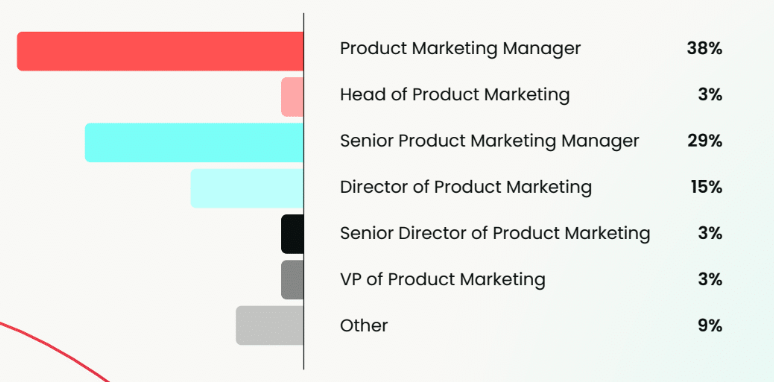
The highest volume of respondents have the following job titles:
- Product Marketing Manager
- Head of Product Marketing
- Senior Product Marketing Manager
- Director of Product Marketing
- Senior Director of Product Marketing
- VP of Product Marketing
Global salary average
As always, we kick off this year's Product Marketing Salary Report with a bird's-eye view of the 2025 compensation landscape.
We break down the four key areas we track: median base salary, average annual bonus, average stock and equity awards from the past 12 months, and average total compensation.
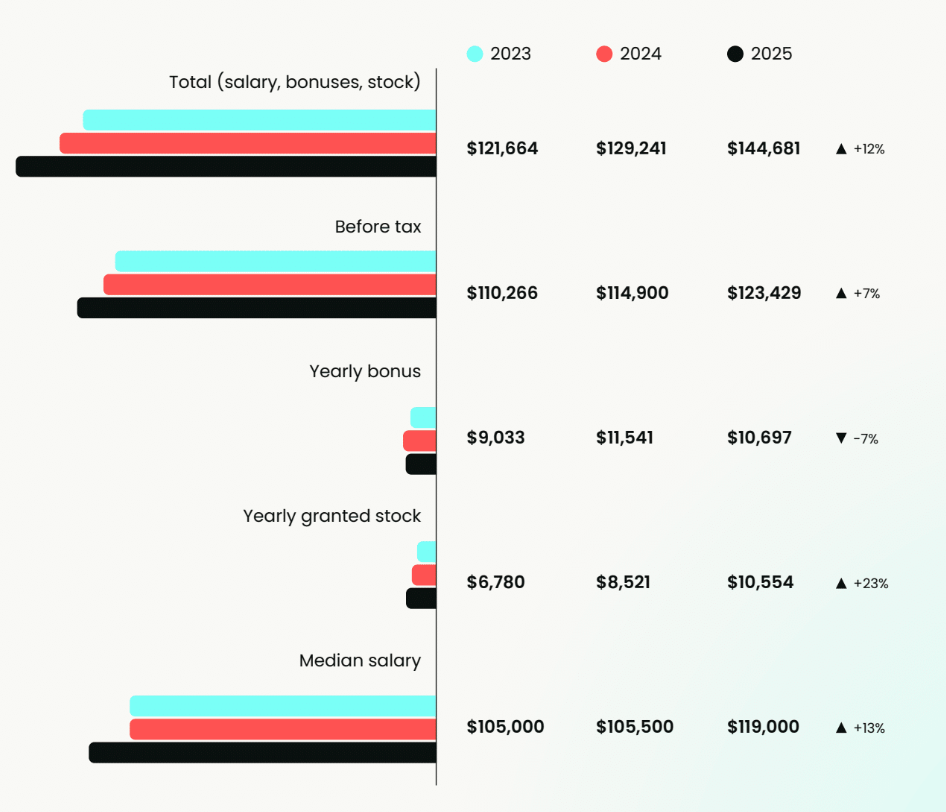
Total compensation – that's base salary, bonuses, and stock grants combined – hit $144,681 in 2025, showing solid 12% year-over-year growth.
Median base salary actually grew even faster at 13%, but overall compensation growth was pulled back a bit by a 7% dip in bonuses.
The real headline here is a 23% jump in stock grants, which points to a clear shift in how companies are putting together their compensation packages, with equity taking on a much bigger role.
The median base salary of $119,000 is good news after two years of things being pretty flat. When you look at this alongside that 23% spike in stock grants, it paints a picture of a product marketing compensation landscape where total rewards are growing much faster than base salary numbers alone would tell you.
Yet global salary averages only scratch the surface. A range of factors shape compensation and earning potential.
As we unpack the survey results, we’ll analyze the data from multiple perspectives, providing a nuanced view of the factors influencing compensation today. We’ll start with geographical location – a key driver of earnings and often the most impactful variable in pay trends.
Salary by location
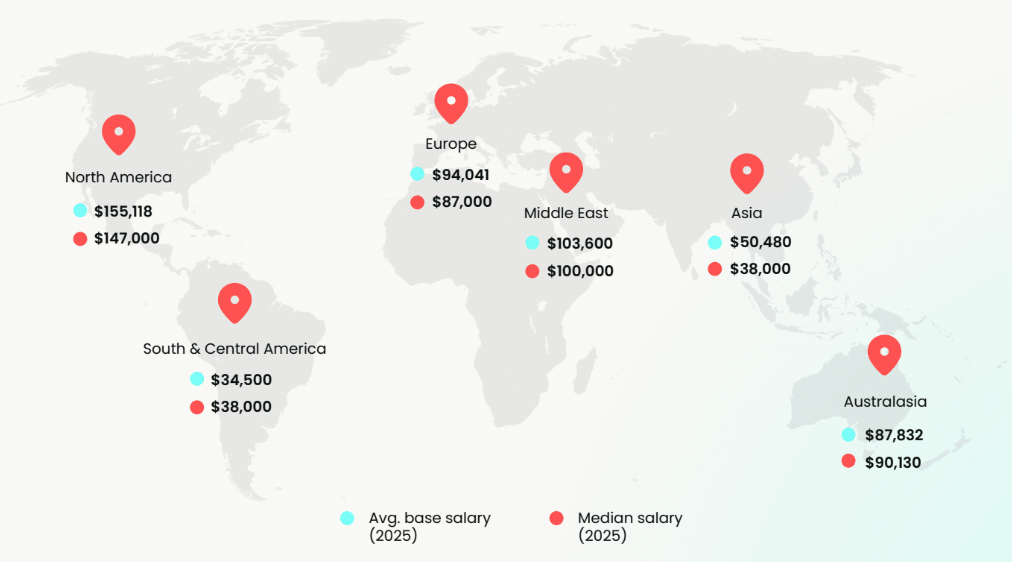
When it comes to just salaries, and excluding other types of compensation, like bonuses, the average median salary by region was:
- North America at $147,000
- Australasia at $90,130
- Europe at $87,000
- Middle east at $100,000
- Asia at $38,000
- South & Central America at $38,000
Note: We received insufficient responses from Africa to report reliable 2025 salary data for this region.
Total compensation (salary, bonuses, and stock)
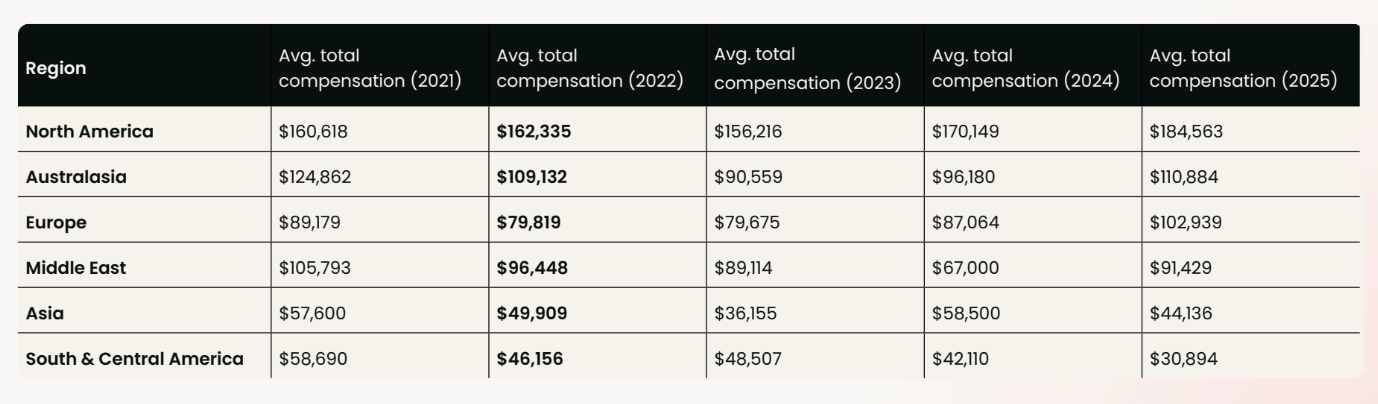
No surprises here – North American product marketers continue to lead the pack when it comes to average total compensation, hitting an all-time high of $184,563 in 2025 (up 7.5% from last year).
That's well ahead of every other region and really highlights just how wide the earnings gap is between North America and the rest of the world. For perspective, the next highest region, Australasia, comes in at $110,844 – roughly a 40% difference.
Europe's showing some promising momentum, with average total compensation jumping 15% to just over $100,000 in 2025. After a few years of pretty flat growth, European companies seem to be stepping up their investment in product marketing talent, likely driven by rising living costs and the need to compete with US companies that are increasingly hiring European PMMs for remote roles.
Australasia saw a modest 9.7% dip to $110,844, while Asia experienced a sharper decline of 39.2% to $44,136. South & Central America had the steepest drop at -30.5% to $30,600. That said, the sample sizes in these three regions are smaller, so it's worth taking these numbers with a grain of salt.
Median earnings by country
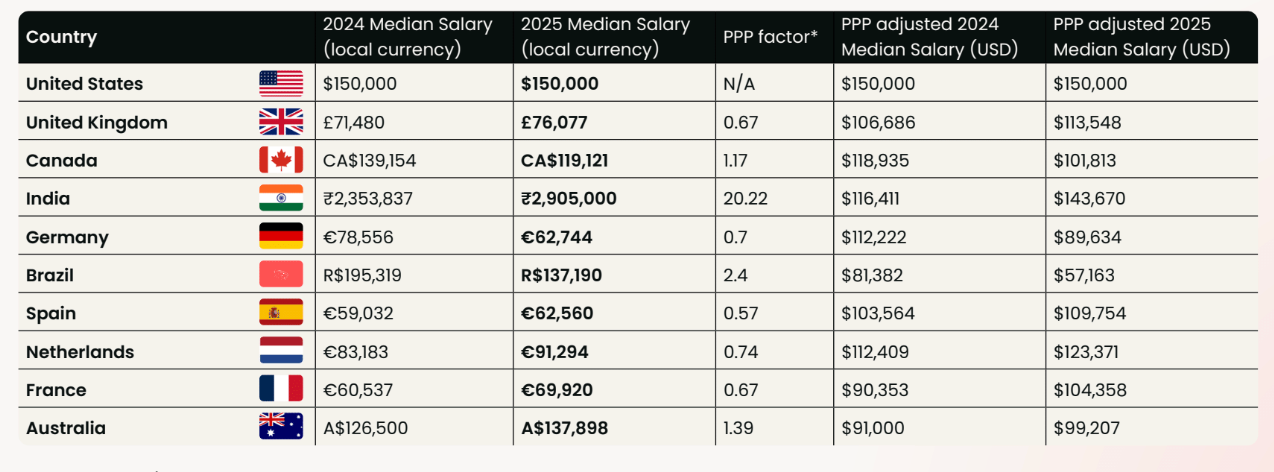
Regional averages are helpful, but where things get really interesting is when you zoom in on individual countries. So we've taken the ten countries with the largest product marketing populations and calculated the median salary for each.
Building on last year's report, we've adjusted each country's median salary by purchasing power parity (PPP) to get a clearer picture of what people are actually earning. This adjustment helps us understand what those salaries really mean when you factor in the cost of living.
When we apply the PPP lens, the gap between North America and everywhere else starts to close quite a bit. European countries, especially – which show relatively modest salaries on paper – stack up much better against the US once you account for living costs and inflation.
Here's where it gets really interesting: India has emerged as the surprise standout when you adjust for purchasing power.
With a PPP-adjusted salary of $143,670, Indian product marketers now have the second-highest relative salaries in the world, right behind the United States. That's the strongest purchasing power for PMMs anywhere outside North America, even though the nominal salaries look much lower at face value.
Gender
First of all, how’s the distribution of product marketing roles by gender?
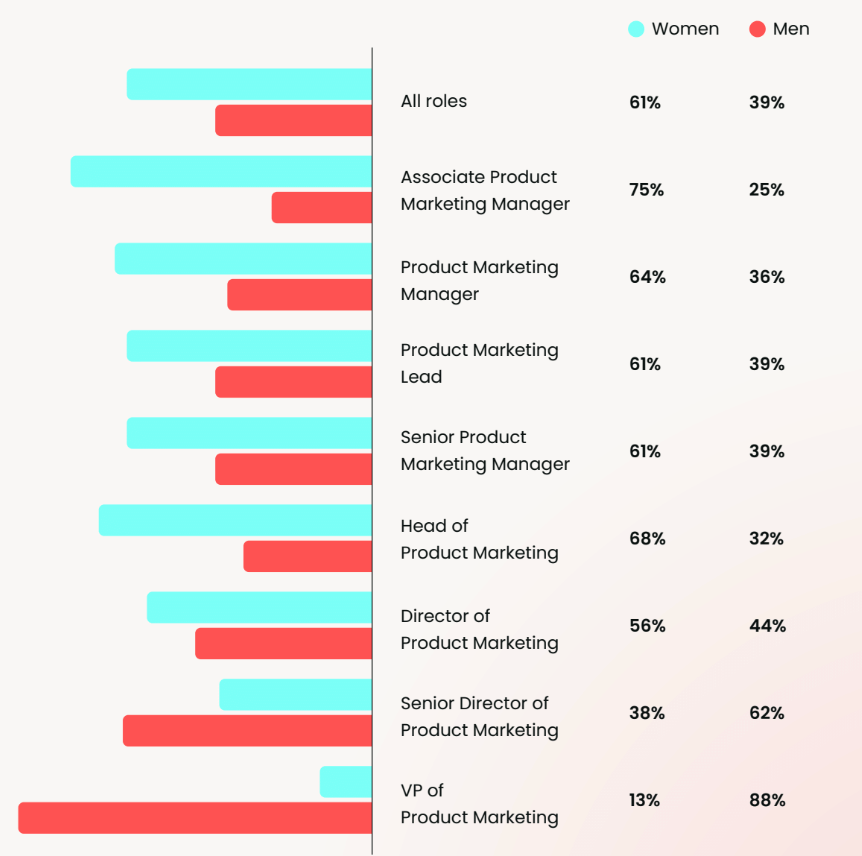
We kicked off our gender pay analysis by breaking down respondents by gender identity to see the male-to-female split within each job title.
What we found is that women still make up the majority of product marketing roles in our study, holding steady at 61% across all levels. But when you dig deeper, there's a troubling shift happening at the top.
The VP of Product Marketing role has seen a dramatic turnaround from last year's near-even split. Women held 55% of VP positions in 2024, but that's dropped sharply to just 12.5% in our latest survey.
On a more positive note, women maintain solid representation at the Director level (56%) and continue to hold the majority of mid-level positions – making up 64% of Product Marketing Managers and 61% of Senior Product Marketing Managers. The Senior Director role shows lower representation at 38% female, while Associate PMMs skew heavily female at 75%.
Is there a gender pay gap in product marketing?
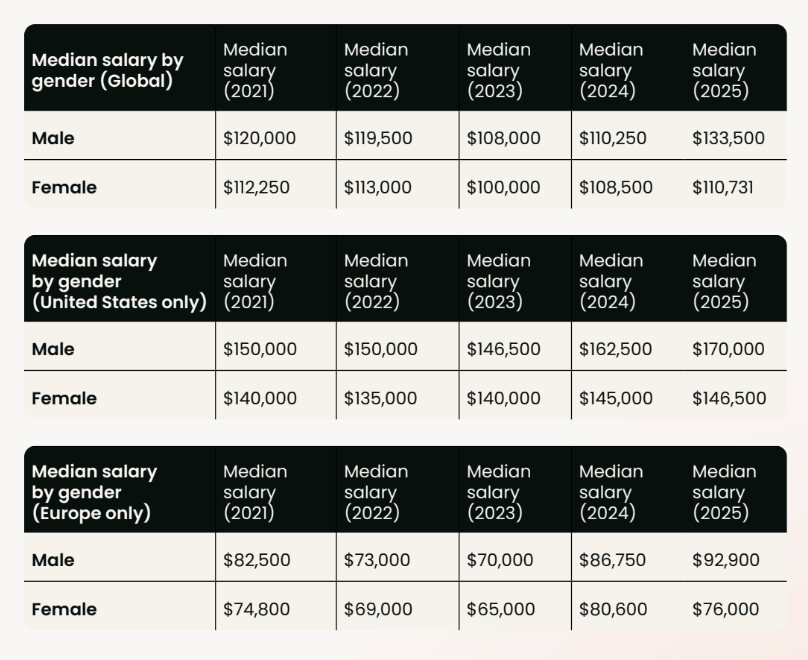
To figure out whether pay inequity is still an issue in product marketing, we looked at median base salaries by gender over the past two years.
Globally, the picture has gotten significantly worse. After narrowing to just 1.6% in 2024, the gender pay gap has blown out to 17.1% in 2025 – the widest we've seen in recent years. Male median salaries jumped 21% year-over-year to $133,500, while female median earnings grew a much more modest 2% to $110,731.
The US follows a similar pattern, though it's not quite as stark. The gap sits at 13.8%, with male median salaries at $170,000 versus female earnings of $146,500. While both saw increases from 2024, male salaries went up $7,500 compared to just $1,500 for female salaries.
Europe shows the most troubling trend. The gender pay gap has widened to 18.2%, with male median salaries hitting $92,900 compared to female earnings of $76,000. Despite a 7% bump in male earnings, female median salaries actually dropped 6% year-over-year – a step backward after the progress we'd seen in previous years.
While product marketing as a field has seen solid salary growth overall, the gains are flowing disproportionately to male professionals across all major markets.
Salary by industry
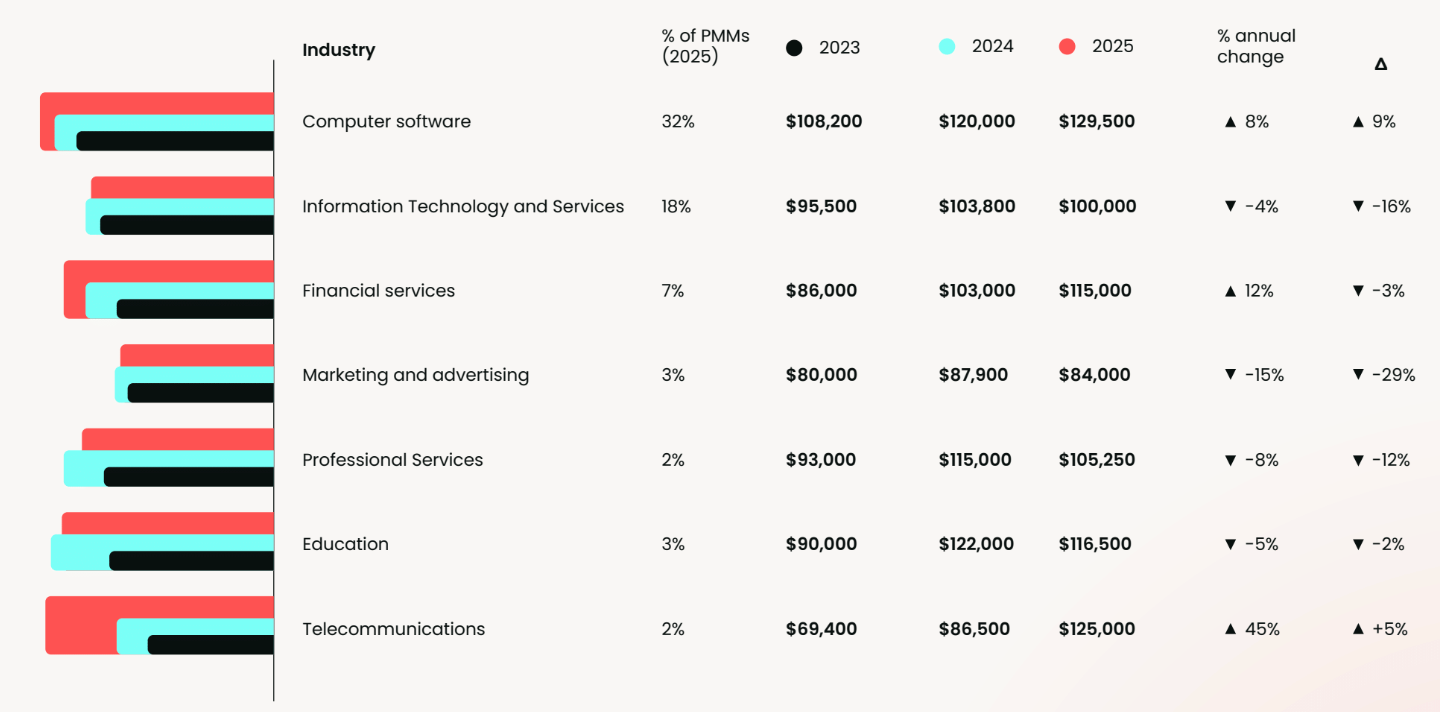
The salaries of PMMs vary significantly by industry – something we’ve observed consistently in our last three Product Marketing Salary reports.
For 2025, we calculated the median base salary for each major industry and compared them to last year's numbers and the overall median of $119,000 to show how each sector stacks up.
Computer software remains the biggest and one of the most lucrative industries for PMMs, representing nearly a third of respondents. With median salaries of $129,500, it pays 9% above average, though growth has slowed to 8%.
The standout story is telecommunications, where median salaries skyrocketed 45% to $125,000 – a complete turnaround from 2024 when telecom was among the lowest-paying industries at just $86,500. It's now 5% above the overall median.
Financial services also posted strong results, climbing 12% to $115,000, continuing its upward trend after historically trailing tech-focused industries.
Information technology and services – the second-largest employer at 18% of respondents – sits at $100,000, down 4% from 2024 and 16% below the overall median.
Marketing and advertising continues to struggle, dropping 15% to $84,000 (29% below average), while education slipped 5% to $116,500.
The internet sector maintains premium compensation at $144,800 (22% above average), though the small sample size warrants caution.
Conclusion
As the field expands worldwide, we hope this survey provides a useful benchmark both for evaluating product marketing incomes and shaping more equitable, inspiring workplaces everywhere!
As mentioned at the start, this article is only a teaser of what you’ll find once you download the report. Get your copy of the report to dive deep into every facet of product marketing salaries, including seniority, experience, and working hours.
You can also check out our salary calculator to discover how your salary compares with other product marketers around the world.


Product marketing insider
Thank you for subscribing
Level up your product marketing career & network with product marketing experts.
An email has been successfully sent to confirm your subscription.
 Follow us on LinkedIn


.svg)
Start the conversation
Become a member of Product Marketing Alliance to start commenting.
Sign up now