


How long does it really take to get a launch campaign across the finish line?
While some studies suggest a marketing campaign takes about 7.4 weeks, we product marketers know the reality is much more complex. When you factor in sales enablement, strategic alignment, and data analysis, that timeline easily stretches to 12 or 16 weeks.
Think about your last major product launch. How much time did you spend on market research? How many rounds of messaging refinement did you go through? How many enablement sessions did you run?
The reality is that product marketing operates on extended timelines because we're orchestrating so many moving pieces across so many different teams.
In this article, you’ll discover how to shrink that launch time by evolving from a traditional individual contributor into a Super IC - an individual contributor who operates with the strategic impact of an entire team.
I’ll share a three-month roadmap to help you leverage AI as a superpower – not just for polishing emails, but for automating complex workflows that reduce launch times by 40%. We’ll cover the transition from foundational AI usage to becoming an "Integrator" and, finally, an "Automator" who builds their own no-code agents.
The PMM’s dilemma: The distance to impact
As product marketers, we often find ourselves at the center of a dozen different functions. We’re tasked with moving the needle, but we rarely have direct authority over the teams we need to align. This creates a significant distance to impact.
Let me paint you a picture that might feel familiar. Meet Lilly, a product marketer who's been tasked with launching a tier-two product. The goal is to drive attachment rates for the company's primary tier-one product by expanding into new customer segments.
Lilly's journey looks something like this:
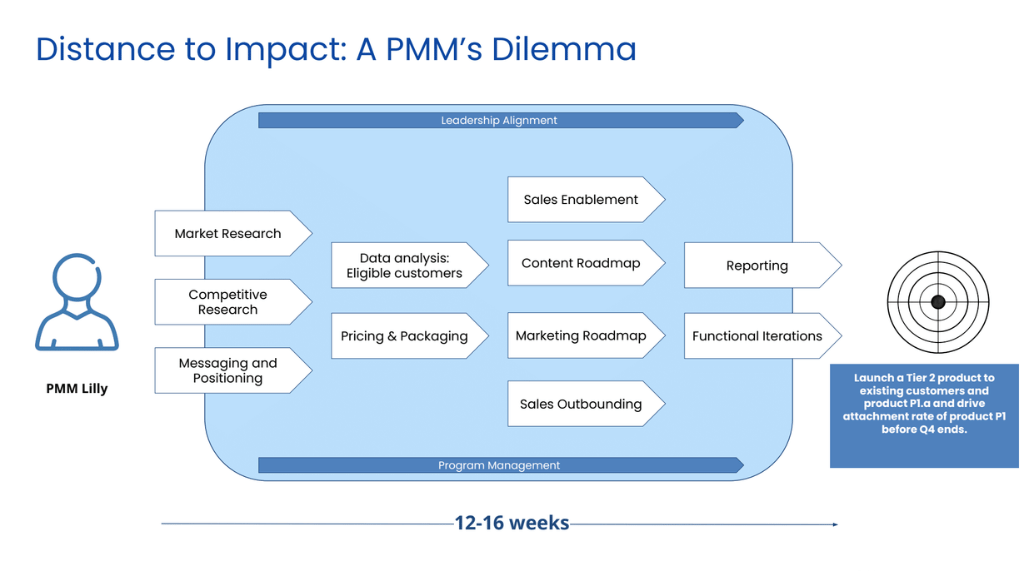
She starts with market research, diving deep into customer needs and competitive landscapes. Then comes the positioning and messaging work - crafting messages that resonate with the new segment while maintaining consistency with the broader brand story.
Next, she's analyzing data to inform pricing and packaging decisions. After that, she's building sales enablement materials, crafting content, and coordinating with demand generation on campaign strategy.
For expert advice like this straight to your inbox every Friday, sign up for Pro+ membership.
You'll also get access to 30+ certifications, a complimentary Summit ticket, and 130+ tried-and-true product marketing templates.
So, what are you waiting for?
Each stage requires multiple stakeholders. Each stakeholder has their own priorities and timelines. Each handoff introduces potential delays. By the time Lilly gets through the full cycle of research, strategy, enablement, and launch, 16 weeks have flown by.
But here's the thing: not much of that time is spent on strategic thinking or creative problem-solving. It's spent waiting for data pulls, scheduling meetings, chasing approvals, and manually creating variations of the same content for different channels.
What if Lilly could compress that timeline from 16 weeks to 8? What if she could maintain the same level of strategic rigor while dramatically reducing the operational overhead?
Now she can, thanks to AI.
Defining the Super IC PMM
The Super IC PMM isn't just a strategic partner and a doer; they're a force multiplier. They own the end-to-end strategy, make data-backed decisions quickly, and drive cross-functional execution with minimal dependencies.
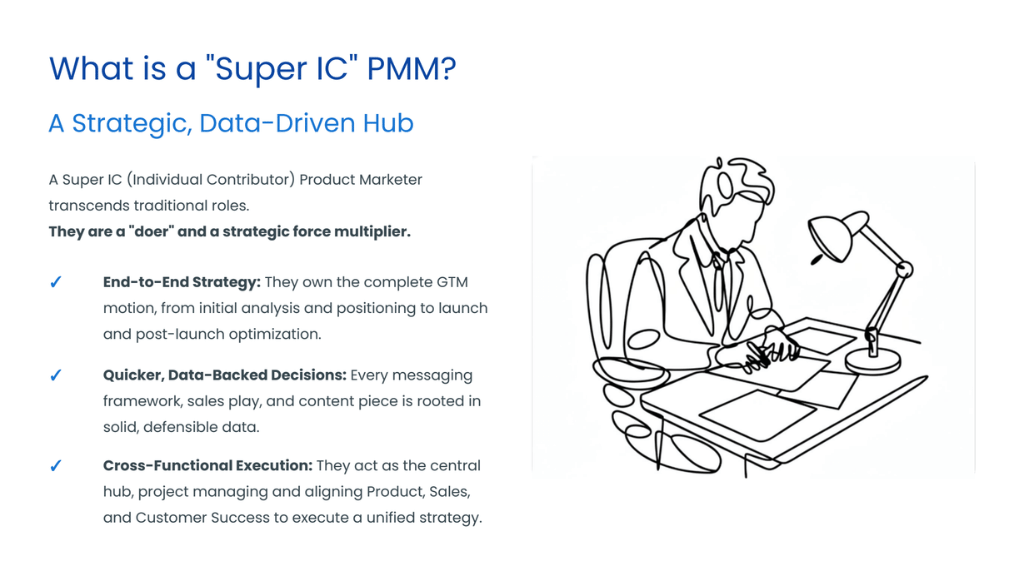
As a Super IC, instead of being one node in a complex network, you become the hub with AI-powered spokes extending your capabilities in every direction. You're not replacing human judgment with artificial intelligence. You're augmenting your expertise with tools that handle the repetitive, time-consuming tasks that used to eat up your weeks.
The transformation happens across five key areas where AI can give you the most leverage:


Product marketing insider
Thank you for subscribing
Level up your product marketing career & network with product marketing experts.
An email has been successfully sent to confirm your subscription.
 Follow us on LinkedIn


.svg)