








It's 2021, and I'm staring at my laptop screen with 37 browser tabs open. Each one represents a different piece of the product launch puzzle I'm trying to solve.
Win/loss interviews in one tab, buyer personas in another, messaging documents scattered across three more. There's the pitch deck, the rogue pitch deck (you know the one), Jira tickets demanding attention, and somewhere in that digital chaos, a file named "final_version7_real_final."
Sound familiar?
That was my life as a product marketer – and it was completely unsustainable.
Despite all this, when I first encountered ChatGPT in fall 2022, my immediate reaction wasn't excitement. It was terror. Pure, unadulterated fear that this thing could potentially do my job. But instead of waiting around to find out, I decided to dive in headfirst.
Now, years later, I spend my days immersed in AI – and I've become that person who sits next to you at dinner parties and asks, "Are you using AI?" Before you know it, I’ve figured out three prompts you can use. The trajectory is always the same: skepticism, then amazement, then that inevitable question: "Is everyone using this?"
They should be.
Luckily, it's easy to get started – and in this article, I'm going to show you how. We'll cover:
- Three core PMM workflows transformed by AI – buyer and persona insights, feature messaging, and launch orchestration
- Four practical habits for getting strategic results from AI
- A go-to-market time machine – where we've come from, where we are now, and where the PMM role is heading by 2027
- An action plan you can implement starting today
The unsustainable reality of modern product marketing
Let me paint you a picture of what product marketing looked like before AI became my copilot. I wasn't being strategic. I wasn't making high-leverage decisions. I was manually combing through data, cranking out assets, building data sheets and brochures, creating decks and battlecards. It was manual labor disguised as knowledge work.
The old model was simple: power through. Late nights, long days, be the PMM hero. We've all been there, right? No boundaries, all the fire drills, all the launches.
But here's the thing: you cannot out-Google Doc the volume of data we sit on today. You can't manually orchestrate the number of channels we're expected to manage. And you definitely can't keep up with the speed at which we're shipping products and features.
The shift for me came when I realized this isn't about personally doing all the work across those 37 tabs. It's about designing the system to help do the work. Moving from solo hero to strategic architect with an AI copilot by your side.
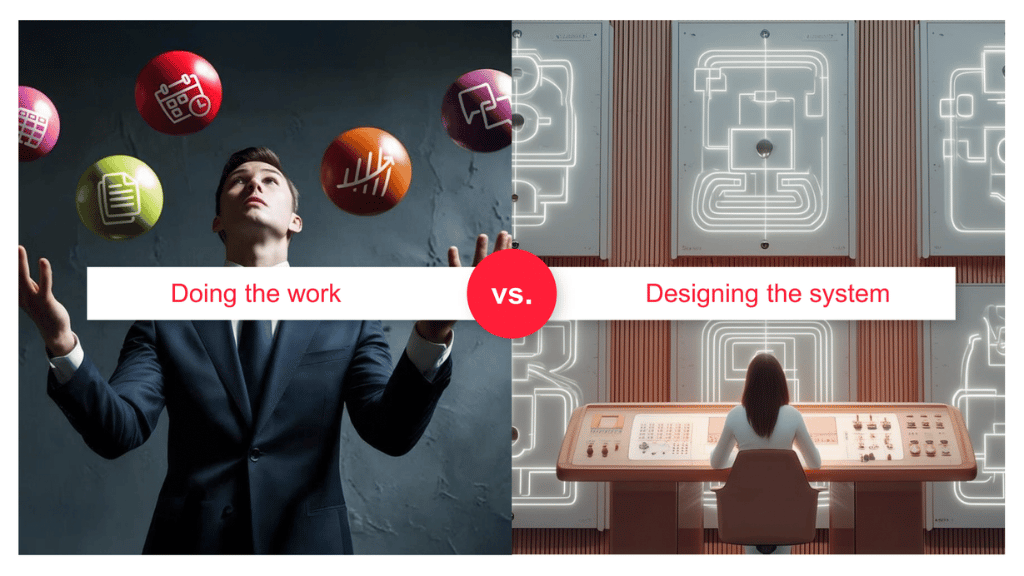
When I say copilot, I don't mean Microsoft's product (though we do use that at Sitecore). I mean AI as a strategic partner that sits across your workflows and handles the things that used to be painfully manual. Reading through win/loss interviews to find patterns. Translating features into outcomes for multiple buyers. Ingesting massive amounts of data and making sense of it all.
The way I treat AI now, and the way we're treating it at Sitecore, is as an orchestration layer that augments all of your workflows end-to-end. Or as one of my early-career team members put it:
"It's your work bestie that's always online, so you don’t have to be."
For expert advice like this straight to your inbox every Friday, sign up for Pro+ membership.
You'll also get access to 30+ certifications, a complimentary Summit ticket, and 130+ tried-and-true product marketing templates.
So, what are you waiting for?
Three workflows transformed by AI
Let's look at three workflows that every product marketer lives in daily:
- Buyer and persona insights
- Mapping features to outcomes for messaging
- Launch planning and orchestration
For each one, I'll show you what it was like in the manual grind era, what's possible today with an AI copilot, and where I think we're heading.
Buyer and persona insights: From static documents to living systems
Before AI
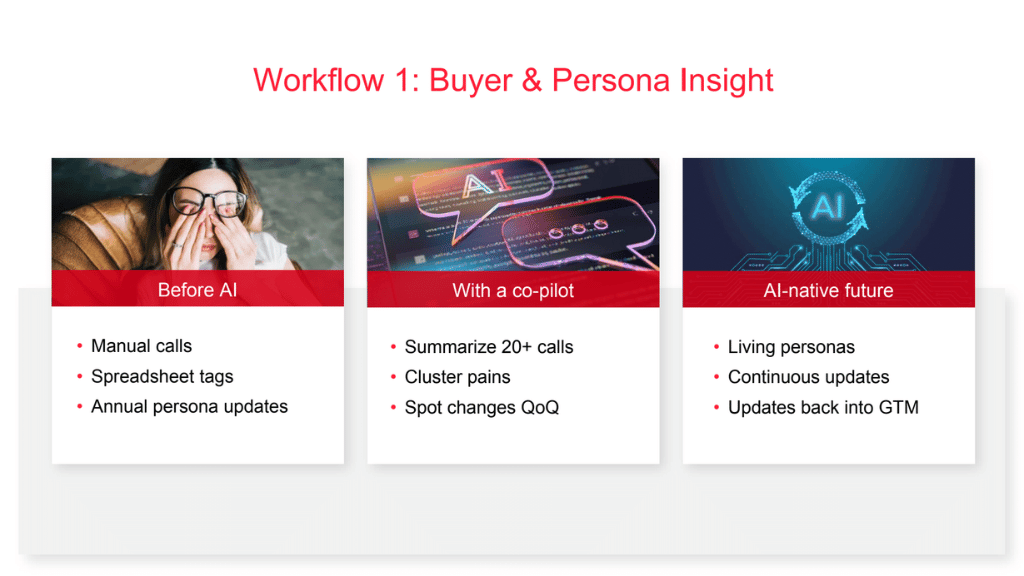
Before AI, gathering buyer and persona insights was purely manual labor. If you were lucky, you'd get to listen to recorded calls. Maybe an AE would let you sit in on a meeting and ask a question. You'd copy and paste insights into documents, trying desperately to detect patterns. You'd slice data by segment, by geography, by company size, all manually.
Then, maybe once every six months, you'd update your buyer personas. You'd create this beautiful PowerPoint deck, and there it would sit, static and slowly becoming obsolete as market conditions changed.
With AI today
The work has completely flipped. I can go into our call recordings and prompt:
"Summarize the last 20 calls with CMOs at enterprises with less than $500 million ARR. Tell me their pain points, objections, what they're facing, and how this has changed from six months ago."
I get structured insights instantly. My job isn't to manually extract patterns anymore. It's to validate what AI finds, check it with sales and customer success, and decide what to do about it.
Where we're heading
I'm working with Microsoft right now to build a living persona system. Imagine AI aggregating signals from across your entire tech stack: Salesforce data, behavioral data from your products, pipeline trends, market intelligence from AlphaSense. This system would update continuously as new calls and deals come in.
It wouldn't just tell you that things have changed. It would make suggestions: "You're seeing wins in healthcare. Here's how to tweak your narrative for HIPAA compliance." Or "This segment is converting 40% faster than expected. Consider reallocating resources."
We're building something that's never existed before. It’s a little scary, but also incredibly exciting.


Product marketing insider
Thank you for subscribing
Level up your product marketing career & network with product marketing experts.
An email has been successfully sent to confirm your subscription.
 Follow us on LinkedIn


.svg)