










On Sunday, something happened at the London Marathon that stopped me in my tracks (pun well intended!).
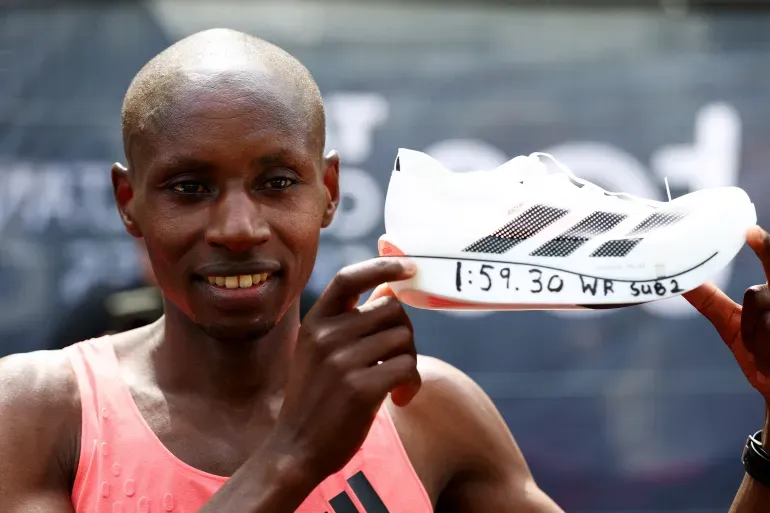
Sabastian Sawe crossed the finish line in 1:59:30, the first-ever official sub-2-hour marathon. His teammate Yomif Kejelcha crossed in 1:59:41 — on his marathon debut. Tigist Assefa broke the women-only world record with 2:15:41.
This is three athletes breaking three world records... and they were all in the same shoe made by Adidas.
As someone who spends their days thinking about product marketing, I couldn't stop thinking about what I'd just watched.
This was an unreal historic sporting moment, but it was also one of the most effective pieces of product marketing I've ever seen. Let's get into why...
The narrative that got stolen
For years, Nike has owned the "breaking barriers" story in running. Their campaigns, their athletes, and their cultural footprint were all carefully built around the idea of pushing the absolute limit of human performance. It's brilliant positioning. Or at least, it was.
Because on Sunday morning in London, Adidas quietly made that narrative theirs.
There was no loud launch campaign, billboard, or carefully timed press release. Just three athletes in their shoes running times the world had never seen before... doing the very thing Nike had spent millions of dollars talking about.
More than luck, that's what happens when your product actually delivers on your promise.
It was a collaboration
Here's what makes this more than a feel-good story for the Adidas marketing team.
The Adizero Adios Pro Evo 3 — the shoe all three athletes wore — wasn't handed to them at the start line. It was developed with them. The apparel too: the Techfit+ Endurance Shorts, the Climacool+ Singlet, the Techfit+ Endurance Suit. Every piece was engineered in close partnership between the athletes and the Adidas innovation team, over years.
Patrick Nava, General Manager at Adidas Running, put it well: the historic result was "a testament to the years of hard work and dedication they have made, alongside our innovation team."
And when Sawe crossed the finish line, he said something that every product marketer should screenshot and stick above their desk:
"It reflects the hard work behind the scenes, the support of my team, and the role of innovation in helping me push beyond limits."
That is your customer, marketing your product to the entire world in real time.
The lesson we don't always want to hear
Here's the part that stings a little, and I say this as someone who loves a good messaging framework as much as anyone.
You can be the best product marketer in the world, and still lose to a better product.
You can nail your positioning, craft a beautiful narrative, build a flawless launch plan... and if your competitor's product genuinely does something yours can't, the market will do their marketing for them.
For free. At scale. In ways no budget can buy.
Every journalist covering the race led with "Adidas." Every running forum is dissecting the shoe tech. Every amateur runner who watched on Sunday is now Googling the Adizero.
In fact, Adidas shares have soared since it happened.
Adidas didn't earn that coverage purely through its marketing team. Their product earned it.
What this means for PMMs
I think the best product marketers understand something easy to lose sight of when you're deep in a launch plan: your job isn't to compensate for a weak product with strong messaging.
Your job is to build such a clear, compelling bridge between what a product actually does and what a customer actually needs that when the defining moment comes, the product can speak for itself.
That means being close to the product and the customer, and understanding the real-world problems your product solves well enough to recognize a "London Marathon moment" when it's coming, and being ready to amplify it.
To me, the best marketing asset you will ever have isn't a campaign but a customer who genuinely can't stop talking about you.
But they'll only do that if you give them something worth talking about.
So yes, obsess over your positioning. Craft the narrative. Build the launch plan.
And then make sure the shoes can run the race.


Product marketing insider
Thank you for subscribing
Level up your product marketing career & network with product marketing experts.
An email has been successfully sent to confirm your subscription.
 Follow us on LinkedIn



.svg)
Start the conversation
Become a member of Product Marketing Alliance to start commenting.
Sign up now