




When I moved from running a product marketing agency into the specialized world of aviation, I arrived with a toolkit I believed was foolproof. I had helped dozens of businesses across fintech, SaaS, consumer goods, and non-profits build their go-to-market strategies from scratch. I had the refined frameworks, the confidence, and the scars to prove it.
Barely a week into the job, I began working on AI software for airline fuel efficiency, with only a day to prepare for an upcoming event. So, I promptly leaned on what had always worked for me and focused on the big, bold outcomes, the “ultimate benefit.”
- Save fuel.
- Reduce costs.
- Maximize operational efficiency.
I polished the messaging using the Value-Benefit-Feature logic I love and honestly felt quite confident. Then, I went to my first airline industry event in Lisbon.
I remember walking the exhibition floor and stopping in the middle of a row of booths with a surreal sense of shock. Every single company had a tall board with the exact same promise:
“Save fuel.”
“Save 3% fuel.”
“Save 5% fuel.”
“Maximize fuel efficiency.”
“Reduce fuel costs.”
I stood there for a moment and laughed. We weren't actually differentiated. We weren't being customer-centric. We were just clones with different brand colors and logos. It was like shouting "the sky is blue".
Later that day, I was grabbing coffee with a Flight Ops Director for a major airline. They had been a client of my company for years, so I asked him point-blank: “When everyone is promising the same percentage of savings, what actually made you choose us over the others?”
He didn’t even blink. “Because SITA can prove it.”
That stayed with me. He wasn't buying a percentage. He was buying the credibility of the technology promised.
The outcomes and values are table stakes in specialized industries, but the “mechanisms” are the differentiator. Strangely, up until that time, we weren’t even marketing that mechanism up front. And that was the missing piece.
The problem with being only "outcome-led"
In specialized industries like Aviation, Healthcare, or Cybersecurity, buyers are professionally cynical. I have observed that they often suffer from what I call “outcome fatigue.”
- CISOs are tired of hearing "Reduce Risk."
- Hospital Administrators are numb to "Improve Patient Outcomes."
- Airlines have heard "Save Fuel" for forty years.
These outcomes, while necessary, are points of parity. They get you into the building, but they don't get you the contract. The real hurdle in a specialized market isn't convincing someone that saving fuel is good; they already know that. The hurdle is proving how you deliver that saving to them while demonstrating that you actually understand the messy, complicated reality of their specific world.
The buyer’s real questions are not:
“What will I get?”
They are:
“Do you actually know how this works in my environment?” and, importantly, “Can you help me prove it?”
The shift from what to how
In many industries, leading with a clear benefit is the gold standard, and for good reason. It works. But I’ve learned that in highly vertical fields, the real breakthrough happens when the ‘How’, the actual mechanism of the work, takes center stage.
There is a world of difference between a Director telling their boss, "This tool helps us save 5% fuel," and them confidently adding, "It does so by optimizing climb profiles using proprietary tail-specific digital twins."
The first part is the marketing claim, but the second part is the technical conviction.
The “how-first” framework
In traditional marketing, a value proposition usually hits three pillars: Who it’s for, What it does, and Why it’s different. That is a great foundation, but in specialized industries, as you know now, we have to go a step further.
So once you know your audience and your benefit, this four-layer framework acts as a "stress test" for your value proposition.
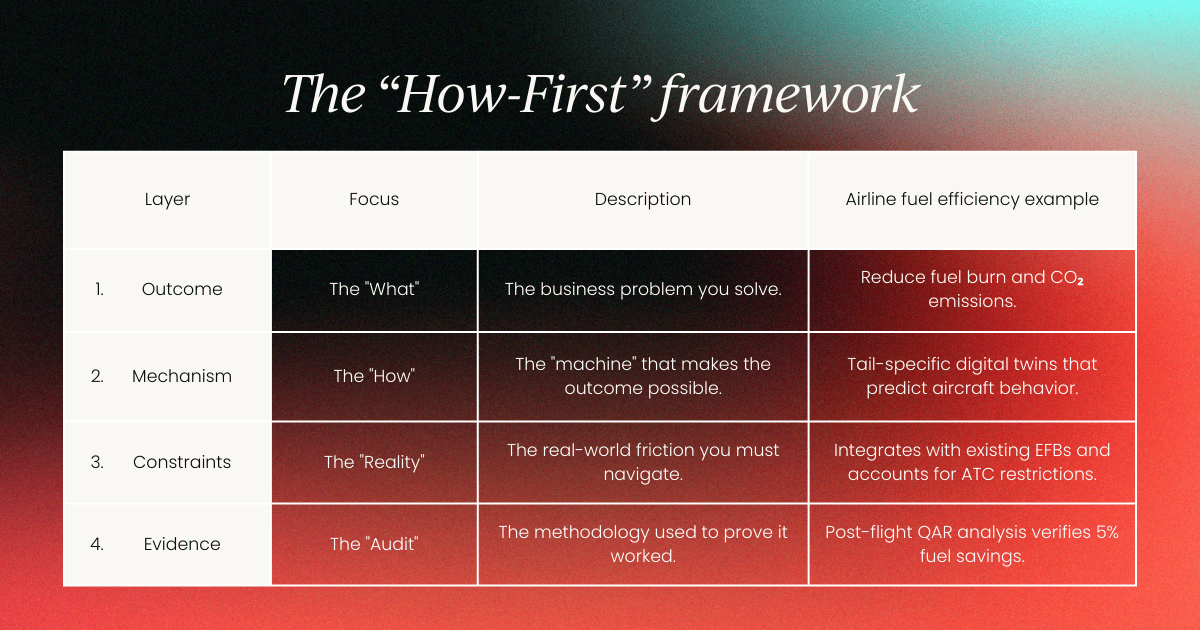
When it comes to translating this into messaging, don’t feel pressured to cram everything into one sentence. I personally like to lead with the Outcome + Mechanism, and then reflect Constraints and Evidence in the body copy to support the promise.
Over time, I also noticed that different stakeholders naturally anchor on different layers across the buyer’s journey: For instance:
Executive leadership→ Outcome + Evidence→ “What business impact will this create, and can we defend it?”
Technical & operational teams→ Mechanism + Constraints→ “How does this actually work in our environment, and where might it fail?”
Procurement & risk teams→ Evidence + Constraints→ “Is this provable, compliant, and safe to commit to?”
The stress-test provides the "meat" needed to tailor your messaging for different personas, ensuring you never make a generic promise again.
How this looks in practice
Let’s step away from aviation for a moment and apply the same stress-test to a more familiar product, from another specialized industry.
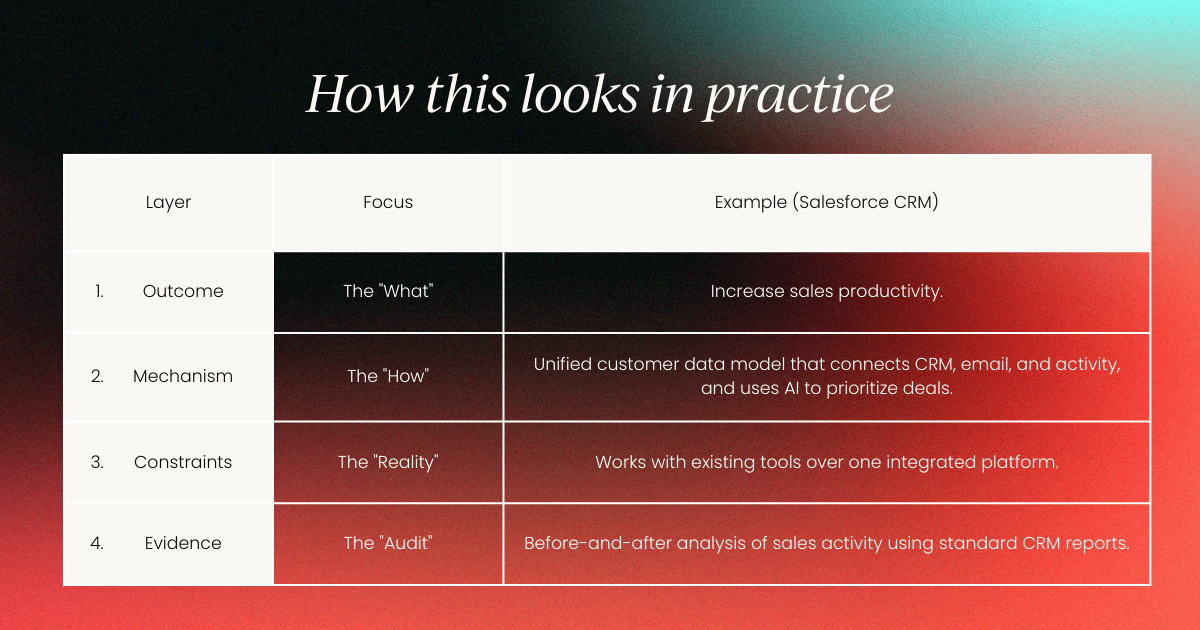
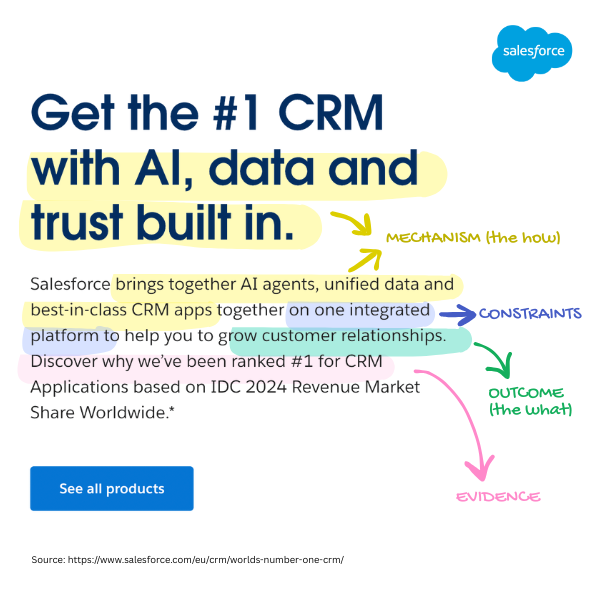
You can actually see this shift in how Salesforce talks about itself today. Their promise is still about growth, but it is now paired with a clearer sense of the mechanism and evidence behind it. Below is a screenshot of their website landing page.
Can you spot all the layers?
Why the "How" is a safety net
In highly specialized industries, buyers are doing more than just looking for ROI. They are looking for protection. They need to protect themselves from being wrong, from failing an audit, or from making a decision that causes a safety issue.
Outcomes don't provide that protection. You cannot defend a decision to your board by saying, "The salesperson promised 5%." But you can defend it by saying, "I vetted their methodology, I checked their data sources, and their logic holds up against our operational constraints."
Ultimately, as PMMs, our job is to make our buyers look good when we are not in the room. We need to give them something solid they can take to their bosses and defend with confidence.
Because backing a new solution is personal. Our champions are putting their credibility and reputation on the line. So when we help them prove that the logic is sound, we are not just selling a product. We are giving them the safety net they need to drive the deal and win.
The template for your next pitch
If you are working with a product team, try to fill out these four lines without using any fluff:
- We deliver [Outcome]
- By using [Specific Mechanism]
- Which works even when [Industry Constraint] is true
- And we can prove it because [Evidence]
If you can't fill out even one of these, your value proposition may likely be too generic for a specialized buyer.
Wrapping up
In specialized industries, your Outcome is just the tip of the iceberg. It is the visible promise that grabs attention.
But if that promise isn't anchored by the submerged weight of a technical Mechanism, respect for Constraints and confidently defended by Evidence, the proposition capsizes under the first customer meeting.
I’ve seen buyers walk away from a potential 5% saving to sign for 2% instead. Simply because the 2% was easier to explain, verify, and trust.
This "How-First" shift worked for me when my generic pitches were falling flat, and it may be the reset your own messaging needs. Big outcomes might open the door, but what really closes the deal is a story your buyer can stand behind.
Give it a try.


Product marketing insider
Thank you for subscribing
Level up your product marketing career & network with product marketing experts.
An email has been successfully sent to confirm your subscription.
 Follow us on LinkedIn


.svg)
Start the conversation
Become a member of Product Marketing Alliance to start commenting.
Sign up now