








Templates and frameworks to pair with this playbook
- Sales enablement maturity model
- Building a sales enablement tech stack checklist
- Sales one-pager template
- Competitive battlecard template
- Objection handling script
- Storytelling framework
- Customer feedback tracker template
- Sales onboarding checklist
Nail the skills
Let me ask you an uncomfortable question: is AI actually making your sales team better – or just faster?
Faster isn't always better; it just accelerates whatever's already happening. If your enablement strategy has real vision and structure, AI makes it even stronger. If it doesn't, AI just speeds up the chaos. And right now, a lot of teams are sitting closer to the chaos end of that spectrum than they'd like to admit.
I’m here to help you bring order to the chaos. Here’s what we’ll cover:
- Why moving faster hasn't made sales teams more effective
- The four ways AI is making sales enablement harder
- A five-point framework built to turn AI into a real force multiplier for sales enablement, rather than a faster route to the same problems
Why speed isn't the same as impact
Sales reps are using AI extensively, and it's saving them time – four to seven hours per rep per week. The question is what they do with those hours. Done well, that saved time goes into better personalized outreach, which, done well, can lift email open rates by up to 29%. Done badly, it just produces more noise, faster.
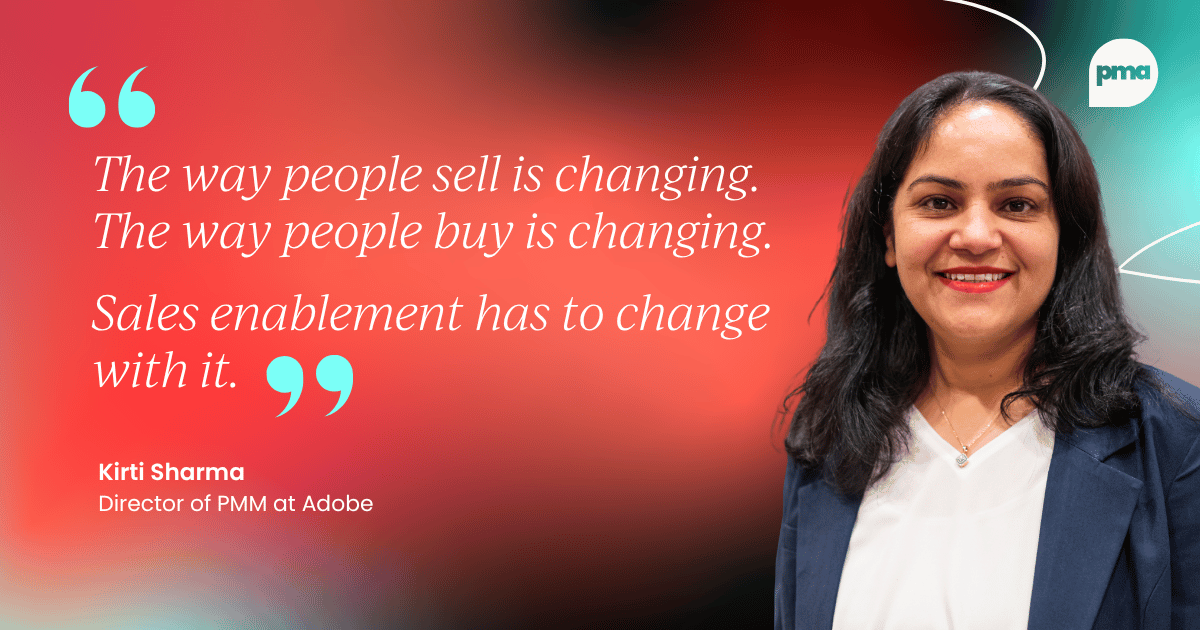
This trend is only accelerating. By 2028, an estimated 60% of sellers' work will run through conversational AI interfaces. The way people sell is changing. The way people buy is changing. Sales enablement has to change with it.
Here's the problem: we've mostly measured sales enablement's success through indirect signals. Pipeline growth, win rates, shorter sales cycles, and faster ramp times for new reps. The trouble is, it's hard to draw a straight line from one enablement session or asset to a change in any of these metrics. At best, we've been able to point to correlation, not causation.
So, 50% of teams end up measuring content adoption instead: how many reps touched an asset, what the training completion rate looked like, what feedback came back from sellers. That's one step removed from proving real impact, and it's critical that we close that gap.
Four ways AI has made this job harder
AI presents four fresh challenges for anyone running sales enablement right now, and each one gets harder to tackle the longer it goes unaddressed.
1. Poor asset utilization
If you're frustrated that your sales team isn't using your enablement assets enough, you're not alone. Roughly 65% of sales content sits untouched. The advent of AI just means you're now producing more content, faster, into the same 65% void.
2. Scaling noise vs. scaling value
The moment every rep can personalize a message instantly, positioning stops being something you control centrally. AI will scale whatever you feed it, generic messaging included, which means the gap between noise and real value comes down to what you put in front of it in the first place.

For expert insights like this, in full, every Friday, sign up for Pro+ membership.
You'll also get access to 30+ certifications, a complimentary Summit ticket every year, and 130+ product marketing templates.
This month only: Save with code SUMMER26.
3. The rising cognitive bar for sales
AI takes the repetitive tasks off reps' plates, but that just raises the bar for everyone else in the game.
If all your competitors are using AI to build polished, well-researched pitches, your differentiation no longer comes from the pitch alone. It comes from the quality of conversations, from how clearly reps articulate differentiation, and from the demo stories they tell.
The PMM's job has shifted toward enabling reps to have better conversations, not just more of them.
4. Messaging drift
Everyone's a content creator now. With AI, any rep can spin up their own one-pager, pitch deck, or – soon enough – their own demo video, without waiting on you.
That's empowering, but it comes at a cost: the moment you hand people the tools to customize your messaging themselves, you lose some control over it. Messaging gets diluted. Sometimes it drifts entirely from what you intended, and the rep is the one left exposed when that pitch doesn't land.
A five-point framework for sales enablement in the AI era
So where does that leave us? With a five-point framework, shaped by what I've built and fixed across various companies.
1. Build a constant feedback loop
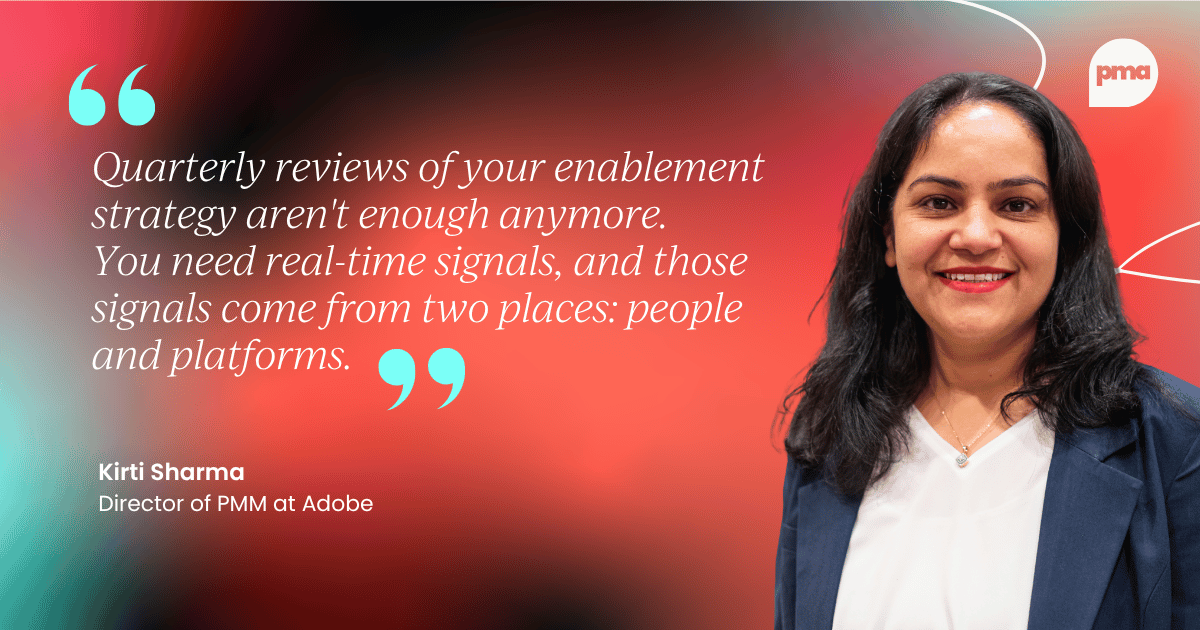
As AI increases content velocity and sales velocity, feedback frequency has to increase with it. Quarterly reviews of your enablement strategy aren't enough anymore. You need real-time signals, and those signals come from two places: people and platforms.
Connecting with your sales team
On the people side, you have to talk to your sales reps regularly. I learned this the hard way early in my career.


Product marketing insider
Thank you for subscribing
Level up your product marketing career & network with product marketing experts.
An email has been successfully sent to confirm your subscription.
 Follow us on LinkedIn


.svg)