







The hackathon was mine. I had pitched it, run it, and paid for it by killing one of our acquisition channels six weeks earlier. Now I stood in the middle of it, with more than two hundred and fifty developers in teams, all building on the platform I run marketing for.

I moved from table to table asking what people were making, catching the rushed two-minute tour of half-built ideas, talking shop with people clearly running on caffeine and adrenaline.
One group had taken a dry civic question, something about a downtown height limit, and turned it into a live debate between AI agents that bickered like real neighbors. Another was mid-demo, laughing at their own bug. Not one of them was thinking about us as a vendor. They were just building, and our product happened to be what they reached for.
“For a technical audience, trust is not a channel you buy. It is a room you earn your way into.”
The number that told me to stop
Six weeks earlier, it had been just me and that spreadsheet, and the one number on it that most marketers find a quiet way to avoid. What we were paying to bring in a developer through paid ads, next to what that developer was actually worth to us once they showed up. Roughly three times. We were spending something like three dollars to earn back one.
When a number like that lands, the trained instinct is to make the channel better. Tighten the targeting, rewrite the ads, fix the landing page, run the test again. I have done every one of those things, more than once, and I know how they feel, which is like doing something useful. So I will be straight about how uncomfortable the other option was, because the other option was not to improve the channel. It was to shut it off.
What the spreadsheet was actually saying took me longer to admit, and it is the part that holds true for your product, not just mine. I was paying, over and over, to persuade the one audience least likely to be persuaded by paying. Every study of how developers buy keeps circling the same finding: they move on evidence, not on persuasion.
They trust hands-on proof, real documentation, and the word of peers who have actually used the thing. They can smell a campaign coming, and they do not like it. I was buying attention from the exact people whose defining trait is a distrust of bought attention.
So here is a test worth keeping, whatever technical product you market. Before you optimize a channel, ask whether the channel is working against the nature of the person on the other end of it. If it is, a sharper campaign will not save you. It will just make you faster at the wrong thing.
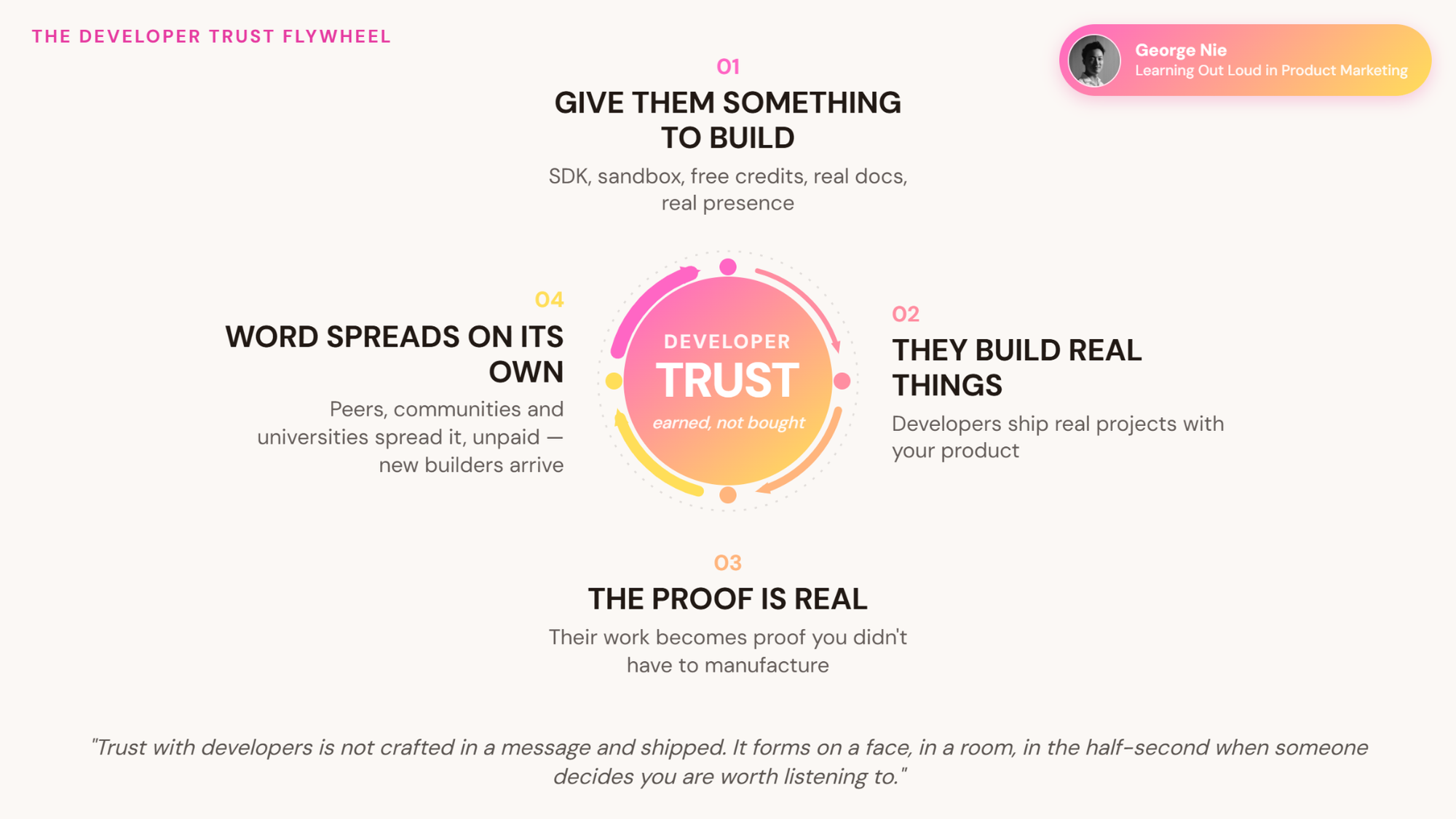
You can't buy a builder, so give them something to build
We pulled the budget out of paid and put it into the opposite kind of work. We ran the hackathon alongside a name developers already recognized in the AI space, the sort of partner whose presence tells a skeptical builder a weekend is worth the gamble.
I started turning up at meetups and agent-focused gatherings, not with a booth and a pitch but to listen, to find out what people were actually fighting with around inference, and to say our positioning out loud to real faces and see which words landed and which ones died on contact. And we put the help where developers already were: a Discord for questions, free credits to keep them going, and docs good enough that someone could get started at midnight with nobody online to save them.
None of that is hackathon-specific, which is the point if you sell something technical that is not a developer tool. Hand people raw material they can do something real with, whether that is an SDK, a sandbox, a free tier, free credits, or documentation that respects their time. Show up where they already gather and give something before you ask for anything. Then get out of the way and let them build the proof you would otherwise have paid a small fortune to manufacture.
And build they did.
The proof builds itself
One team wired together something that sat inside your meetings, listened, and quietly fired off the follow-up emails and spun up the code repositories as decisions were made, so half your action items were done before you stood up.
Another built a small personal assistant that read everything already scattered across your own laptop and told you what you had forgotten. A third let you paste in any URL, sent a swarm of agents to pull the page apart, and handed back two full redesigns in about twelve seconds. Nobody commissioned these. Nobody briefed them. People made them because they wanted to, with our product as the raw material.
Then the part I keep having to stop myself from burying. Some of them paid. On their own, after the event was over, with no sequence nudging them and nobody watching, they put in a card to keep building. The audience we could not profitably buy had just gone and bought itself.
And they talked. They told their classmates, their coworkers, the communities they belonged to. Word moved through local universities and startups on its own, carried by people we never paid, and it was cheaper, and it stuck better than anything we could have produced ourselves.
“My proof that this hackathon worked is not a conversion curve. It is a Discord full of developers who still message me, by name, months later, mid-build.”
Two things caught me off guard. Our own engineers, the people who stare at this product all day, lit up watching outsiders build things with it that none of us had pictured, and a marketing call ended up lifting morale inside the building.
Then the pull started coming from outside, with community groups asking us to sponsor and speak at the next thing before we had cleaned up from the last. The channel we killed never did any of that. This one kept feeding itself.
The fair objection: it doesn't forecast
I can argue against all of this myself, and it is a real objection, so it deserves its strongest form. This does not forecast cleanly. A hackathon is lumpy and seasonal and hard to put a confident number on, and if you walk into a planning meeting with a story about a great weekend, a finance partner hears an anecdote, not a plan. That is fair. I am not going to pretend an event is as legible as a paid dashboard where a dollar in predicts a lead out.
But that is the wrong thing to measure it against, and the honest answer is in the one language marketers are strangely shy about using: money.
We moved the budget into a motion that ran at roughly a third of paid's effective cost, and unlike paid, it compounded, with people converting themselves and pulling others in after them. That is not a worse forecast than paid. It is a better use of the money, with a self-serve engine bolted onto the back of it.
When you take this to a skeptical boss, do not defend the weekend. Defend the ratio, and point at the tail: the sign-ups that kept landing for months with no spend behind them.
And no, none of this is new. That is the strength of it, not a weakness. The most technical companies on earth, the ones selling to the hardest engineers alive, have always run developer communities and events and genuine relationships instead of leaning on ads alone. There was nothing clever in what we did. The only hard part was finding the nerve to switch off an expensive channel the day the math told us to, when everything you are trained to do says optimize the campaign instead of asking whether it should run at all.
This is not a war on paid
I want to be clear, because it would be easy to walk away with the wrong lesson. Paid acquisition is not a sin, and events are not a virtue. Paid earns its keep in plenty of places: catching intent that already exists, reaching people who genuinely respond to being reached, holding a brand in front of a market.
The argument is narrower and more useful than "ads bad." Match the motion to the person. When your audience is defined by an allergy to being sold to, the answer cannot be a louder version of selling. It has to be contribution. You give first, you show up in person, and you make the value obvious enough that people carry it for you.
Where the trust actually forms
“Trust with developers is not crafted in a message and shipped. It forms on a face, in a room, in the half-second when someone decides you are worth listening to.”
If you sell a technical product and you have been treating "reach developers" as a channel you just haven't cracked yet, I would offer that the channel is the problem, not your execution of it. The pipeline was never a thing you could buy. It is what you get when you give people something worth building on, and you have the sense to be in the room when they build it.
So before you brief the next campaign to go chase developers, sit with the harder question. If you stopped spending to reach them tomorrow, and handed them something genuinely worth building on instead, who would actually show up?
Mine filled a room. I think yours would too.


Product marketing insider
Thank you for subscribing
Level up your product marketing career & network with product marketing experts.
An email has been successfully sent to confirm your subscription.
 Follow us on LinkedIn



.svg)
Start the conversation
Become a member of Product Marketing Alliance to start commenting.
Sign up now