















The first month in a new role can seem bewildering. I liken it to moving cities and joining a new school. You face the challenge of socializing with new classmates, alongside the subtle pressure to prove your capacity and capability. I can speak to this because I have started a fully remote role, still finding my footing on what was expected of me while trying to prove myself in month one.
Barely a week in, I was handed a massive drive of content assets and given access to the content management system, with the sole responsibility of completing a content audit. Inside were hundreds of files with no owners, strategy decks from past product cycles, and poorly named folders. It felt like I had been let into a dumpster and asked to rearrange and colour-code everything inside – an exhaustingly overwhelming task.
My first instinct was to block out hours of deep work and read through everything, trying to uncover what worked and what didn't. It didn't take long to realize that this wasn't going to hold up, not in a month, and not while I was still learning who to even ask about half of what I was reading.

Most companies suffer from content bloat. Research from SiriusDecisions estimates that 60 to 70% of B2B content goes unused, largely because it is unfindable or no longer relevant to the buyer. Walking in as the new PMM hire means inheriting that bloat as cognitive overload: you’re trying to map a content library you don't understand yet, created under a strategy you weren't there for.
A valid, and seemingly responsible, approach to the content audit is to review everything. The problem is that it’s counterproductive. It’s not just too much work; it optimizes for the wrong outcome. According to the CORE framework for the first 90 days as a PMM, your first thirty days are best spent in observation mode, finding out what’s working and what isn't from cross-functional teams.
It’s tempting to put off a content audit because there seems to be simply too much content, but that is not really the problem. The real problem is that, as a new product marketer, you have no way of immediately knowing which content is still accurate, which is performing, which reflects an old product direction, and which is actively helping the business achieve its goals.
That’s why I believe you need a strategic approach to auditing your team's content in your first 30 days, not an exhaustive one.
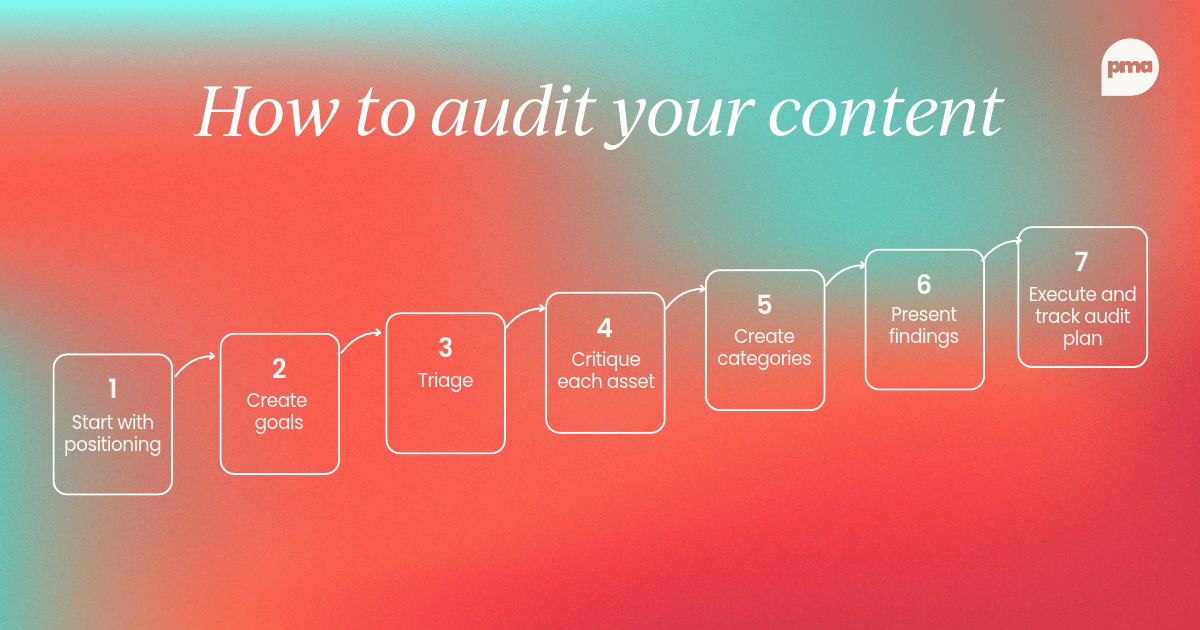
Start with positioning and not the content
Before I look through documents, I get clear on the product's positioning, ICP, competitive alternatives, value proposition, roadmap, messaging framework, and business direction. These give me a fixed reference point to judge everything else against. Starting a new role also means you’re still learning the product, which is why you shouldn't run the audit alone.
I use my listening tour to do two things at once. I benchmark stakeholder feedback against the information I've gathered, so that I can understand where perception and reality diverge before I look through the content management system and drive.
My goal is to find out whether the content assets drive results. A battlecard that looks outdated to me may still be closing deals. I wouldn't know that from auditing the content alone; I would only find it out through conversation and usage data.
In a previous role, there was no formal positioning document to benchmark the content against, so I established that context through meetings with stakeholders and the information already available about the product and customers. With that, I was able to complete a content audit and develop a content strategy.
The goal isn’t to audit content against what you personally like; it’s to audit against the product's positioning, customer reality, and business direction.
Create content audit goals
Once you’ve established a fair understanding of the product, align your content audit to the broader business goals. Determine what the business is trying to accomplish within the quarter. Is there a new product line being introduced? Is the business's goal pipeline velocity, a new market, or product adoption?
Without this step, the content audit can easily become a box-checking exercise, where you spend weeks cataloguing everything that exists without identifying what actually matters.
The question should move from "What content do we have?" to "Which content is helping us achieve our business goal?"

Triage before you audit
As a new hire, a lot is competing for your time, and it’s wise to protect it from endless one-to-ones and onboarding sessions. You can't afford to open every file or go through all the subcategories on the website.
I start with the assets that directly contribute to the business's goals, particularly the highest-performing and highest-visibility assets that a customer is likely to encounter across important touchpoints. These could include the homepage, product pages, sales deck, highest-traffic blog post, and onboarding sequence.
If the homepage is misaligned with positioning, it’s misaligning every visitor who lands on it, not just one prospect reading a forgotten PDF three folders deep.
Critique each asset
With the benchmark created from your listening tour and internal documents, you have a fairly objective view from which to critique content assets. Assess them across four areas:
- Content performance
- Relevance and accuracy
- Positioning and messaging
- SEO opportunities.
For content performance, I consider which assets are delivering results. Depending on the content, I look at metrics such as clicks, shares, downloads, bounce rate, click-through rate, and comments.
For relevance and accuracy, I consider whether the information in the blog post or one-pager is still current. Is it consistent with what is on the homepage? Are the statistics valid? Does it represent what exists today, and is it relevant to the current product roadmap?
For positioning and messaging, I look at whether the content is aligned to the product's narrative, positioning, and messaging framework. Do the webpages tell the same story, or does it feel disconnected?
Finally, I consider SEO opportunities, particularly for discoverable content. My goal is to find out whether the assets meet SEO standards. Are the keywords naturally integrated? Are there broken links? Is the content relevant and high quality? Could several fragmented assets be contributing to the same topic without building meaningful authority?
A helpful way to do this is to create an Excel sheet, outline the priority content assets based on the goals you have set, and critique them in line with the criteria above.
Create categories
On the same Excel sheet, sort every asset into one of four categories:
- Retain: This covers high-performing assets that drive results, rank well, and are consistent with the product's positioning. Starting a new role does not mean everything needs changing; it means recognizing what is working.
- Refresh: This covers assets that require optimization to deliver results. It could involve updating the format, rewriting sections, or replacing old statistics.
- Regroup: Combining duplicated, fragmented, or disjointed assets into a comprehensive source. This helps to avoid confusion and improve topical authority.
- Retire: Deleting or archiving pages that offer no commercial value and are not relevant to the company's product.
Present findings
Present your findings to your manager and relevant stakeholders. Your documentation on what to retain, refresh, regroup, and retire will serve as direction for what is prioritized in the following months. Some assets will require immediate attention, while others can sit within a longer-term plan.
Execute and track content audit plan
A clear audit plan can be executed easily once the previous steps are done. Assign responsibilities to team members and set clear deadlines to track execution. More importantly, monitor whether the changes improve performance. An audit without execution is wasted effort, but execution without measurement also limits what you can learn from the exercise.
Conducting a content audit in month one is feasible when approached strategically. It’s important not to try to fix everything at once. Start with the product's positioning, prioritize what matters, critique against a consistent benchmark, decide what to retain, refresh, regroup, or retire, and then execute against the findings. With this, you should have a clearer understanding of what’s working, what’s no longer serving the business, and where the product story needs to go next.


Product marketing insider
Thank you for subscribing
Level up your product marketing career & network with product marketing experts.
An email has been successfully sent to confirm your subscription.
 Follow us on LinkedIn



.svg)
Start the conversation
Become a member of Product Marketing Alliance to start commenting.
Sign up now