











Have you ever been asked by your CEO to demonstrate the value of product marketing? You know, those dreaded conversations about metrics, OKRs, and ROI that leave you scrambling for spreadsheets?
We've all been there.
I've always found this to be one of the most challenging aspects of our role. It's tough because product marketing sits at what I call the "go-to-market center of gravity." Sales enablement, product management, growth marketing, demand gen, and brand marketing all revolve around us. That central position makes it incredibly hard to quantify what we actually do.
So, in this article, we're going to tackle the question of how to prove product marketing’s ROI head-on.
The metrics mirage: Why we're measuring the wrong things
In product marketing, many of us lean on metrics that feel comfortable – outputs that are easy to track but don’t prove real business value.
You know the ones. Blog counts, webinar volume, endless content production. These activity-based measures create what I call a metrics mirage: the illusion of productivity.
But doing more doesn’t mean doing what matters. And when results fall short, leadership inevitably asks: What have you actually been doing?
The truth is that these busywork metrics aren’t sustainable — and often aren’t the right things to measure in the first place. And now that AI can help you churn out five blogs a month without breaking a sweat, tracking sheer volume tells you even less than it did before.
What matters – and what will matter going forward – is the real impact you’re driving for the business.
The new product marketing reality
Like many product marketers, I come from a product management (PM) background. Back in my PM days, I thought product management was the most misunderstood field – it was new and looked totally different from organization to organization.
Sound familiar? That’s because product marketing is exactly where product management was a decade ago.
Today, product management is well understood in most organizations. People know exactly what product managers need to do, how to measure them, how to assess their productivity and effectiveness, and how to grow those teams.
Product marketing? Not so much. We're lagging behind our product management counterparts by about ten years.
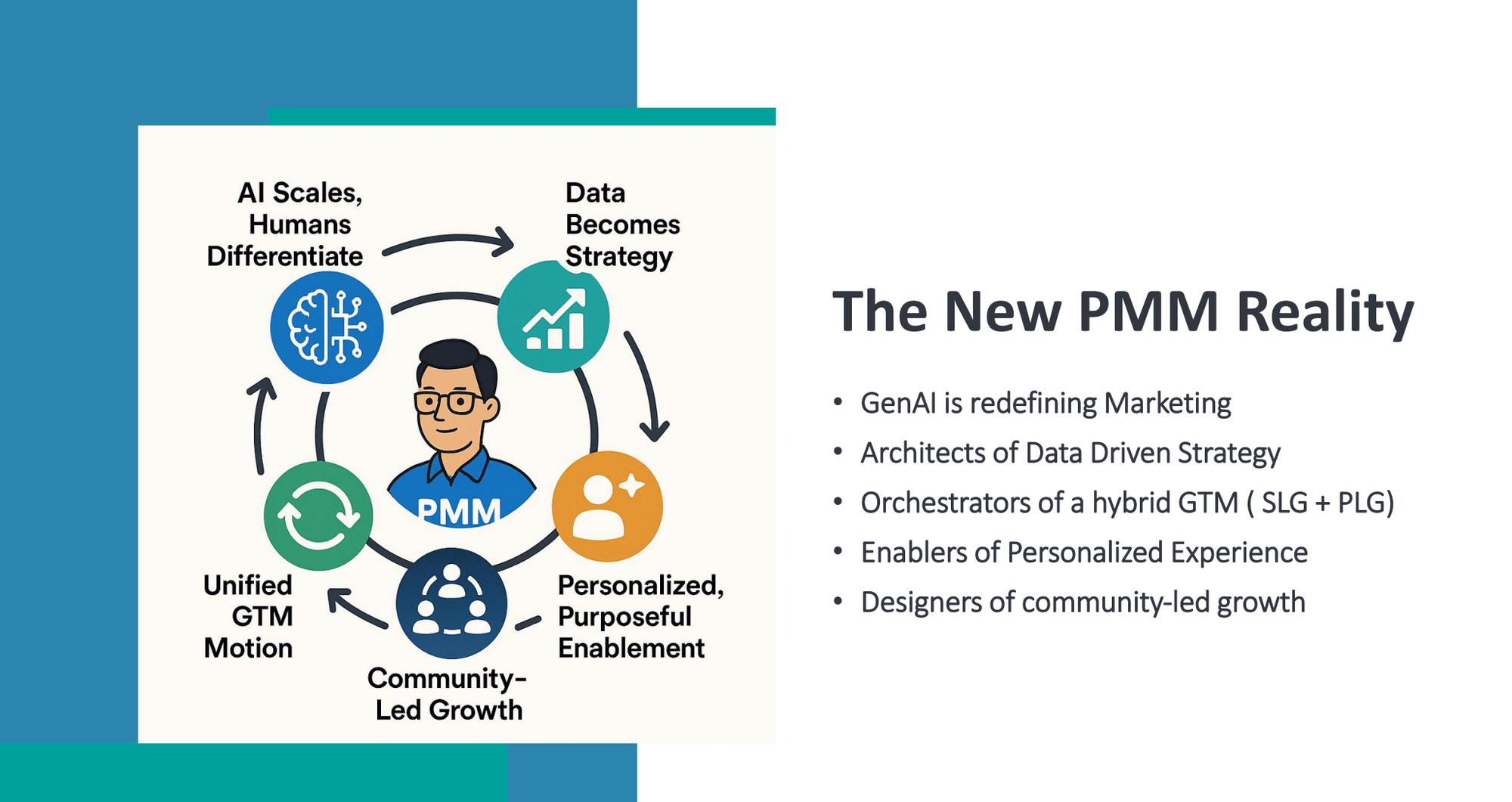
Here’s the exciting part: product marketing is changing fast. We’re becoming deeply data-driven, using data strategy to steer go-to-market (GTM) decisions.
And we’re no longer supporting a single GTM motion – we’re orchestrating multiple ones. Traditional sales-led growth still dominates for on-prem products, while SaaS teams often rely on product-led motions. These models are very different, and navigating both is now core to the PMM role.
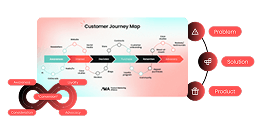
Increasingly, companies want a hybrid GTM: self-serve for smaller deals and a sales-led path for larger ones. Product marketing bridges these worlds. We enable the customer journey, shape personalized experiences, and design community-led growth initiatives.
At SmartBear, product-led growth didn’t have a natural home. It moved between demand gen and product until we realized it belonged with product marketing. PMM is the only function that can truly map and message to customers across their entire journey – from discovery to trial to onboarding and beyond.
This shift creates a new PMM reality. To thrive within it, we must operate as strategic drivers of impact rather than tactical producers of outputs.
For expert advice like this straight to your inbox every Friday, sign up for Pro+ membership.
You'll also get access to 30+ certifications, a complimentary Summit ticket, and 130+ tried-and-true product marketing templates.
So, what are you waiting for?
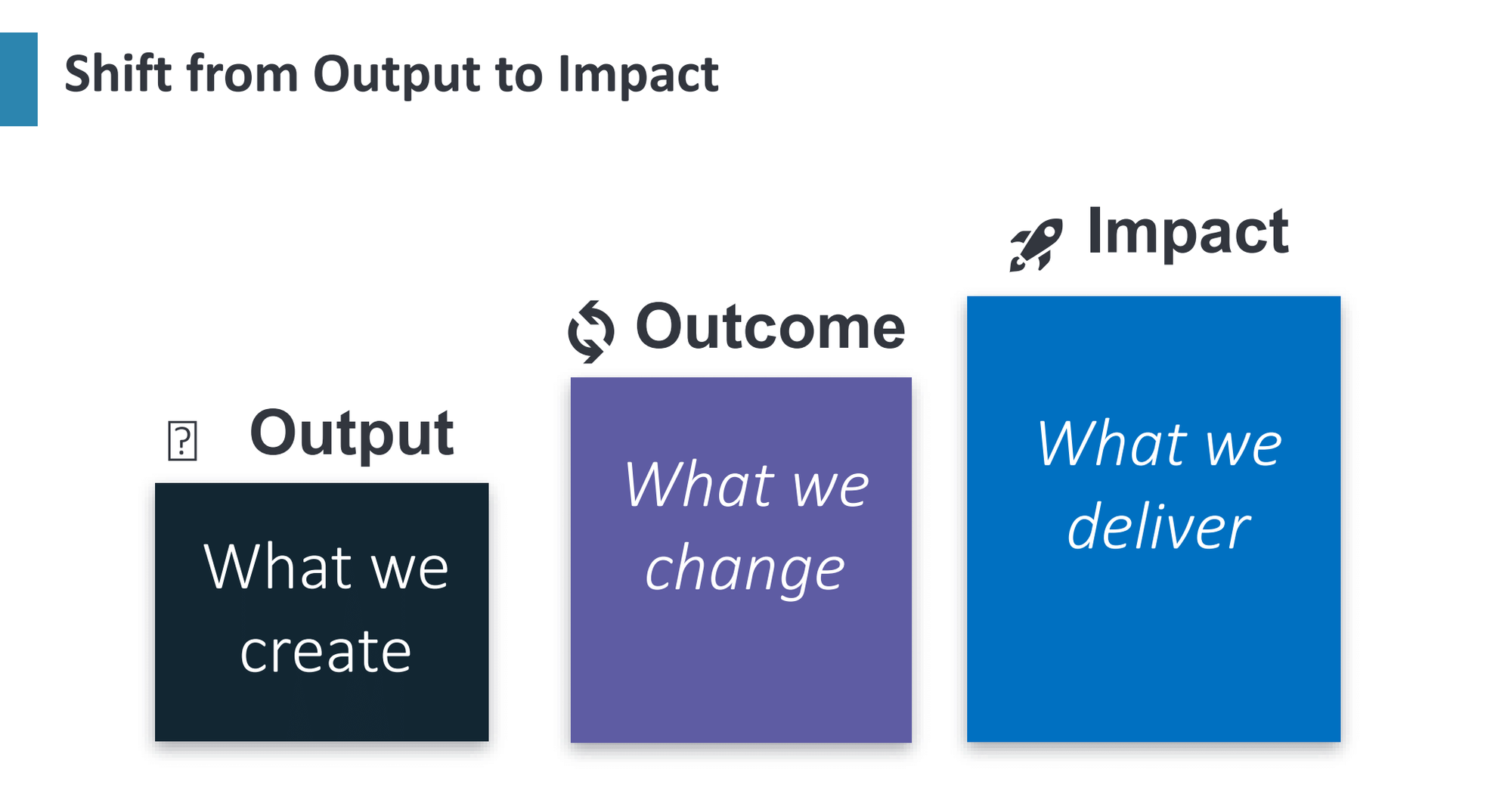
The output-outcome-impact framework
Let me share a model I developed about fifteen years ago while working at a pre-revenue startup in Boston. I was the company’s first product marketing hire, and with the team sitting at fifty people and set to double within a year, the workload was quickly outpacing capacity. I needed to make the case for adding a second PMM person.
That turned out to be surprisingly difficult. A new salesperson is easy to justify; you can tie them directly to revenue. An engineer is similar; they’re building software. But a product role? That’s where the conversation becomes much more complicated.
The framework I developed has proven invaluable for building OKRs, becoming more strategic, and justifying headcount. It's built on three levels:
- Output: What we create – assets, campaign documents, enablement materials
- Outcome: What we're looking to change – engagement rates, win rates, adoption metrics
- Impact: The business value delivered – pipeline, revenue, retention
When was the last time a product marketing report or dashboard in your company led with an impact metric rather than an output metric? If you can't remember, it's time to change that.
Mapping impact across the customer journey
To make this framework more tangible, let’s look at how product marketing shows up across the customer lifecycle.


Product marketing insider
Thank you for subscribing
Level up your product marketing career & network with product marketing experts.
An email has been successfully sent to confirm your subscription.
 Follow us on LinkedIn



.svg)