






Templates and frameworks to pair with this playbook
Quick question: what is ChatGPT saying about your product? If you don't know, you've got a blind spot, and it's growing fast.
In my role as Director of Solution Marketing at G2, I watch how B2B buyers make decisions. Here's what's happening right now: shortlists that once held ten or twelve names now hold two or three, and a growing share of the buying journey takes place inside a chatbot conversation you'll never see.
This is both a demand gen and product marketing problem, one I’m here to help you solve. In this article, you'll learn:
- How the buyer journey has evolved and compressed
- How AI chatbots build a shortlist
- What large language models look for before they'll recommend you
- The steps you can take today to win visibility in AI-generated answers
If there's one thing I want you to walk away with today, it's this: the way buyers find and shortlist vendors has changed more in the last two years than it did in the previous two decades. If you're still running the same playbook, you're already behind.
The three eras of buying compression
To understand where we are now, you need to understand how we got here. I think of recent buying history as three distinct eras, and each one compressed the buyer's world a little further.
First, we had the big book era. Everything a buyer needed was in the Yellow Pages. They'd have a problem, crack open the book, find ten or twelve vendors, and reach out. Simple.
Then, the internet changed everything and along came the search era. A buyer could self-serve an enormous amount of information from a single page of results. Your website, your content, and your SEO strategy determined whether you showed up at all.
This era also gave birth to the dark funnel. Buyers were doing all their research, forming opinions, building shortlists, and only raising their hand when they were nearly ready to buy. We lost visibility into a big chunk of that journey.
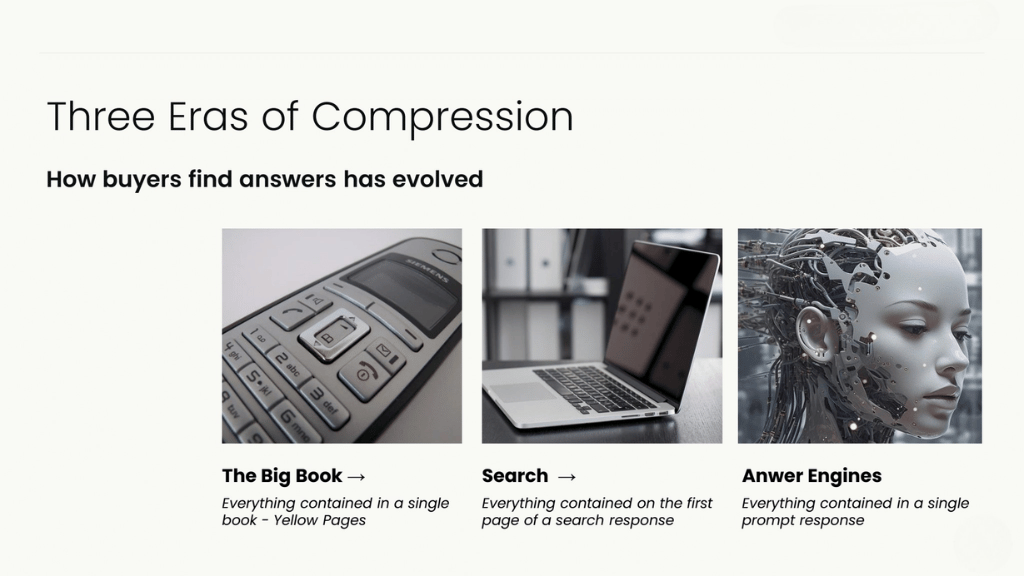
Now we're in the third era. The era of the answer engine. Everything a buyer needs to make a purchasing decision can now be contained in a single conversation with a chatbot.
One chat, that's it, and the consequences are significant; vendor shortlists are shrinking to just two or three vendors. Only then does the buyer reach out. Fewer vendors are even getting the opportunity to compete.
Why this is a product marketing problem
Although demand gen has historically been the team most concerned about organic traffic, this isn't just a demand gen problem. It affects all of us, including product marketing.
How do you get in front of customers when you don't even know what the chatbots are saying about you? It's a black box. The dark funnel has never been darker.
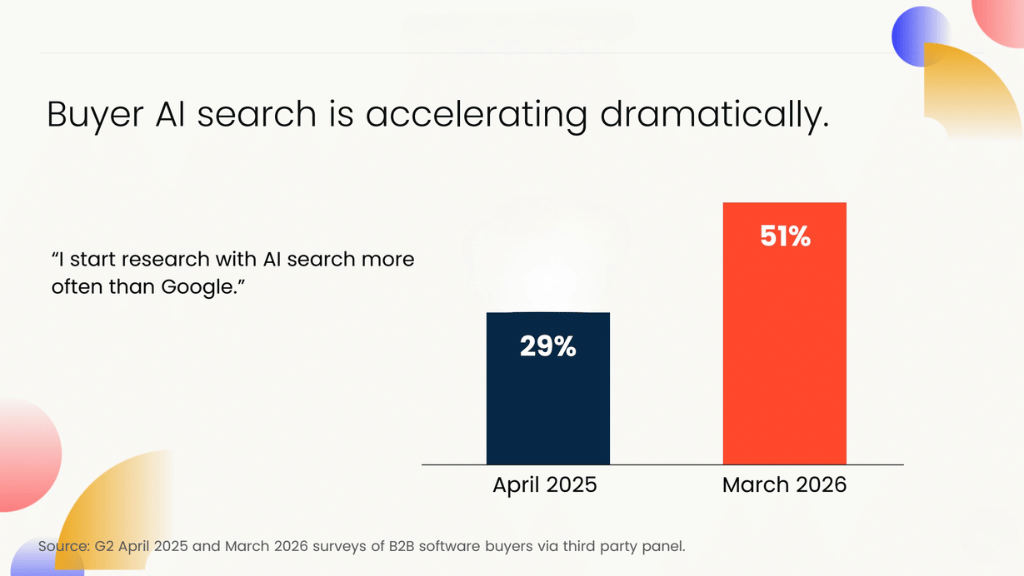
We polled over 1,000 B2B software buyers and decision-makers and found that 51% are now starting their search in a chatbot like ChatGPT or Perplexity. We ran this survey in April 2025 (29%), in October (around 50%), and again in March of this year (51%). There's been a slight plateau, which tells us not every buyer is ready to go all-in on AI-assisted search. However, the trend is clear, and it's not reversing.
This doesn't mean SEO is dead. You still have 49% of buyers using traditional search engines, and that's not a number you can afford to ignore. But you absolutely need to be addressing answer engine optimization (AEO) alongside your traditional SEO work.
Two buying journeys running in parallel
Right now, you've got two different types of buyers moving through your funnel simultaneously.
The traditional buyer has a problem, goes to Google or Bing, does a keyword search, lands on your website, maybe checks a review site or a market research analyst firm, builds a shortlist, and decides to reach out.
The AI-assisted buyer has a problem, opens a chatbot, has a back-and-forth conversation, and then decides to reach out.
One of the most striking data points about that second journey: seven out of ten users are surprised by what the chatbot recommends. That's a huge deal. It means big brands aren't automatically getting recommended; sometimes the smaller players are.
If you work for a smaller brand, that’s great news; it means you can still get in front of buyers. And if you're a big brand, that should concern you, because why aren’t you getting recommended?
For expert insights like this, in full, every Friday, sign up for Pro+ membership.
You'll also get access to 30+ certifications, a complimentary Summit ticket every year, and 130+ product marketing templates.
So, what are you waiting for?
How shortlisting works in the age of AI
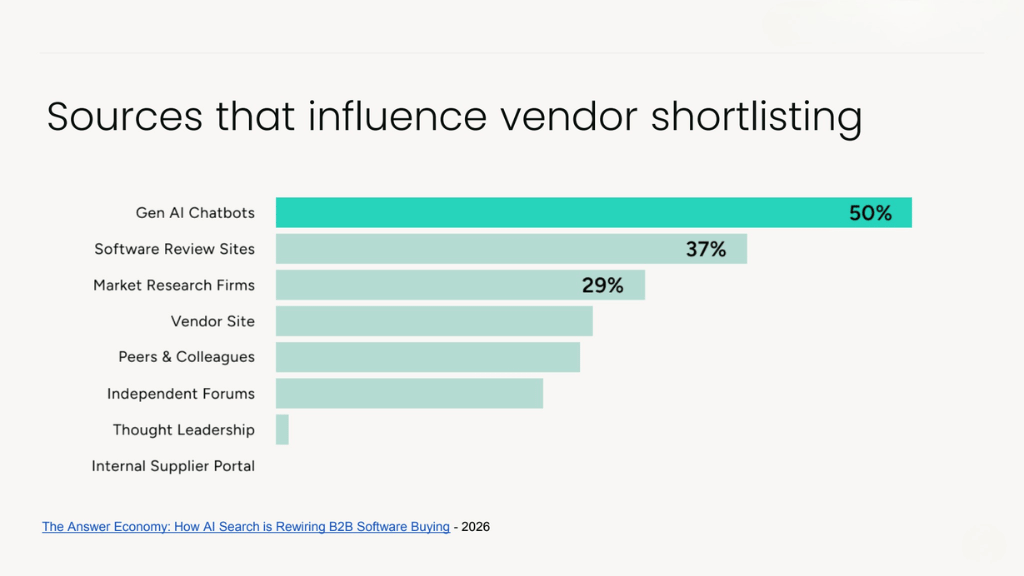
Generative chatbots influence around 50% of shortlists. Review sites and market research firms are next. Investing in both is critical.
Here's the thing about how chatbots build shortlists: it's not a one-shot process. A buyer doesn't just type "give me a vendor shortlist" and accept the first answer. The process is more layered than that.
It usually starts small. A buyer asks a low-stakes question, like "What are the top ten products in this category?" Then they narrow it down by use case and ask follow-up questions. As the conversation goes on, the chatbot senses they're moving closer to a purchase decision, so it starts leaning more heavily on trust signals.
You can actually see this happen. Early in a conversation, you'll get a plain answer with few or no citations. But as the conversation deepens, citations start appearing, then branded citations with logos attached.
A lot of people see those citations and think: "I need to be one of those." And yes, that's true. But here's the part that might surprise you: almost no one clicks on those citations. Your average buyer is not clicking through. They're reading the answer and moving on.
So, the citation matters not because buyers are clicking it, but because it signals to the LLM that your brand is a trusted source worth referencing – and that changes whether you get recommended at all.


Product marketing insider
Thank you for subscribing
Level up your product marketing career & network with product marketing experts.
An email has been successfully sent to confirm your subscription.
 Follow us on LinkedIn


.svg)