








Created by:
 James Shaw
What is a business case template?
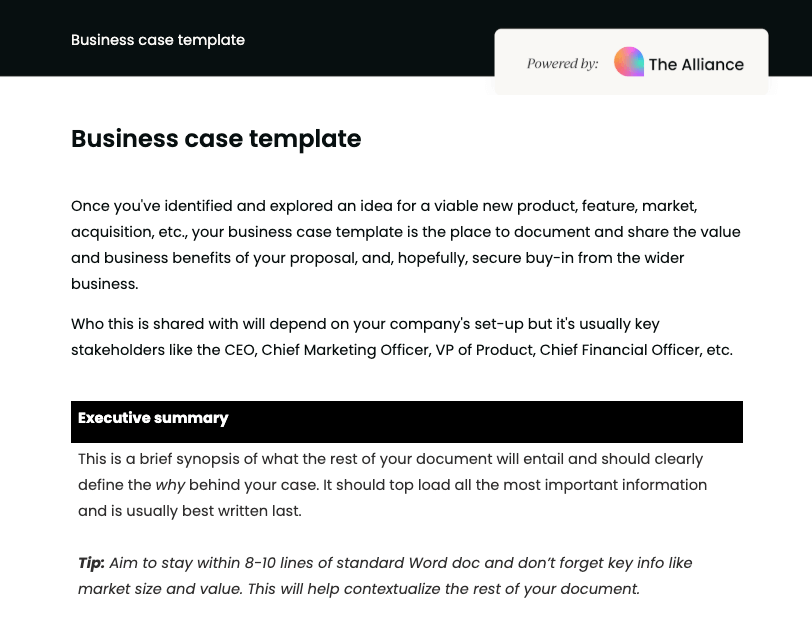
A business case template is a downloadable document designed to provide a clear and concise justification for a proposed business initiative. To use it, all you need to do is download your copy and fill in each section. Simple!
A strong business case will outline the rationale behind the idea, the benefits it will bring, the resources required, and the financial implications for the organization. Our template is an invaluable resource for anyone presenting a proposal to key stakeholders (such as the CEO, CMO, VP of Product, and CFO) ensuring they understand the value and necessity of the project.
In other words, it's the first step toward getting the backing you need!
Why is a business case template useful for marketers?
- Structured clarity: It provides a systematic approach to presenting your ideas, ensuring all critical aspects are covered.
- Strategic alignment: Helps align your proposal with the organization’s strategic goals, making it easier to gain executive buy-in.
- Informed decision-making: Offers a comprehensive view of the potential impact, enabling stakeholders to make informed decisions.
- Resource management: Clearly outlines resource requirements, helping in efficient planning and allocation.
- Risk mitigation: Identifies potential risks and provides strategies to mitigate them, demonstrating thorough preparation.
How to use our business case template
Creating a business case for the first time can be daunting. That's why we've created a template you replicate. Once you've downloaded your copy below, simply follow these 10 steps to create your own winning business case.
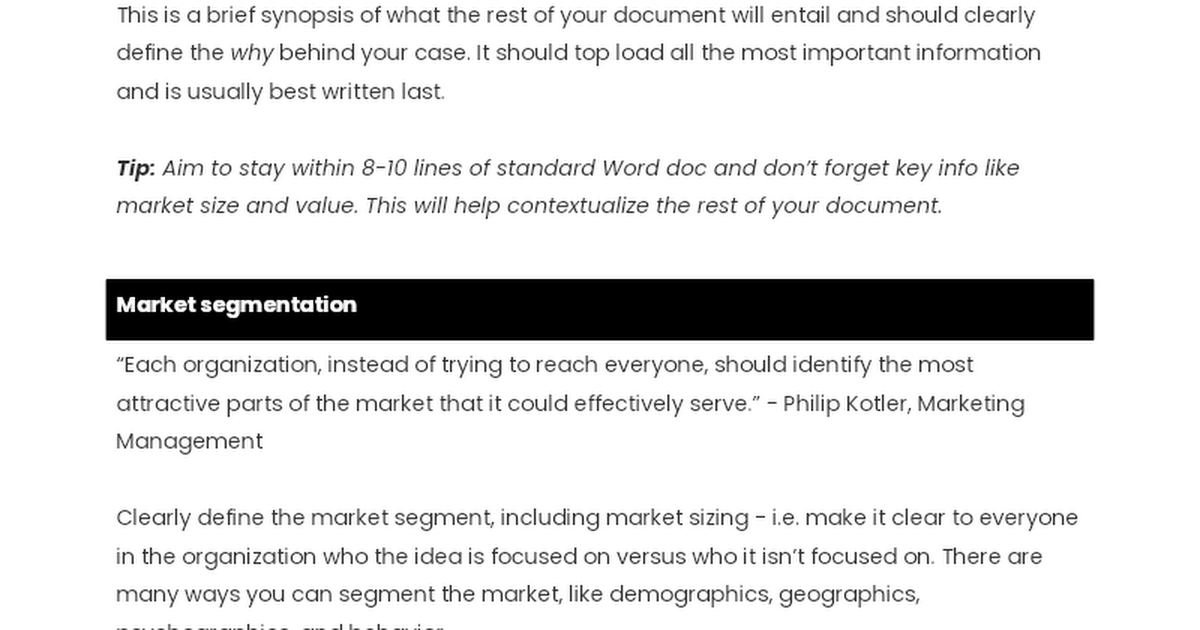
- Executive summary: Start with a brief synopsis of your proposal. Highlight the most crucial points and ensure it clearly defines the 'why' behind your case. Write this section last for maximum clarity and impact.
Tip: Keep it concise, around 8-10 lines, and include key information like market size and value. - Market segmentation: Define the market segment you’re targeting. Explain the market size and characteristics, and specify who your idea is for and who it isn't.
- Current problems: Outline the problems your proposal aims to solve. Provide evidence from customer interviews, support tickets, or market research to validate these issues.
Tip: Use 3-4 bullet points to explain the problems and how you identified them. - Opportunities on offer: Describe the benefits your solution will bring, such as increased market share, revenue, or customer loyalty. Tie these benefits to organizational goals and support them with data.
Tip: Lead with the benefit and back it up with proof. - Competitive summary: Analyze market trends, competitors, and potential opportunities and threats using frameworks like PESTEL.
- Finances: Detail the revenue model and provide a comprehensive cost breakdown. Include charts or graphs for better readability.
Tip: Ensure costs are precise and validated by relevant departments. - Resource requirements: Identify the internal and external teams needed, their roles, and the duration of their involvement. Validate your resource estimates with the concerned departments.
- Timelines: Present a high-level timeline for your project, including key stages and internal approvals needed. Keep it concise and realistic.
Tip: Validate your timelines with relevant stakeholders to ensure feasibility. - Risk assessment: Highlight potential risks, their impacts, and your mitigation strategies. Be honest and transparent to build trust with stakeholders.
Tip: Openly discuss risks to demonstrate thorough planning and preparedness. - The alternatives: Provide a brief comparison of alternative options to achieve the same outcome. Evaluate each based on benefits, costs, feasibility, and risks, and rank them accordingly.
FAQs
Q1: What does a completed business case example look like?
A: Here's a worked example using the same 10 sections as the template above, for a fictional business proposing a dedicated competitive intelligence function. The numbers are illustrative, though the $15,000–$40,000 range for a CI platform license reflects real current market pricing.
Executive summary: Our sales team is losing an estimated 12% of competitive deals due to outdated or missing competitive intel, based on last quarter's win-loss interviews. This business case proposes hiring a dedicated Competitive Intelligence Analyst and licensing a CI platform to close that gap, at a first-year cost of $110,000, with a projected payback inside 9 months.
Current problems: Battlecards are 8+ months old on average and rarely used. Three lost deals in Q3 specifically cited pricing confusion that an up-to-date battlecard would have addressed.
Opportunities on offer: A formal CI function is projected to lift competitive win rate from 38% to 45%, in line with benchmarks from similarly sized SaaS companies running dedicated CI programs.
Finances: CI Analyst salary: $85,000/year. CI platform license: $25,000/year (mid-range for a dedicated platform). Total first-year cost: $110,000. A 7-point win-rate lift on current competitive deal volume is projected to recover roughly $340,000 in year one.
Resource requirements: One new FTE (CI Analyst), reporting into product marketing, plus roughly 10% of an existing PMM's time during onboarding and handoff.
Timelines: Month 1: hire. Month 2: platform implementation and battlecard rebuild. Month 3 onward: live reporting cadence.
Risk assessment: Risk: new-hire ramp time delays impact. Mitigation: ship an interim battlecard refresh using the platform's existing templates in week two, rather than waiting for the full rebuild.
The alternatives: Keeping CI as a part-time responsibility was rejected, since that's the status quo already causing the problem. Outsourcing CI to an agency was evaluated at roughly $60,000/year, but rejected due to a lack of internal, deal-specific context.
That's not every line of a full business case, but it shows how each section moves from a general instruction to a specific, numbers-backed statement, which is the main thing that's hard to picture from a blank template alone.
Q2: What's the difference between a business case, a business plan, and a project charter?
A: They get confused because all three tend to show up early in a project's life, but they answer different questions, for different audiences, in sequence.
Business case: justifies a single proposed investment or initiative to executives, budget holders, and the CFO. Its scope is one decision or project, not the whole business.
Business plan: sets the direction for an entire business or a major new venture, aimed at investors, leadership, and the board. Its scope is the whole business, not a single decision.
Project charter: authorizes and defines a project that's already been approved, aimed at the project team and delivery stakeholders. Its scope is that one approved project's execution, not whether to do it in the first place.
The business plan sets the overall direction. The business case justifies one specific bet within that direction, costs, benefits, and the case for doing it now. The project charter picks up once that bet is approved, and turns it into scope, roles, and a delivery plan. If you're asking “should we do this,” you need a business case. If you're asking “how will we execute this,” you need a charter, and that's the document that follows once this business case gets a yes.
Q3: When do you need a business case?
A: A business case is worth writing when any of the following apply:
- You're requesting a budget or headcount investment above your own spending authority.
- The initiative touches more than one team or function, so people outside your own department need to buy in.
- Leadership is going to ask “what's the ROI,” and you need a documented answer rather than an improvised one.
- You're proposing one option among several credible alternatives, and need to show you've actually weighed the trade-offs.
- The initiative carries meaningful financial, reputational, or operational risk that stakeholders will expect addressed upfront.
- You want a reference document to hold the project accountable to its original goals as it progresses.
If none of these apply, say it's a small, reversible decision that's already within your own budget and authority, a business case is probably overkill. A quick note to your manager will do.
Download your business case template
If you're not already a member, simply sign up for our Insider plan (it's free!) and refresh this page to access your business case template.



Product marketing insider
Thank you for subscribing
Level up your product marketing career & network with product marketing experts.
An email has been successfully sent to confirm your subscription.
 Follow us on LinkedIn


.svg)