





Templates and frameworks to pair with this playbook
- Competitive intelligence newsletter template
- Win/loss analysis presentation
- Market sizing template
- Customer segmentation framework
- RACI matrix template
- Product launch tiers framework
- Quarterly State of the Union template
Nail the skills
Have you ever been asked to produce a battlecard for a deal you didn't even know about? Or to launch a product you didn't know was in development?
If so, you're in good company. Over the past four to six years, I've talked with solo product marketers, managers, directors, and people building PMM functions from scratch, and the pattern repeats at every level. Someone asks for content after the decision has already been made, you deliver, and a few weeks later it happens again.
That reactive loop costs more than your time. It costs PMM its seat at the strategy table. As VP of Product and Business Development at XP Power, I want to help you change that, so your PMM team doesn't have to fight to prove its worth every budget cycle. Here’s what I'll cover:
- Why reactive work limits PMM’s influence, and how AI raises the stakes
- The three engines of the PMM operating system: market intelligence, strategic marketing, and go-to-market
- How an ownership map and a steady rhythm turn those engines into a flywheel
- Where you sit on the PMM maturity model
- Four moves to make on Monday
Your day starts on someone else's clock
You've probably lived this. You're asked for a battlecard after the deal is already at risk. You're asked for messaging after the launch date is set. You're asked for a market view after the roadmap is locked, and you're asked to weigh in when you have influence but no authority.
Those requests lead to three questions that almost every PMM I speak with is wrestling with:
- Where does product marketing belong?
- How do we add value that leadership can see?
- How do I prove we're critical?
They're frustrating questions because product marketing adds value to every function it touches. The reason behind all this confusion and frustration is reactive work. When your week is a series of battlecards and content requests, you end up without a seat at the strategy table.
AI makes that question urgent
AI is compounding this problem. If your job is to produce a piece of content or a deliverable, you're in trouble because with the right context, AI can often do that job faster and better.
Now, more than ever, PMM needs to shift from being an output function to being a decision function.
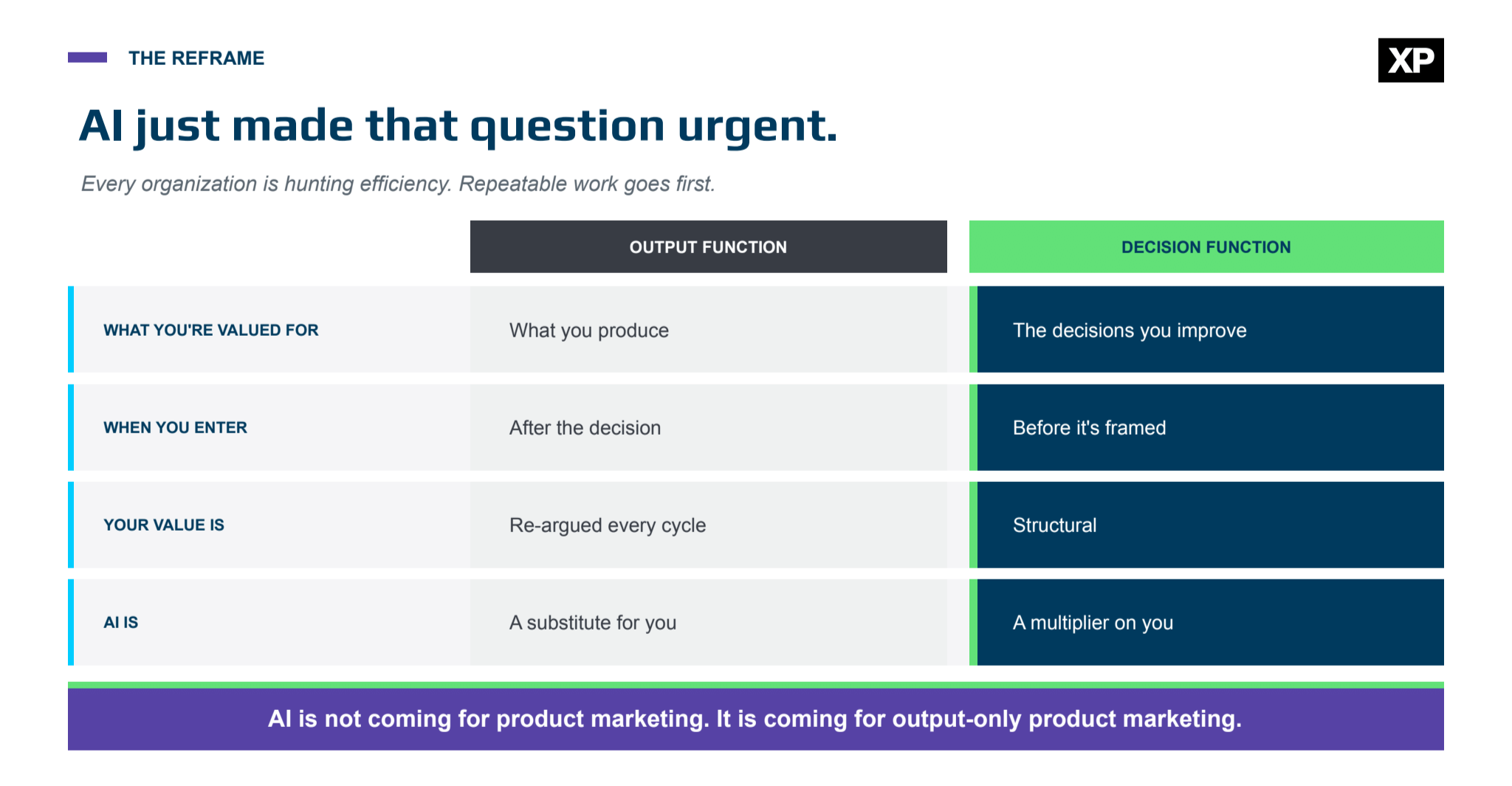
Here's how I think about that shift:
- An output function is valued for what it produces, while a decision function is valued for the decisions it improves.
- An output function only gets to contribute after decisions have been made, while a decision function is there from the start of that decision-making process.
- An output function fights to prove its value every cycle, while a decision function’s value is structural, built into how the business defines its strategy.
- An output function sees AI as a substitute for its work, while a decision function uses AI as a multiplier on its impact.
AI will come for output-only product marketing. A PMM function that improves decisions for the whole company has a much brighter future.
For expert insights like this, in full, every Friday, sign up for Pro+ membership.
You'll also get access to 30+ certifications, a complimentary Summit ticket every year, and 130+ product marketing templates.
So, what are you waiting for?
The PMM operating system
To move away from output-only product marketing and build a more strategic function, you need a system. I call it the PMM operating system.
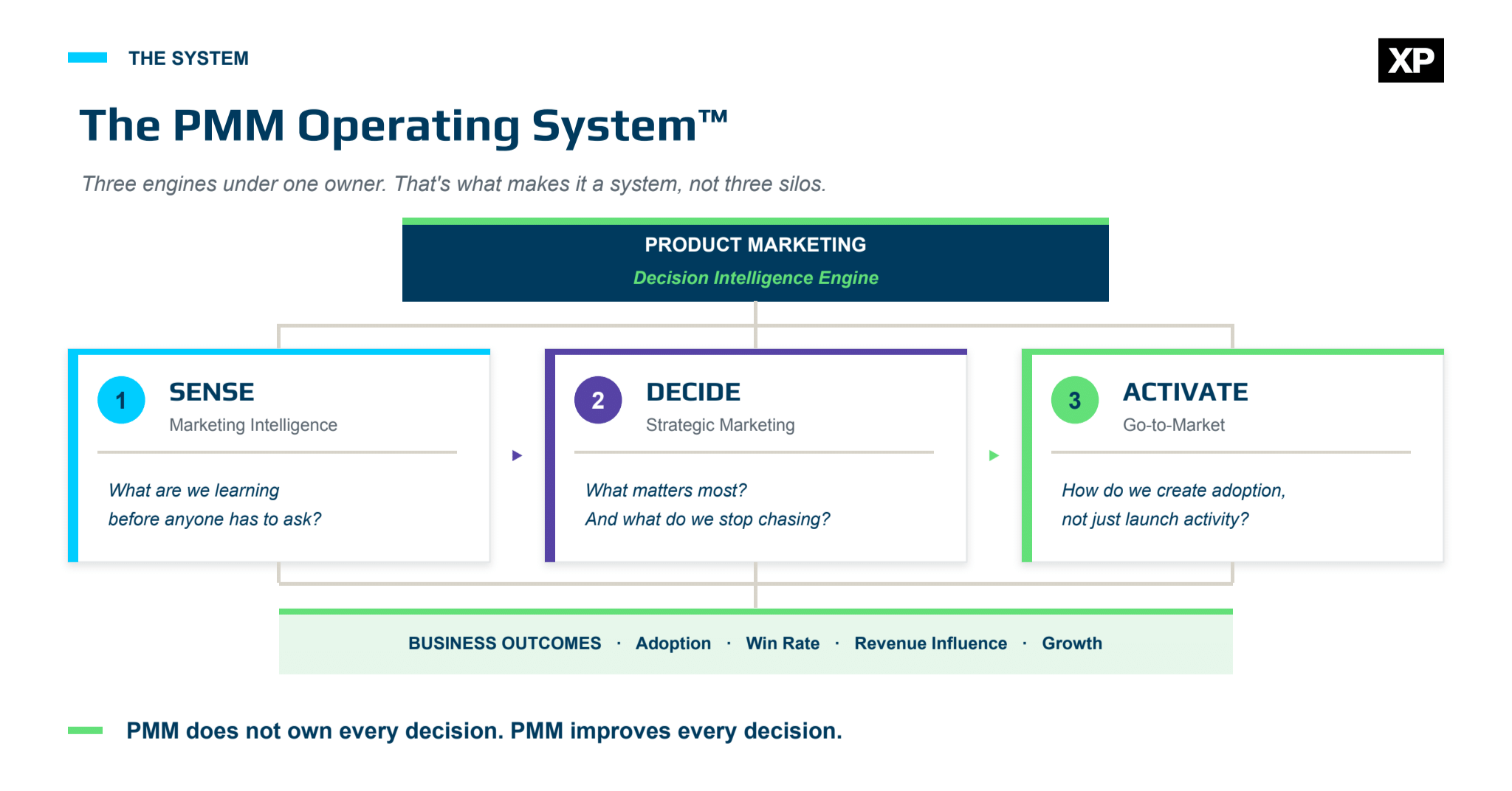
The system has three engines under one owner: market intelligence, strategic marketing, and go-to-market. Chances are, you’re already running some version of all three engines. However, the real question is whether you're running them proactively, and whether each one connects to business outcomes.
Each engine answers one key question:
- Market intelligence: What are we learning before anyone has to ask?
- Strategic marketing: What matters most, and what do we stop chasing?
- Go-to-market: How do we create adoption, not just launch activity?
In this system, PMM improves every decision, even the ones it doesn't own.
Engine 1: Market intelligence
Marketing intelligence covers three areas: the market, customers, and competitors.
On the market side, you're looking at industry trends, geographic signals, and segment-level shifts.
There are plenty of tools to help here, and AI has made this much easier. You can build an agent in Claude (or whichever system you prefer) and start pulling in relevant signals without any major investment. Don't start with the tools, though; start with the problem you're trying to solve. The tools are there to serve the system, not the other way around.


Product marketing insider
Thank you for subscribing
Level up your product marketing career & network with product marketing experts.
An email has been successfully sent to confirm your subscription.
 Follow us on LinkedIn


.svg)