







Templates and frameworks to pair with this playbook
Relevant skills and certifications
Most of us are using AI every day. Enterprise licenses, access to the best models, no token limits getting in the way. That part's sorted.
But have you ever built anything with AI? A tool. An automation. A system that runs without you having to prompt it every single time? Perhaps not.
That gap between using AI and building with AI is value left on the table.
I lead product marketing and content at Ontra, an AI-powered platform for private markets. Over the past year or so, I've been thinking hard about how PMMs can move from being AI users to being AI builders. In this article, I’ll share a framework that's helped me do that, along with a concrete example you can steal.
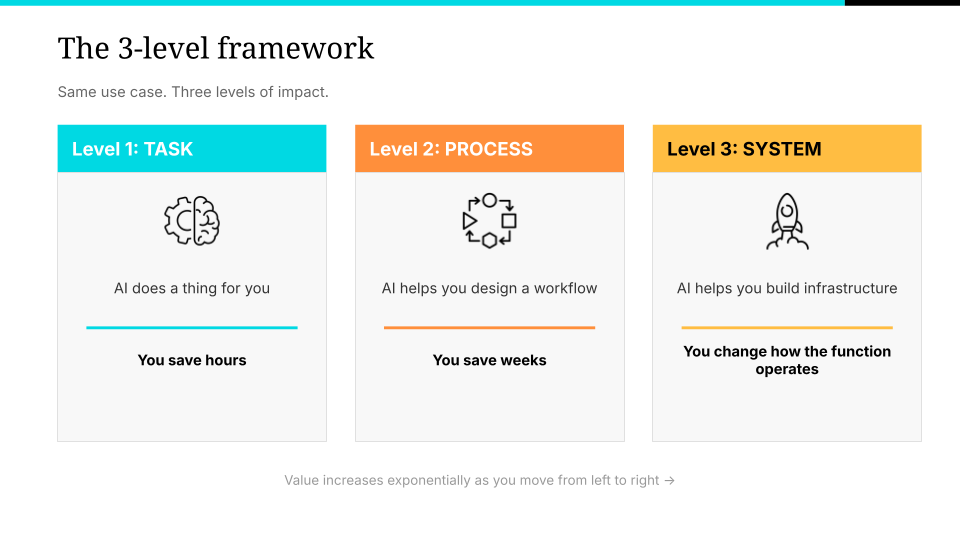
The 3-level framework: Task, process, systems
Think of the framework as a spectrum. On the left, you've got task-level AI use. In the middle, process-level. And on the right, systems-level thinking. The value increases exponentially as you move rightwards.
Level 1: Tasks
This is where most of us live. You ask AI to do a thing, it does the thing, and you save a few hours. It’s useful but limited.
A good example is filling out a battlecard. You feed Claude a bunch of Gong recordings, some product docs, a few competitor pages, and the template you've spent years perfecting. Claude populates the template.
Just six months ago, this process was still painful. You’d have to spend ages fixing the output. Now it's seamless, and it saves hundreds of hours.
The problem with this approach is that you've essentially hired a brilliant contractor who delivers perfect work and then forgets everything the next day. You're the only one getting value from it. Your team isn't. Your sellers are still hunting through a Google Drive folder somewhere. The battlecard goes stale in a few weeks, and you have to start again.
For expert insights like this, in full, every Friday, sign up for Pro+ membership.
You'll also get access to 30+ certifications, a complimentary Summit ticket every year, and 130+ product marketing templates.
So, what are you waiting for?
Level 2: Processes
This is where you start designing workflows rather than just running tasks. It's a meaningful step up.
Using the same battlecard example, instead of manually updating it every month, you build a process where Claude monitors specific competitive channels in Slack. When new intel surfaces, whether from a closed-lost opportunity or a field update, Claude flags it and asks you: "This looks like it might affect your battlecard. Here's how I'd update it. Should I?" And you just say yes or no.
That's a useful unlock. If you haven't explored scheduled tasks in Claude yet, it's worth doing. You can set Claude to run the same task at a fixed cadence, daily, weekly, whatever makes sense. Your battlecard stays fresh without you having to manually trigger everything.
But you're still not quite there. Your sellers are still digging through an 80-slide deck trying to find the right information mid-call. The content exists. The problem is delivery.
Level 3: Systems
This is where product marketers need to focus. Systems-level thinking means using AI to build infrastructure that changes how your function operates, not just how you personally work. The value compounds across your entire company, not just across your own to-do list.
Let me share an example so you can see what I mean.
Real example: The competitive intel Slack bot
I built a Slack bot over a weekend. The insight behind it was straightforward: most of us are on Slack all day.
If you can surface the right information inside the tool people are already using, you remove a huge amount of friction. You don't have to train anyone on a new system. You don't have to convince anyone to change their behavior. The information just shows up where they already are.
The bot runs on four simple Slack commands:


Product marketing insider
Thank you for subscribing
Level up your product marketing career & network with product marketing experts.
An email has been successfully sent to confirm your subscription.
 Follow us on LinkedIn


.svg)