








Templates and frameworks to pair with this playbook
- Win/loss analysis presentation
- Win/loss interview questions
- Win/loss email invite templates
- PMM power-prompts: Market research & competitive intelligence
- Claude setup planner
- Pressure-test your messaging template
- Objection handling script
Relevant skills and certifications
Every product marketer I know is juggling a million jobs. Sales wants to know what to say to win the deal in front of them. Product wants to know what to build next. The exec team wants to know how we capture more market share. It’s on you to give all of them an answer.
AI can help you carry that load, but when you ask it the questions that matter – such as which product gap is costing us deals – it can only work with what it knows. Without the real buyer voice, it guesses.
I’m the Director of PMM and Content at Klue, where we run product marketing as a lean team. In this article, I’ll share how we’re feeding our AI stack buyer intelligence from every deal, including deals we were never in. Here’s a preview of what I'll cover:
- Why our goals haven't changed, even as our tools have
- The four layers of win/loss data that can feed your AI stack
- How interviews with buyers outside our pipeline tightened our positioning
- How we collected win/loss at scale and changed course within one quarter
- Three ways we put the insights to work
Your goals haven't changed, but your teammate has
A little while back, I was chatting with a good friend and product marketer I look up to, Trevor Evans, as part of my Humans in the Loop series.
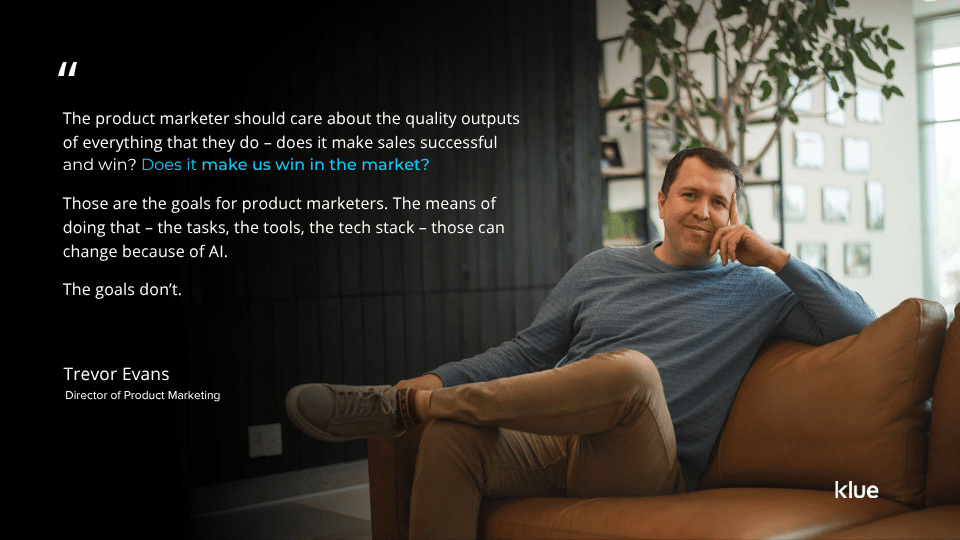
Five minutes in, he said something that grounded the whole discussion. Product marketers should care about the quality of everything they produce: does it make sales successful, and does it help us win in the market? AI may completely change the tasks, the tools, and the tech stack. The goals stay the same.
As product marketers, we exist to help our businesses win more. That's it.
We've got stakeholders pulling us in every direction. Sales needs to know what to say to win the deal in front of them. Product wants to know what to build next, what competitors are doing, and whether any of it even matters. Marketing needs a differentiated story that stands out. And the exec team, underneath every question they ask, is really asking one thing: how do we capture more market share?
We owe all of these people direction. And now, we've got a powerful tool sitting on our laps to help us get there faster.
Most of us already use LLMs daily for product marketing work, whether that's generating battlecards from call recordings, running a positioning and messaging agent, or monitoring what's happening in the market.
It feels like having a new teammate. And as someone who's spent time as a solo product marketer, that's kind of nice.
For expert insights like this, in full, every Friday, sign up for Pro+ membership.
You'll also get access to 30+ certifications, a complimentary Summit ticket every year, and 130+ product marketing templates.
So, what are you waiting for?
Coaching your new teammate
Like any new teammate, AI needs coaching. I'm guessing you’ve scolded your LLM in the past week. Maybe it produced copy that was completely off message. Maybe it misunderstood your question. Or (purely hypothetically, of course!) maybe you ran hours of analysis, realized it had botched some of the data, called it out, and got a very apologetic reply.
As product marketers answering some of the most important questions inside a business, we can't afford to rely on sub-par outputs. So, what do we do? We coach our AI. And to do that well, we have to think clearly about what makes us valuable as product marketers in the first place.
The most valuable role in the organization is the product marketer who understands the buyer, the competition, and the market better than anyone else. That understanding is exactly what we need to hand to our AI teammate.
Win/loss is the buyer intelligence your AI stack is missing
To coach an LLM, you need real answers to hard questions. How have buyer priorities shifted? Which product gap is costing you deals? What do buyers think of a competitor's pricing model? Those answers live outside your four walls.
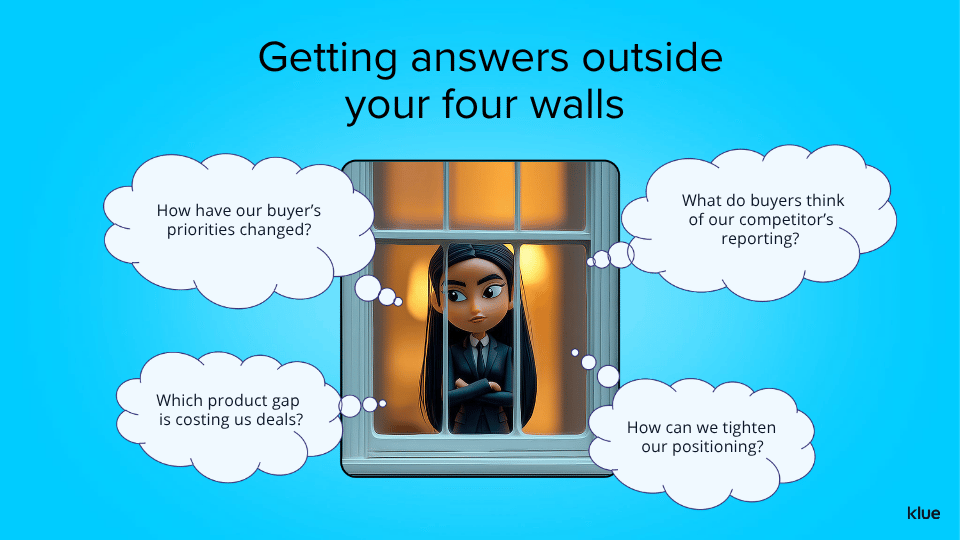
AI can now help us collect voice of buyer data across every deal, from every perspective. I think about it in four layers, and together they give you an unfair advantage.
- Deals you weren't in: Verified evaluators, churned customers, and buyers who evaluated your competitors, never talked to you, and chose them. Using AI, you can source and run interviews with this group.
- Every opportunity in your pipeline: Using your CRM and call recordings, you can build an agent that sends a quick recap when a deal closes, win or lose. It covers buyer requirements, competitors involved, and what tipped the decision, so you aren't relying on the one-word response a seller left in your CRM.
- AI interviews: These give you scaled coverage of buyers in hard-to-reach geographies, or buyers who ghosted you after the first demo. You don't want to spend your own time chasing those interviews.
- Human interviews for strategic deals: This is where humans can't be replaced. These are the late-stage deals your CEO will hammer you on. Run them yourself or bring in a third party.
This is a level of buyer intelligence we never had before, and it can be the brain behind every agent and workflow in your product marketing. Let me share three stories that show what that looks like in practice.


Product marketing insider
Thank you for subscribing
Level up your product marketing career & network with product marketing experts.
An email has been successfully sent to confirm your subscription.
 Follow us on LinkedIn


.svg)