







A technical system architecture for product marketers that wins deals
I still have the last persona deck I ever created in my last organization. It's sitting in a folder on my Google Drive. Eighteen slides. Beautifully designed. Three months of customer interviews. Detailed pain points, goals, and buying criteria for each role.
Sales used it for… maybe two months.
Not because it was bad research, it wasn't. It failed because when a sales rep opened a contact record for "Sarah Chen, VP of People & Culture," the persona couldn't tell them what Sarah specifically needed to hear. Just what VPs of People & Culture generally care about.
In that gap between "generally" and "specifically," we lost deals.
We had two VP of People & Culture prospects in the same month. Same industry. Similar company size. Both fit our "Growth-Stage HR Leader" persona perfectly. Same pitch deck.
The first one was signed in five weeks. The second ghosted us, then bought from our competitor.
VP #1 was analytical and wanted ROI models and benchmarks. VP #2 wanted relationship building and peer validation. We treated them identically. We lost one.
That's when it hit me: I wasn't a bad PMM when I was building personas. I was just using the wrong infrastructure.
The gap isn't in our research skills. The gap is in our systems. While we're still grouping people by job title and industry, the most sophisticated revenue teams have moved to contact-level precision. They're using personality AI, behavioral signals, and transformation mapping to customize every touchpoint.
This isn't about working harder. It's about building smarter infrastructure.
What AI in product marketing actually makes possible
AI in product marketing wasn't ever about Claude writing your messaging or using tools like Chorus or Gong to analyze hidden pain points in sales transcripts. The real shift was in intelligence infrastructure.
AI has made it economically feasible to do things that used to require enterprise budgets:
- Personality prediction from public data.
- Real-time signal detection across thousands of companies.
- Behavioral pattern recognition that can tell you how someone makes decisions, not just what their job title focuses on.
I started experimenting and building small systems, as well as teaching myself APIs, data enrichment, and how to orchestrate AI-powered tools into something coherent.
And I realized: I wasn't ineffective when I was building personas, but I thought about "better messaging" instead of "better systems."
While most PMMs group people by job title, sophisticated revenue teams use AI-powered personality prediction, automated signal detection, and transformation mapping to customize every touchpoint.
This isn't about working harder. It's about understanding what's possible now.
If someone asked me to approach buyer personas today, I wouldn't create another persona deck. I'd build a decision-driving customer model through contact-level intelligence. That's what my learning process has taught me, not just how to survive, but how to actually solve the precision problem that personas never could.
What "living decision- driving customer model" actually means
A living customer model has three characteristics that personas can't deliver:
1. Self-updating intelligence
Your personas require manual quarterly updates. A living model ingests new signals automatically, job changes, tech stack updates, funding announcements, hiring patterns, and flags when a contact's context has changed.
Example: Your champion gets promoted to VP. The model detects this via LinkedIn, updates their influence level in your CRM, and alerts sales: "Decision authority increased. Renegotiation window opened."
2. Individual-level precision
Personas group people ("Enterprise CTOs care about security").
Living models track individuals ("This specific CTO just posted about a security incident”).
Urgency level: High.
Recommended approach: Lead with compliance framework, not product features").
3. Context-aware activation
Static personas sit in decks. Living models trigger actions. When a high-fit prospect shows buying signals, the model doesn't just record it; it generates the specific messaging angle, recommended content, and urgency timeline for that contact.
This is the shift: from "here's what this role cares about" to "here's what this person needs to hear right now based on what just happened in their world."
And seriously, for building this, the barrier isn't the budget. It's architecture thinking.
You don't need massive enterprise platforms to do this. You need to understand how to stitch together the right AI tools in the right sequence, and that's exactly what I had to learn the hard way.
Think of this as the PMM equivalent of the modern data stack. Just as data teams moved from monolithic data warehouses to composable architectures, PMMs can build composable intelligence systems that rival enterprise platforms at a fraction of the cost.
The four layers of a living customer model
Here's the technical infrastructure that enables this. I built this entire system on Clay.com with API integrations to specialized tools. No engineering team required. No enterprise budgets needed.
Layer 1: Identity resolution → "Who are we tracking?"
What it does: Automatically identifies and tracks decision-makers in your ICP without manual list uploads.
How it works in practice:
Traditional approach: Export a list from Sales Nav or Apollo.io, upload to your MAP, and hope it's still accurate in 30 days.
Living model approach:
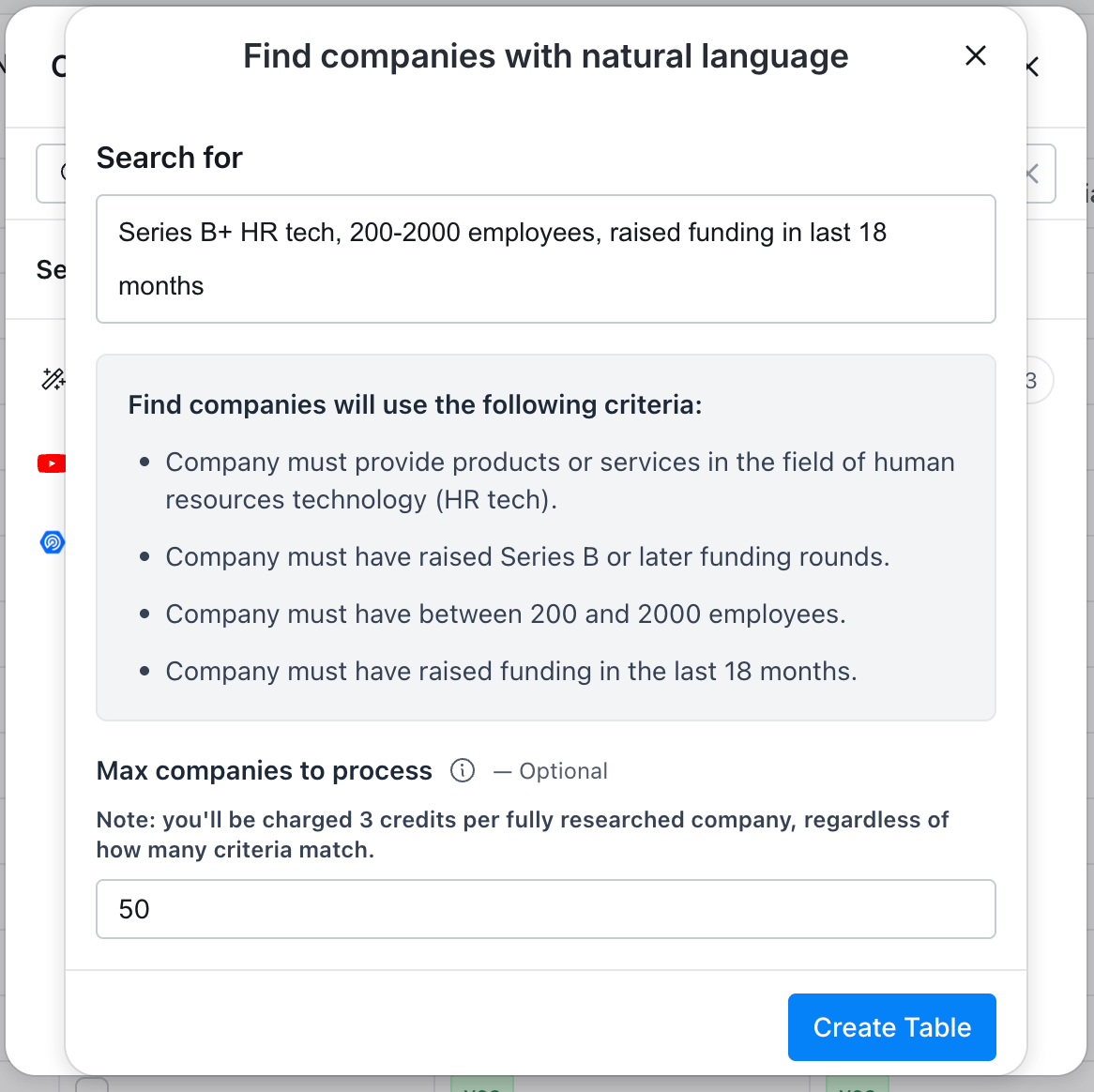
- Define your ICP parameters once: Series B+ HR tech, 200-2000 employees, raised funding in the last 18 months (using Clay’s “Find Companies” feature with natural language)
- Clay monitors company databases (Crunchbase, Harmonic, Builtwith) and automatically identifies new companies that fit
- "Find People" integration pulls decision-makers matching your buying committee criteria
What you get:
- Contact details (name, email, LinkedIn URL)
- Firmographics (industry, size, revenue, funding stage)
- Professional context (tenure, team size, reporting structure)
- Technographics (current tech stack detected from their website)
Layer 2: Behavioral intelligence → "How does this person decide?"
What it does: Predicts communication preferences and decision-making patterns so sales knows how to engage before the first conversation.
How it works in practice:
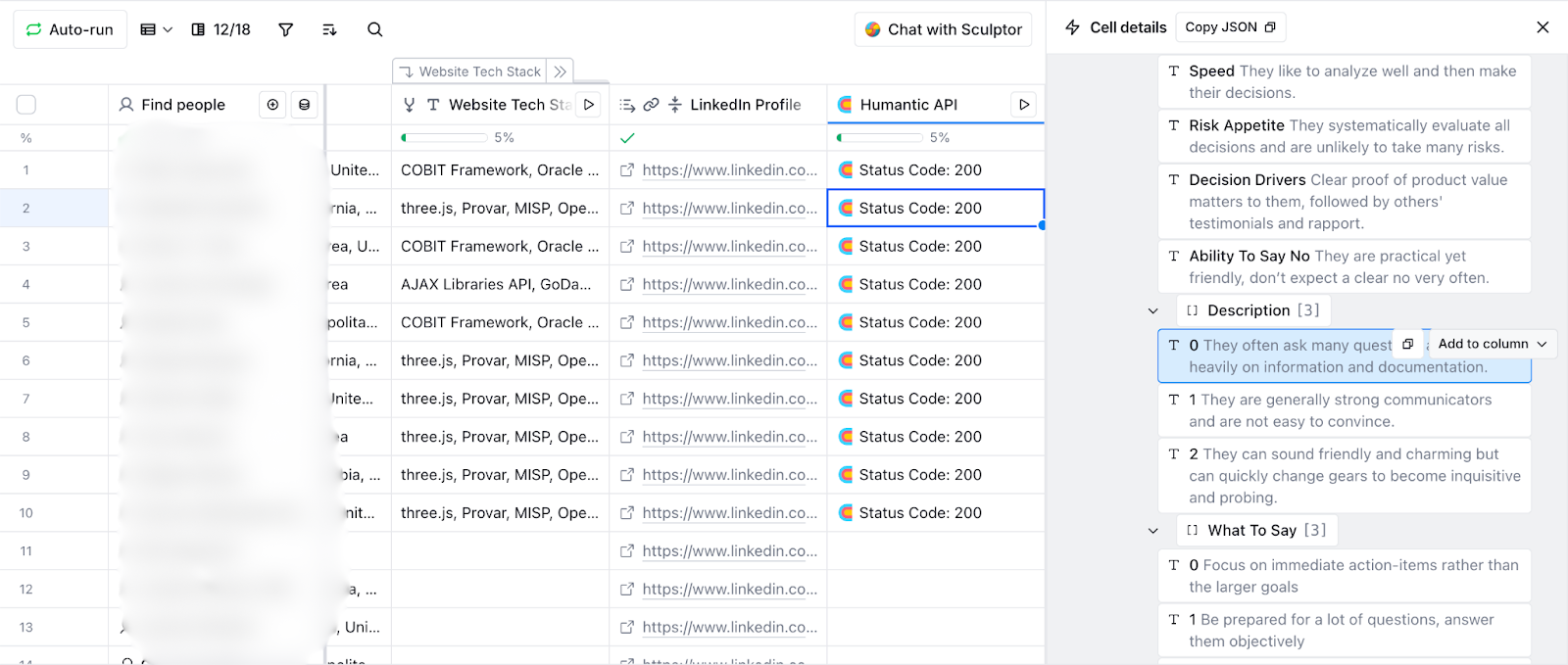
Connect Humantic AI to Clay via API. Humantic analyzes public behavior: LinkedIn activity, writing samples, engagement patterns, and returns personality intelligence that populates custom fields in your CRM.
What sales sees when they open a contact record:
"High C (Conscientious) profile. Prefers detailed documentation before calls. Decision speed: Slow (requires consensus). Recommended approach: Send technical comparison doc before meeting. Expect 2-3 stakeholder validations."
Create these as templated guidelines in your CRM. When sales opens a contact record, they immediately see which approach to use, no custom request required.
Important caveat: Personality AI is predictive, not definitive. Accuracy ranges from 70-85%. Use it as a starting point, not gospel. Sales should adapt based on actual conversation dynamics.
Layer 3: Signal-driven transformation mapping → "What just changed in their world?"
Here's what took me too long to understand: pain points don't drive purchases. The gap between the current reality and the required future state does.
Traditional personas list generic pains ("needs better reporting"). They don't map the complete transformation: what's broken today, what success looks like tomorrow, and all the friction in between.
How it works:
Clay monitors behavioral changes that correlate with buying readiness:
- Growth signals: Hiring 10+ sales reps in 90 days, new office openings, Series B+ funding
- Change signals: New VP hired, tech stack changes (competitor removed), company rebranding
- Distress signals: Negative reviews mentioning pain points, security incidents, compliance requirements
For each high-intent signal, document five transformation elements:
Example: Signal detected = Company removed competitor from tech stack
- Current pain: Previous solution failed to deliver ROI. The team lost trust in the vendor. Operating without critical capability while evaluating alternatives under time pressure.
- Business impact: Operations degraded. Manual workarounds burning 15-20 hours weekly. The executive team was frustrated. Procurement skeptical of new vendors after a failed implementation.
- Current state: Just cancelled solution. Using temporary workarounds. Active evaluation, decision window is 2-4 weeks before operations degrade further.
- Ideal state: Fast implementation with guaranteed ROI milestones. Vendor that delivers on promises. Out-of-box solution. Strong customer success support.
- Buying criteria: Proven track record with similar situations. Implementation under 2 weeks. Performance guarantees. No long-term contract after vendor failure.
Urgency indicator: Hot signal. 2-4 week evaluation window. They're actively searching now.
This intelligence populates your CRM automatically. Sales doesn't request it. You don't manually create it for each deal. The system generates it when signals fire.
Layer 4: Activation layer → "What should we do right now?"
What it does: Pushes intelligence to the systems where revenue teams actually work: CRM, Slack, email, and triggers specific actions based on what the model detects.
The problem this solves:
Intelligence that lives in spreadsheets doesn't get used. It needs to surface exactly when and where decisions are made.
How it works in practice:
All enrichment data, personality intelligence, and signal detection flows into structured CRM fields that I designed specifically for sales activation.
Custom CRM fields you can create:
Personality and communication:
- DISC profile type
- Communication preference (data-driven / relationship-driven / consensus-driven)
- Decision-making style (autonomous / consensus)
- Decision speed (fast / medium / slow)
Buying intent and context:
- Intent level (researching / evaluating / deciding)
- Active signals (hiring spike, funding, leadership change, tech stack change)
- Signal urgency (hot / warm / monitoring)
- Signal detection date
Competitive and positioning:
- Current tech stack
- Known competitors
- Competitive awareness level
Engagement and content:
- Preferred content types
- Last content consumed
- Objection history
Buying committee role:
- Influence level (champion / economic buyer / technical buyer)
- Decision authority
Recommended actions:
- Messaging approach
- Recommended content
- Last intelligence update (timestamp)
What this enables:
Sales opens a contact record. Instead of generic notes or blank fields, they see:
"High C profile. Requires detailed documentation before engagement. Active signal: Just hired new Director of HR (suggests growth mode). Urgency: Warm. Recommended approach: Lead with scalability case study from similar company. Attach technical implementation guide before first call."
Automated workflows you can build:
- High-urgency signal detected → Slack alert to assigned AE with pre-written outreach template specific to the signal type
- Personality profile completed → CRM task created: "Review recommended communication approach before next touchpoint"
- Competitor removed from tech stack → Automatic email sequence triggered with transformation-specific messaging
- Champion promoted or changed roles → Alert to AE: "Decision authority changed. Re-qualification needed. New context available in CRM."
Real use case:
Contact record for "David Chen, VP of Sales, Series B SaaS company."
Traditional CRM data:
- Title: VP Sales
- Company: TechCo
- Last activity: 47 days ago
- Stage: Prospect
Living model data:
- DISC profile: High D (wants ROI, speed, competitive edge)
- Recent signal: Company raised Series B ($24M) 12 days ago
- Hiring activity: 8 sales roles posted in last 30 days (growth mode confirmed)
- Tech stack: Currently using Competitor A, also uses Salesforce, Gong
- Signal urgency: Hot (growth capital needs deployment soon)
- Recommended approach: "Lead with time-to-value metrics. They're scaling fast and need tools that work immediately. Emphasize implementation speed and sales team ramp time reduction. Use Series B SaaS case study."
- Suggested first line: "Saw you just raised your Series B! Congrats. Noticed you're hiring 8 sales roles. Most teams at your stage hit a wall around rep #15 when onboarding takes longer than quota attainment. Worth a conversation about ramp time?"
The failure modes nobody talks about
This isn't magic. Here's what can go wrong:
Data accuracy issues: Personality predictions are 70-85% accurate. Enrichment data can be outdated. Signals can be false positives (hiring spike for unrelated department).
Solution: Treat this as directional intelligence, not absolute truth. Sales should validate assumptions in the first 30 seconds of conversation.
Maintenance burden: APIs break. Data sources change. Enrichment costs compound at scale. You'll spend 2-4 hours monthly maintaining this infrastructure.
Solution: Build monitoring into your workflow. Set up alerts when enrichment costs spike or data quality degrades.
Privacy and ethics: Personality profiling from public data raises legitimate concerns. GDPR requires consent for certain processing.
Solution: Work with legal to ensure compliance. Be transparent about data usage. Don't profile individuals in regions with strict privacy laws without explicit consent.
Organizational resistance: Sales might not trust AI-predicted personality types. Leadership might not see the ROI immediately.
Solution: Start small. Run A/B tests with 20% of your pipeline. Show conversion rate differences. Let the data prove the value.
Where personas still matter
This isn't "personas are dead." It's "personas are foundational, not sufficient."
You still need personas for:
- ICP definition (which accounts to target)
- Content strategy (which topics to cover)
- Messaging architecture (core value props by role)
Contact-level intelligence sits on top of this foundation. It answers: "Given this persona, how do I customize for this specific individual?"
Think of it as precision layering:
- Persona: Defines the target (VP Sales, growth-stage SaaS)
- Contact intelligence: Customizes the approach (analytical vs. relationship-driven)
- Signal mapping: Creates urgency and context (hiring spike = transformation moment)
All three layers working together.
The real question
The future of product marketing isn't "more personas" or "better messaging."
It's whether you can build intelligence infrastructure that connects behavioral signals to transformation context in real time.
Most PMMs will keep building personas because it's comfortable. It's what leadership expects. It's what the templates tell them to do.
But the ones who learn to build contact-level intelligence who understand that precision is now economically viable will win deals while everyone else debates whether their personas need quarterly updates.
You don't need enterprise budgets anymore. You need architectural thinking.
Start small: pick 100 high-value contacts, run them through this stack, measure conversion rates against your control group.
The data will make the case better than any persona deck ever could. That's how you win deals in 2026.


Product marketing insider
Thank you for subscribing
Level up your product marketing career & network with product marketing experts.
An email has been successfully sent to confirm your subscription.
 Follow us on LinkedIn


.svg)
Start the conversation
Become a member of Product Marketing Alliance to start commenting.
Sign up now