








Templates and frameworks to pair with this playbook
Relevant skills and certifications
Open LinkedIn on any given day, and you'll find a dozen posts telling you you're already behind on AI. Get to your desk, and leadership hands you the same mandate: start using AI, now.
It's loud, it's constant, and it says absolutely nothing about what this new world of AI usage should actually look like on a Tuesday afternoon for a product marketer.
I've been doing product marketing since before I knew that was even a thing. I joined Salesforce about seven years ago, and I've worn a lot of hats since then: go-to-market lead, core PMM, and now head of our outbound team, covering events, digital, and social alongside our campaigns team.
Over the past year or so, my team has tried to answer that Tuesday-afternoon question for real. Not just how to get individually faster with AI, but how to make PMM itself more valuable because of it. We got some things right. We also got some things badly wrong, and I want to walk you through both.
In this piece, I'll cover:
- Why treating AI as a personal productivity boost failed to make PMM more valuable
- Why context, the thing PMM has always owned, doesn't scale unless you turn it into infrastructure
- What we borrowed from fintech company Ramp's playbook for shared AI infrastructure
- What that infrastructure actually looks like inside Salesforce today
- Three tips for rebuilding PMM in the AI era, without waiting for someone else to hand you the playbook

For expert insights like this, in full, every Friday, sign up for Pro+ membership.
You'll also get access to 30+ certifications, a complimentary Summit ticket every year, and 130+ product marketing templates.
This month only: Save up to 299 USD with code SUMMER26.
Why "just go faster" wasn't the answer
As product marketers, we're used to ambiguity. Distinguishing signal from noise is basically the job description. So, when presented with a raft of AI tools, most of us did what we do best: with a mandate but no map, we went and figured it out.
We put our heads down and got faster and smarter with tools like ChatGPT and Gemini. We were suddenly able to pump out first drafts for demo scripts. We could generate webinar briefs. We started to infuse industry context into our messaging and spin up talk tracks for events. All of that was useful. All of it was real progress.
Then we tried to extend that same instinct to the teams we serve. At Salesforce, we started dumping the first-call decks, product deep dives, and FAQs that sales weren't using into NotebookLM, so reps could interact with it conversationally.
On paper, that felt like a huge step forward. They'd finally adopt our messaging, right?
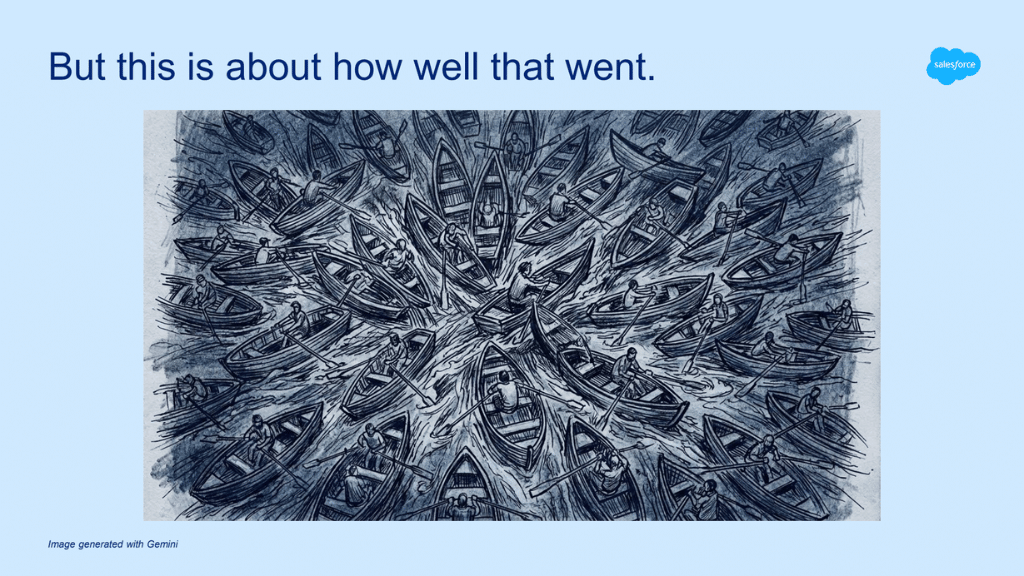
Here's how that actually went: hundreds of people rowing in different directions. It created chaos, not scale. We had no way to tell if sales was actually adopting these tools, or who'd rebuilt the same thing seven times over, or whether sales even needed what we were building in the first place. It wasn't doing what we needed it to do.
The uncomfortable data point
That's when we stepped back and noticed something a little uncomfortable: all of that individual productivity that AI had unlocked wasn't making the product marketing function any more valuable.
There's data behind this. I've been listening to the AI Daily Brief podcast (highly recommend it), and one episode references a PwC study finding that nearly three-quarters of AI's economic gains are being captured by just the top 20% of companies. It's the 80/20 principle again.
What separates that top 20% is that they're not treating AI as a productivity tool. They're treating it as a growth tool, one that creates new work and opens new opportunities, rather than just doing existing work faster.
One line from that episode stuck with me:
"AI has made every individual 10x more productive. No company has become 10x more valuable as a result."
Product marketing's whole job is building value for our companies, so shouldn't we be the ones figuring out how AI actually gets us there?
Nobody has the full playbook for that yet, and we don't have it all figured out at Salesforce either. But let me share what we're doing to get closer.
PMM is the context layer, but context doesn't scale
PMM has always had one thing that nobody else in the org can quite replicate: context. We understand the customer, the market, the stakeholders, the product, and the competitive landscape all at once.
AI helps us unlock that context, not by making us faster, but by turning what we know into something the rest of the org can actually use to move.


Product marketing insider
Thank you for subscribing
Level up your product marketing career & network with product marketing experts.
An email has been successfully sent to confirm your subscription.
 Follow us on LinkedIn


.svg)