





A new trend is emerging across product organizations. Teams are testing ideas faster, releasing capabilities more frequently, and beginning broader rollouts as soon as results show promise. What once took months can now happen in weeks or even days.
The productivity gains of using AI in the development process are real. In one controlled study, developers using GitHub Copilot completed a coding task 55 percent faster than developers working without it.
But faster product delivery creates a difficult question for product marketers:
What happens when the product can ship faster than the organization can effectively bring each release to market?
AI has compressed development cycles, but it has not changed what it takes to build positioning, prepare go-to-market teams, and introduce a clear product story. When the release calendar becomes the marketing calendar, internal audiences struggle to keep up while customers see a sequence of feature updates instead of a clear point of view.
The answer is not to slow product delivery. It is to become more intentional about how each release reaches the market.
In this post, I will share how I use launch tiering to choose the right go-to-market motion, along with three approaches I have used to manage high-volume roadmaps.
When release velocity outpaces launch readiness
Release velocity and launch readiness operate on different timelines.
A product team can release a capability as soon as it is technically ready. However, product marketing still needs time to validate the audience, sharpen the positioning, and connect the release to a broader story.
The rest of the go-to-market organization needs time as well. Sales needs to understand which opportunities the capability supports. Customer Success needs to know which customers will benefit. Solutions teams may need to update demos while campaign teams need enough context to build a cohesive narrative.
Externally, buyers may miss improvements that are relevant to them because those updates are surrounded by messages that do not apply to their needs. Research led by Gloria Mark found that people spend an average of about 47 seconds on one screen before shifting their attention elsewhere. Announcing something once does not mean the intended audience noticed it, understood it, or remembered it.
Nobody is waiting for the next announcement, and every launch still has to answer the same question:
Why should I care?
An overloaded launch calendar also creates pressure to use AI to generate the positioning, campaign copy, and sales enablement required to keep up. AI can organize information, synthesize research, and pressure test early ideas, but it cannot compensate for unclear positioning.
Product marketers ultimately own the strategic decision of how each release should enter the market. Whether it warrants a full market launch, should be incorporated into a broader narrative, or is best activated through a targeted customer motion. This judgment determines whether a release drives meaningful market impact and revenue contribution, or simply adds to noise.
Use tiering to choose the right go-to-market motion
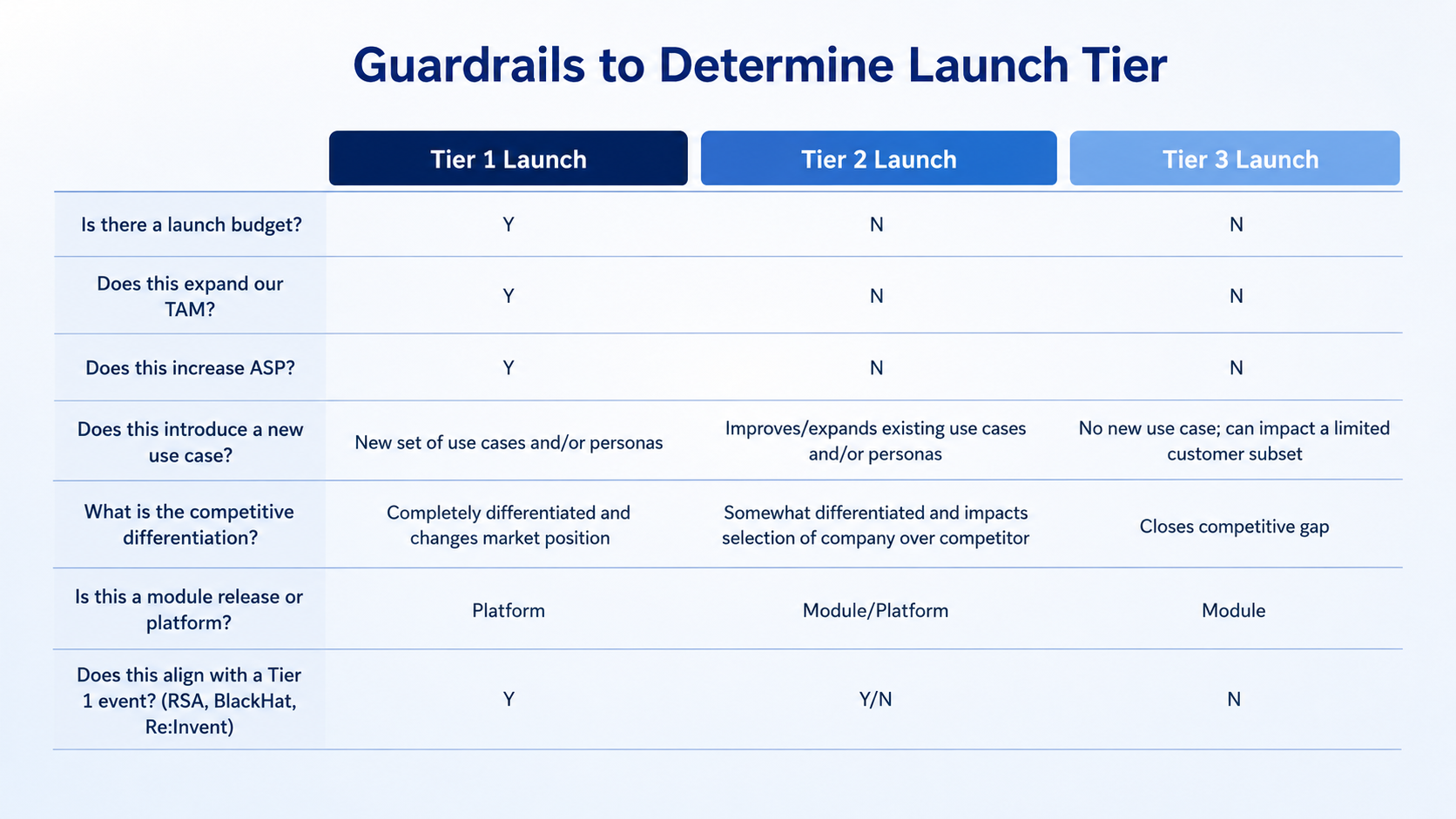
Launch tiering is often used to determine how much support a release receives. In an environment where product teams can ship every week, it should serve a more strategic purpose by identifying the motion most likely to create a meaningful outcome.
A Tier 1 release may introduce a new product, enter a new market, or represent a significant shift in company strategy. It deserves a dedicated launch because the business needs broad awareness, internal readiness, and a coordinated market response.
Tier 2 releases add meaningful capabilities, expand an existing use case, or strengthen the company’s competitive position. They matter, but they do not always need independent launches. They may create more impact when aligned to a central campaign theme or combined into a larger launch.
Tier 3 releases typically improve the experience for existing customers. They may simplify a workflow, enhance reporting, or extend an integration. These improvements can create substantial customer value without changing the company’s overall market position.
The tier should determine which audience needs to understand the release, what action the business wants that audience to take, and which motion is most likely to produce that outcome.
Pro tip: Use AI to build your first release tiering model
Provide AI with criteria such as revenue impact, target audience, new use cases, competitive differentiation, customer impact and required cross-functional effort. Ask it to create a draft scoring model, intake form and recommended motion for each tier.
AI can help apply the framework consistently, but product marketing should make the final call based on market context, customer relevance, and organizational capacity.
How I have managed release velocity in practice
Tiering provides the decision framework, but it does not prescribe one answer for every release. The right approach depends on the audience, the significance of the story, and whether several releases become more meaningful when presented together.
Build a market story around a central theme
When several releases support the same business outcome, I organize the go-to-market strategy around that outcome rather than the individual release dates.
I used this approach during a quarter when several feature enhancements on the roadmap supported a central theme of improving DevSecOps. We were releasing smaller capabilities, including guided remediation and improvements to our security scanner. Each could have been promoted independently, but together they addressed a much larger problem for our ICP.
We built an integrated campaign around one question: How can organizations turn DevSecOps from an aspiration into a repeatable operating model?
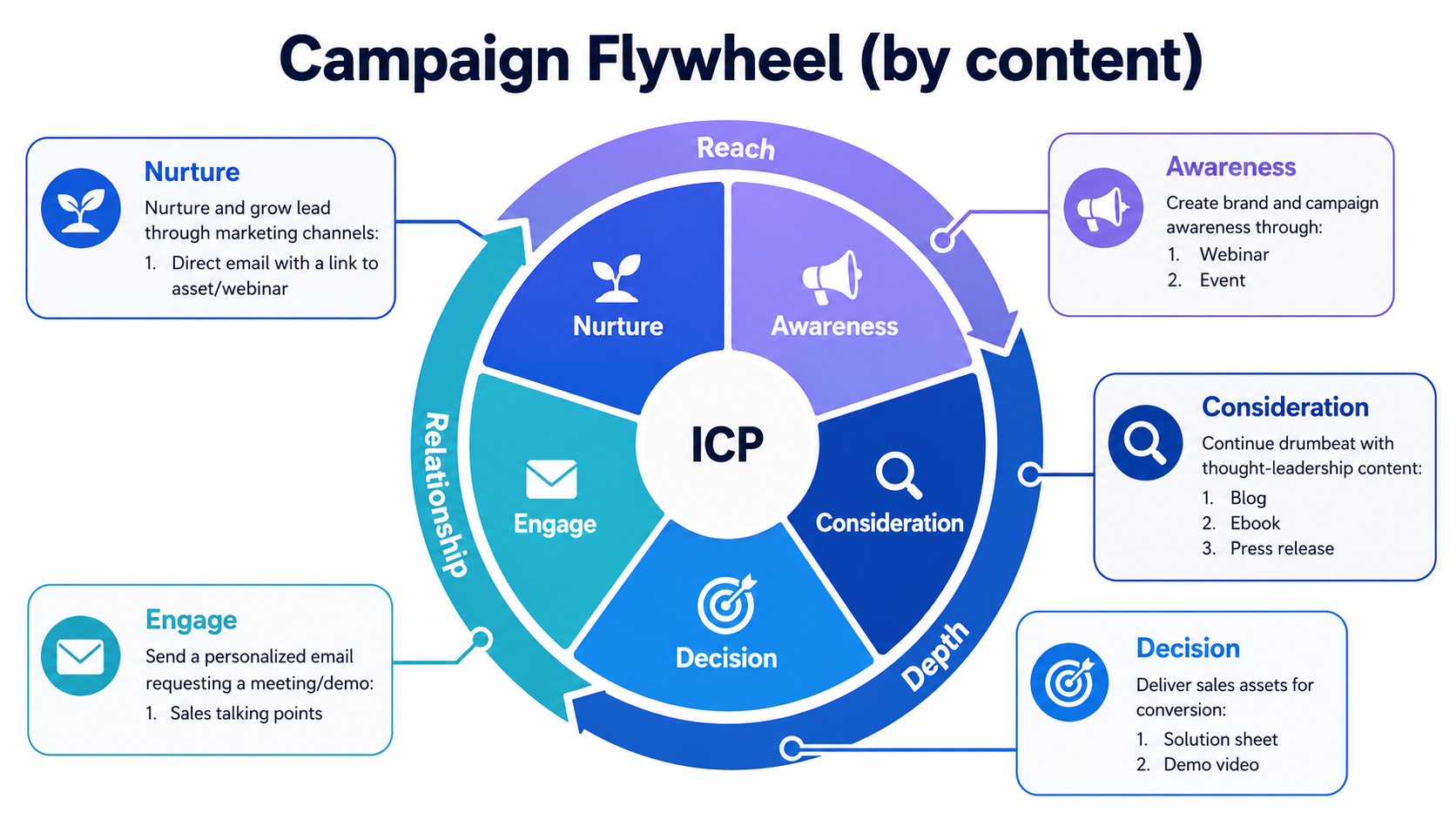
That question became the foundation for the DevSecOps: Making It Happen campaign. We ran the campaign throughout the quarter, organizing the go-to-market team around this central theme and building a campaign flywheel designed to create momentum over time.
The flywheel started with awareness content that established the problem, including webinars and events. From there, we kept the drumbeat going with consideration-stage content such as blogs, ebooks, and a press release. We then supported decision-making with sales-focused assets like a solution sheet and demo video.
Finally, we kept prospects engaged through nurture motions, including direct follow-up tied to key assets and webinars, along with sales talking points to help move conversations forward.
Instead of treating each asset as a standalone deliverable, we used each piece of content to create the next interaction. The new product capabilities served as proof within a larger story rather than competing as separate announcements.
The impact of this integrated program was substantial. Because the entire go-to-market team was aligned around a single market story, that consistency translated into measurable results with our ICP: 783 new contacts, 519 marketing qualified leads, 13 introductory sales calls and $1.1 million in influenced pipeline.
This approach works best when several releases contribute to the same customer problem but do not need to become available at the same time. Product can continue shipping while product marketing gives the market one clear story to understand.
Turn smaller releases into a different motion
Smaller Tier 3 releases are often intended to improve the product experience for existing customers. They may include bug fixes or competitive catch-up features that create value without changing the broader market story.
These are not the types of announcements that warrant a demand generation campaign, but release notes alone rarely give customers enough context to understand why an update matters.
One way I approached this was by creating a recurring Product Pulse program that gave these releases a more useful path to customers. We grouped updates into a predictable monthly cadence and explained each capability through the customer problem it addressed.
I have also created enablement kits for Customer Success with a concise overview of what changed, which customers would benefit, suggested messaging, and guidance for demonstrating the capability.
This allowed Customer Success Managers to bring relevant updates into existing account meetings, adoption reviews, and quarterly business reviews. By meeting customers within conversations that were already happening, we could take a more consultative approach to feature enhancements instead of simply relying on release notes.
The measure of success changed with the motion. I cared less about broad awareness and more about whether the intended customers discovered the capability, used it, and saw additional value. Adoption data, customer feedback, and renewal or expansion signals provided a more meaningful view of impact.
This approach gives smaller releases more strategic support than a release note without asking the broader go-to-market organization to absorb a new story for every product improvement.
Bundle medium releases into one major tier 1 launch
Several Tier 2 releases may be meaningful without being large enough to command sustained market attention on their own. In these cases, I have bundled related capabilities into a coordinated Tier 1 launch, often anchored around a major industry event.
At the RSA Conference, we brought together capabilities across risk visibility, business risk quantification, AI-assisted investigation and automated response. Each delivered real customer value, but individually they would not have created a cohesive market story.
Together, they formed a more complete narrative. Customers could understand their risk, evaluate the business impact and take action faster through a more connected experience. The broader transformation became the center of the launch while the individual capabilities served as proof.
RSA gave us a concentrated moment to bring that story to market through teaser content, a press release, booth demos, executive meetings, analyst briefings and customer conversations.
This required tight coordination with product and engineering. We worked backward from the event date to confirm what would be ready, what could be demonstrated and which claims the product could support. The launch narrative had to reflect what customers could actually experience, not what was still on the roadmap.
A marquee event can amplify a strong launch, but it cannot create the story. The releases still need to address a connected customer problem and collectively represent a meaningful shift in product capability.
When those conditions are met, bundling gives several medium releases more impact than they would have individually while giving the market a clearer narrative and go-to-market teams a focused moment to prepare.
Key takeaways for PMMs
When product teams release faster, product marketing should not respond by creating more launches. The opportunity is to become more deliberate about which releases need a market moment and which require a different path.
Do not let the release calendar become the marketing calendar. Product availability should inform the go-to-market plan, but it should not automatically determine when or how the market hears the story.
Use tiering to choose the motion, not only the asset list. The tier should clarify the audience, desired action and most appropriate way to introduce the release.
Build the story around the customer outcome. When several releases support the same problem, organize the campaign around that problem rather than asking the audience to understand each capability independently.
Give smaller releases a meaningful path to customers. A Customer Success motion can create more adoption and account value when a release primarily benefits existing users.
Measure success based on the motion. Broad awareness may matter for a Tier 1 launch while adoption, renewal and expansion signals may provide a better view of impact for a Tier 3 release.
Product marketing turns release velocity into market impact
AI will continue to accelerate how quickly product teams experiment, build and release. The strategic role of product marketing is to determine how that velocity translates into market impact and business value.
That means launch planning cannot be reduced to a checklist of assets or a communications calendar. Product marketing must evaluate the significance of each release, identify the audience that will care, choose the right go-to-market motion, and define the outcome the business should expect.
Sometimes that means creating a major market moment. In other cases, it means building a broader campaign story, activating Customer Success, or holding a release until it strengthens a more meaningful narrative.
These decisions elevate product marketing beyond tactical execution. They position PMMs as strategic operators who connect product investment to customer demand, revenue opportunities, and measurable business outcomes.
Release volume alone does not create growth. Market impact comes from the choices product marketing makes about where to focus, which stories deserve attention, and how each release can contribute to adoption, expansion, pipeline, or revenue.


Product marketing insider
Thank you for subscribing
Level up your product marketing career & network with product marketing experts.
An email has been successfully sent to confirm your subscription.
 Follow us on LinkedIn


.svg)
Start the conversation
Become a member of Product Marketing Alliance to start commenting.
Sign up now