













There is a conversation happening inside nearly every B2B company right now. It usually sounds like this: the product is getting better, the roadmap is full, the team is shipping, but deals are taking too long to close, churn is quietly climbing, and the story the sales team tells on Monday morning is different from the one marketing published on the website last week.
Nobody can quite explain why the company isn't growing the way it should.
The answer, more often than not, isn't a product problem. It's not a sales execution problem. It's not a pricing problem. It's a narrative problem. And it's costing your company more than you think.
Product marketing managers are supposed to solve exactly this. In theory, they are the architects of how the market understands, values, and buys what a company builds.
In practice, most PMMs are buried in launch decks, feature announcements, and reactive collateral requests, executing brilliantly on the wrong things.
This article is about that gap. About how real, strategic, pull-based narrative is the mechanism that connects product value to revenue outcomes. And about how the PMMs who understand this are quietly building the most defensible competitive positions in their categories.
The problem most PMMs aren't willing to name
Ask a founder why growth has stalled, and you hear about product gaps or sales execution. Ask their PMM, and you get answers about the need for better content, more campaigns, and a cleaner positioning doc.
Nobody in the room points at the actual fault line: the market doesn't understand, clearly and viscerally, why the problem your product solves is costing them right now.
This isn't a messaging failure. It's a depth-of-problem failure.
Most B2B PMMs today describe the problem at the surface level, acknowledging it exists, listing its symptoms, then quickly pivoting to the solution. What they rarely do is make the buyer sit with the problem long enough to feel its weight. And that missing weight is precisely why the solution never lands with the force it should.
Consider the difference between these two framings of the same problem:
Version A:
Most B2B sales teams struggle with fragmented pipeline visibility, which leads to missed forecasts.
Version B:
Every Monday morning, your VP of Sales opens the CRM and sees a pipeline that looks healthy on paper and knows, instinctively, that at least 30% of it's noise.
She can't prove it yet. So she runs the week on a forecast she doesn't trust, makes resource calls she can't fully justify, and carries the quiet anxiety of knowing she will have to explain a miss she saw coming.
Both describe the same problem. Only the second makes the buyer stop scrolling. It creates identification when the reader sees themselves in the story before a solution is ever mentioned. That identification is the beginning of pull.
Most PMMs never go to this level because they are trained to move fast from problem to solution. The instinct is understandable. But it short-circuits the very mechanism that makes narrative work, i.e., tension. Without tension, without giving the buyer enough time to feel the cost of the status quo, there is nothing for the solution to release.
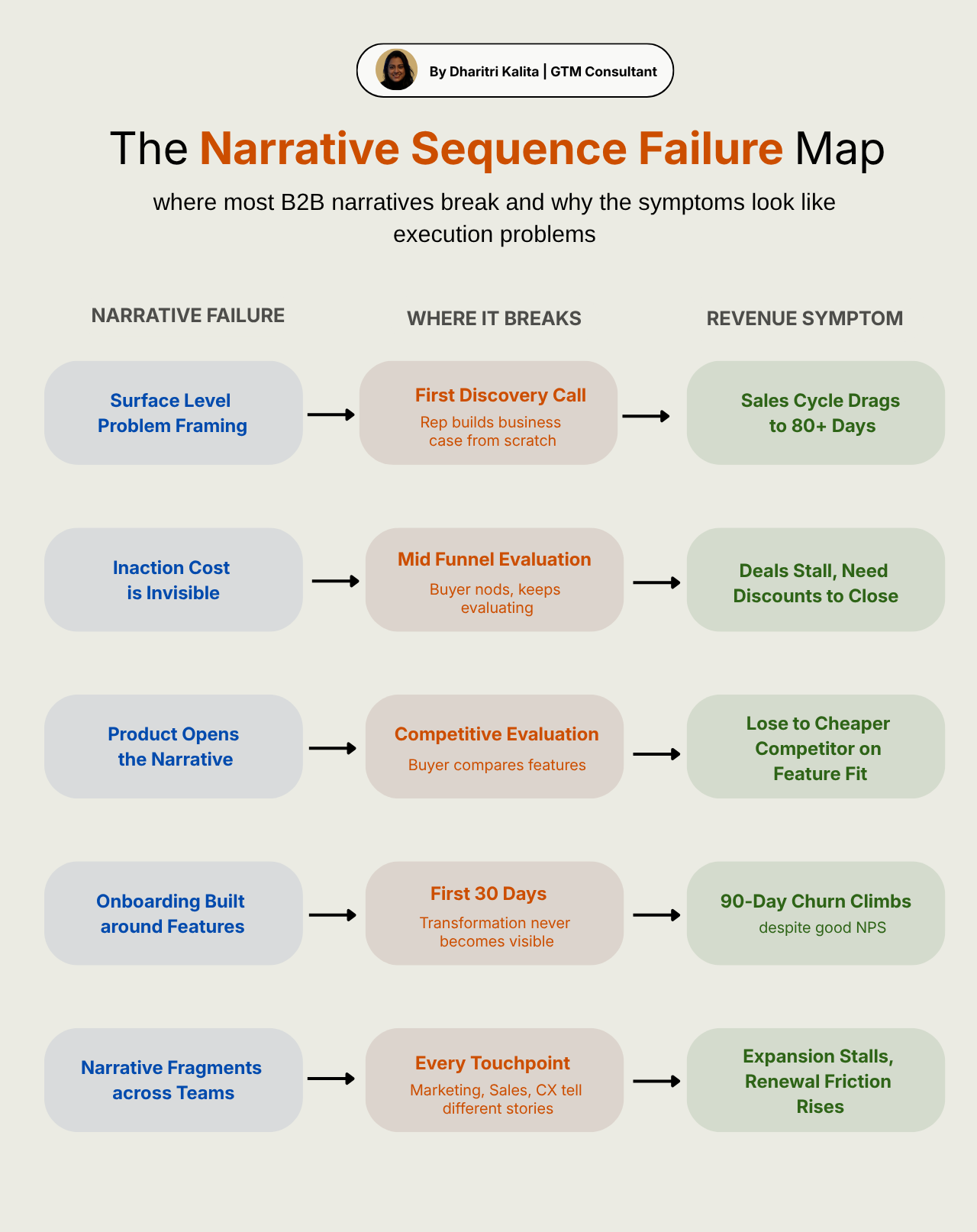
When this depth is missing upstream, everything downstream suffers. Sales cycles drag because buyers aren't pre-convinced of the problem before the first pitch. Win rates on competitive deals stay flat because the narrative never claimed the frame of reference.
Churn creeps in because customers who never fully believed in the problem don't stay long enough to experience the transformation. The symptoms look like execution problems. The cause is almost always narrative.
What great films know that most PMMs have forgotten
There is a reason certain films stay with you long after the credits roll, while others vanish before you have reached the car park. It's not the production budget. It's the way the story makes you feel the weight of the problem before it ever offers a way out.
Think about The Pursuit of Happyness. The film doesn't open with the protagonist's success. It opens with eviction notices, a child sleeping on a public bathroom floor, and a father who can't bring himself to tell his son the truth about their situation.
The audience isn't given hope in the first act. They are given weight. They are made to sit inside the problem to feel its texture, its daily cost, its quiet indignity until the tension becomes almost unbearable.
And then, only then, does the resolution arrive. Not with fanfare. A single, quiet moment. A man covering his mouth so his son can't see him cry.
The payoff is overwhelming precisely because the problem wasn't rushed past.
This is the structural principle most PMMs violate. They rush to the resolution of the product, the demo, the ROI slide, before the buyer has been made to care. It's the narrative equivalent of opening a film with the award ceremony and then cutting back to explain why it was deserved. The sequence is backward. And the buyer can feel it, even if they can't say why they aren't engaged.
You can't skip the problem and still make the solution feel urgent. The problem isn't the setup for the story. The problem is the story. The solution is simply what happens when someone who has been made to care finally has a path forward.
This reframes the entire PMM job. The question isn't how to make the product sound compelling. It's how to make the problem feel undeniable. Once the buyer can't look away from the problem, they will find the solution themselves, and they will feel an urgency that no deadline or discount could manufacture.
Because here is what follows: real urgency in B2B is never created externally. It lives in the gap between where the buyer is and where they need to be in the numbers they aren't hitting, the team friction they can't resolve, and the competitive ground they are slowly losing.
The PMM's job isn't to create urgency. It's to name the urgency that already exists. That is a naming act, not a pressure act. And it's far more durable than any artificial deadline.
The companies that already know this… and what you can learn from them
This isn't a theoretical argument. The companies that have built the most defensible market positions in the last decade all share one structural decision: they built their narrative around the problem before they built it around the product. Here is what that looks like in practice.
Gong: Anchoring the problem in a single, undeniable number
Gong's early GTM narrative wasn't built around call recording or revenue intelligence. It was built around a single, devastating insight: sales managers are present for less than 3% of their team's customer conversations.
That number didn't explain what Gong did. It named the problem the “reality gap” between what leaders believed was happening in their pipeline and what was actually happening.
Every piece of early content ran through this frame. Blog posts, sales decks, conference keynotes, all of them started by making the reader feel the cost of that 97% invisibility before Gong ever entered the story.
The result was a buyer who arrived at the first sales conversation already convinced the problem was real, already doing the math on what it was costing them. Sales cycles compressed. Win rates on competitive deals improved not because Gong had better features, but because they owned the frame of reference. Competitors were evaluated against criteria Gong had already defined.
HubSpot: The decade-long narrative that built a category
HubSpot didn't invent inbound marketing as a tactic. They invented it as a narrative weapon. The entire framing was built to make outbound marketing: cold calls, spray-and-pray email, and interruptive advertising look not just ineffective, but ethically questionable.
This was a belief-shift strategy executed over a decade. The Inbound Marketing blog, the annual INBOUND conference, and the free certifications weren't brand awareness investments. They were distribution mechanisms for a single narrative: the way you have been marketing is broken, it's damaging your brand, and there is a better way.
By the time a buyer was ready to evaluate a CRM, HubSpot had already enrolled them in a worldview. The product felt like the natural conclusion of a story HubSpot had been telling for years.
This is what narrative compounding looks like at scale. You can't copy a decade of consistently told, market-shaping story in a product sprint.
Notion: A cautionary tale about narrative incoherence
Notion's early growth was remarkable. For several years, Notion struggled with a narrative that tried to be everything to everyone: a note-taking app, a wiki, a project manager, a database. The product was genuinely powerful. But the story was genuinely incoherent.
The pivot to "the connected workspace" wasn't a product change. It was a narrative decision. By naming the actual problem: tool sprawl and the cognitive fragmentation it creates, Notion gave their ICP language for a cost they were already experiencing. Expansion revenue improved. NPS improved. The product hadn’t changed. The story had.
How PMMs build a narrative that compounds commercially: Six steps
Most narrative work in B2B is built forward, starting from the product, describing benefits, hoping the message lands. The narratives that compound are built in the opposite direction. They start from the buyer's reality and work inward.
Step 1: Diagnose the belief your buyer is trapped in, before you touch the message
Before you can shift a belief, you need to know what belief is currently holding your buyer in place. Not their pain points, but their worldview. The specific, often unspoken conviction they hold about how the problem works, why it persists, and why what they're doing now is "good enough."
The diagnostic question isn't "what does my buyer struggle with?" It's "what does my buyer believe about this struggle that is factually incomplete or wrong?"
That gap between their current worldview and the one that makes your solution feel inevitable is the design brief for your entire narrative. If you can't write down the belief your buyer holds today and the belief they need to hold after encountering you, you don't have a narrative. You have a product with words around it.
Step 2: Name the problem at its structural root, not the symptom your competitor also claims to solve
There is a reliable test for whether you've gone deep enough: ask yourself whether your buyer's current vendor could say the same thing. If yes, you're at the symptom level, not the root cause.
Root-cause framing does something different from symptom-level framing. It makes the buyer realise the problem is structural to how they currently operate. It won't disappear on its own and can't be fixed by trying harder with existing tools.
The symptom is "my sales team has poor pipeline visibility." The root cause is "you’re managing a 2024 sales motion with a 2017 CRM philosophy, and the gap between what your system captures and what actually drives deals has been widening every year." One makes the buyer think "interesting." The other makes them put down their coffee.
Step 3: Build the arc in the right sequence: Buyer's world first, your product last
The single most common structural error in B2B narrative: the product enters the story too early. The founder, understandably, is proud of what they've built and wants to show it. So the narrative opens with "we help companies do X" and then tries to build backward into why X matters.
The sequence that compounds commercially runs in the opposite direction:
- First, describe the buyer's present reality with situational precision, specific enough that they feel seen, not just categorised.
- Second, name the shift that is making their current approach increasingly expensive: something changed in the market, in buyer behaviour, in competitive dynamics. This is the "why now" of your narrative. Without it, even the most compelling product feels like a nice-to-have.
- Third, make inaction visible. Show them specifically what the next twelve months look like if nothing changes. Buyers are more motivated by what they stand to lose than what they might gain.
- Fourth, and only then, introduce the product. Not as a feature set, but as the most direct path from the broken present to the better future the narrative has been building toward.
Step 4: Run the narrative through every commercial touchpoint, not just marketing
A narrative that lives on the website but gets abandoned in the sales call is a brand asset. A narrative that runs coherently from the first content piece to the year-two renewal conversation is a revenue architecture.
Most companies have a fragmentation problem that they don't recognise as a narrative problem. Marketing builds one story. Sales invents their own pitch. Customer success talks adoption metrics. Product talks features.
The buyer, moving across these touchpoints, assembles three or four incompatible versions of what the company is for. That cognitive work costs trust, and trust that costs effort to maintain will eventually be withdrawn.
Narrative coherence means the underlying arc stays constant while the words adapt to each context. The sales rep validates the worldview that the content established. Onboarding maps back to the language of the problem the buyer was sold on solving. The renewal conversation asks: Have you experienced the transformation we promised?
Step 5: Anchor every narrative claim to a number your buyer is already responsible for
A narrative that can't be expressed in commercial terms will always feel like marketing to the people who control budgets. Every element of the arc should connect to a metric that already lives in your buyer's performance review: revenue at risk, deals slowing, team hours lost, churn accelerating.
When you do this work, buyers start doing the business case math themselves before a sales rep ever walks them through it. You also convert narrative from a marketing investment into a commercial lever your sales team can use, and your CS team can reference at renewal.
The companies that do this well stop relying on urgency tactics like discounts, deadlines, and manufactured pressure. They don't need to manufacture urgency because the narrative has already made the cost of the status quo visible. The urgency was always there. They just named it.
Step 6: Govern the narrative like a product, because it compounds or it fragments
A narrative that isn't actively governed will fragment. Not through sabotage, through drift. Each team, facing its own pressures and audiences, gradually optimises the story for its context until four different stories are being told under one company name.
Narrative governance isn't a style guide. There is agreement across every team that touches the buyer on the belief being shifted, the problem being named, and the transformation being promised. The words can differ. The arc can't.
In practice: a shared framework every revenue-facing team has internalised, not just filed. Win/loss reviews that probe specifically whether the narrative resonated or broke down. An onboarding experience built around the language of the problem that brought the buyer in. A renewal process that measures progress against the transformation promised at close.
When governance is working, the narrative compounds. Each customer who closes inside it adds evidence. Each case study deepens the proof. Each analyst or peer who picks up the vocabulary reinforces the frame. The narrative doesn't reset when the campaign ends. It appreciates. You can't copy years of a consistently told, market-shaping story in a product sprint. That appreciation is the moat.
Where narrative, revenue, and long-term value finally converge
Run these six steps consistently across the full commercial arc, and something changes in the company's revenue profile that is difficult to explain until you see it.
The first thing you notice is that acquisition gets cheaper without getting smaller. Buyers arrive pre-educated. The narrative has already framed the problem, named the shift, and made the cost of inaction visible before the first sales conversation. Reps spend less time convincing and more time confirming.
Then the competitive picture changes. When a company owns the frame of reference, when its narrative has defined how the problem is understood and what good solutions are supposed to look like, then competitors aren't evaluated on equal terms.
They are evaluated against criteria that the narrative-setter already owns. This is exactly what Gong did with pipeline visibility and what HubSpot did with inbound methodology. Winning a competitive deal stops being about feature comparison and starts being about narrative alignment.
Then the customer base starts behaving differently. Customers inside the narrative don't need to be sold on expansion. They expand because the narrative gave them a reason to want more of what they already believe. They bring in new teams, advocate internally for broader adoption, and speak to peers in the language the narrative gave them. That peer conversation is a distribution the company didn't pay for, and it's the most credible distribution that exists.
A narrative built with depth and distributed with consistency doesn't reset. It appreciates. Each customer who closes inside it adds evidence. Each case study makes the transformation more credible. Each analyst or peer who picks up the vocabulary that the narrative establishes reinforces the frame.
You can copy a feature in a sprint. You can't copy years of consistently told, market-shaping stories. The narrative becomes the moat.
The narrative isn't what you build after you find product-market fit. It's the mechanism through which the market recognises that you have. Build the narrative like a product, govern it like a product, and it will eventually become the most defensible asset you hold, the only one in the GTM stack that genuinely gets harder to copy as it deepens.


Product marketing insider
Thank you for subscribing
Level up your product marketing career & network with product marketing experts.
An email has been successfully sent to confirm your subscription.
 Follow us on LinkedIn


.svg)
Start the conversation
Become a member of Product Marketing Alliance to start commenting.
Sign up now