










Life has a funny way of redirecting you when you least expect it. One moment, I was a Content Marketing Manager at RemotePass, focused on blogs, campaigns, and the usual brand-building rhythm. The next, I was knee-deep in product work after stepping in to lead the company’s biggest partnership launch at the time.
That single detour was the beginning of a much larger shift. What started as “helping with a GTM” quickly became a full-on product marketing responsibility. Before long, I was leading more than 15 launches end-to-end and spending far more time working with Product, Sales, and CS than drafting content calendars.
In this article, I’ll break down what helped me make that transition successfully and the practical steps content marketers can use if they’re considering PMM or feeling stuck somewhere in the middle.
Before we get into the practical steps, it’s worth explaining why I chose to pursue product marketing in the first place.
Why did I choose product marketing?
Even though my title at RemotePass eventually evolved into product marketing, it wasn’t my first encounter with the discipline.
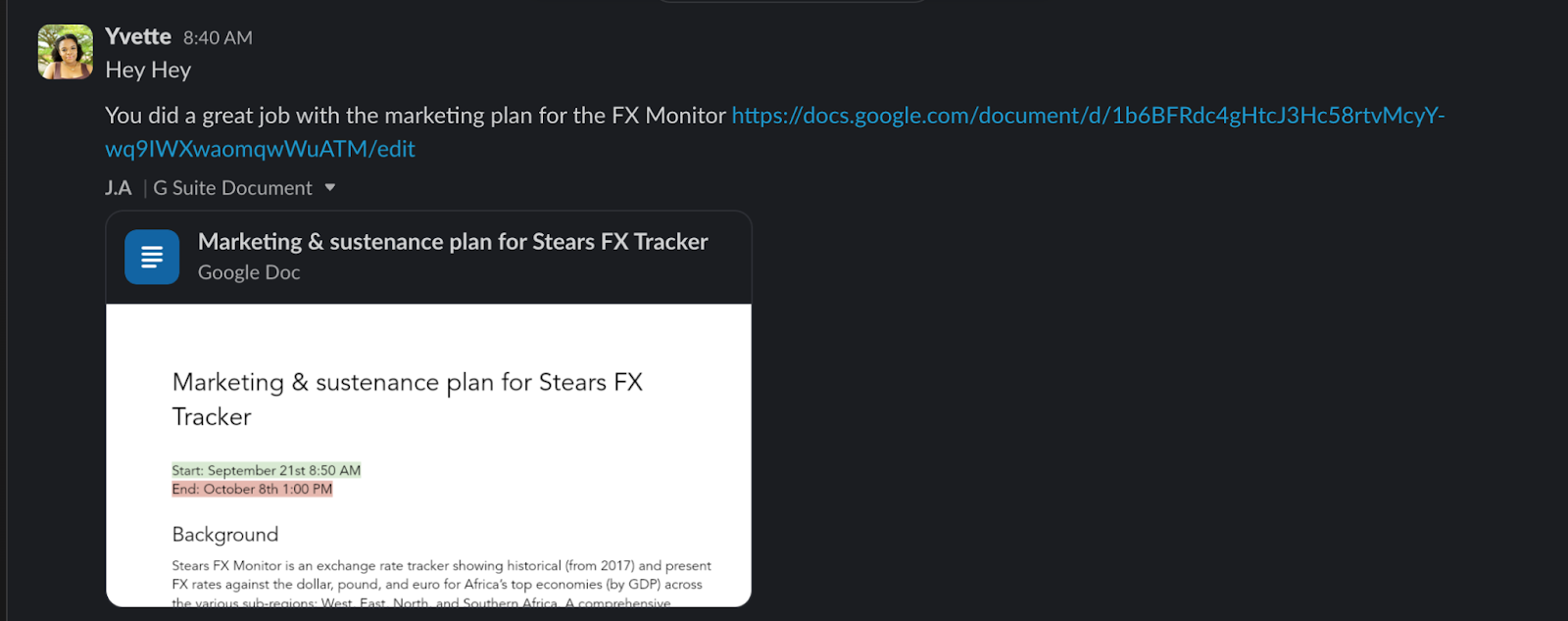
Back at Stears — a pan-African data intelligence company — I was already creating go-to-market plans for campaigns, writing product updates, and crafting push notifications that translated complex data features into simple user value.
I didn’t call it “product marketing” then, but in hindsight, that was exactly what it was.
So when RemotePass needed someone to step into PMM work, the shift wasn’t foreign. What was different, however, was the level of intentionality I brought into it.
For context, I’ve always wanted to ascend into C-level marketing leadership before the end of the 2020s decade. But I didn’t see that happening if I stayed exclusively in a content track.
This is because while content is an incredible foundation, leadership roles — VP, Director, CMO — require a wider toolkit: understanding customer psychology, shaping product narratives, influencing revenue, and building go-to-market strategy. Product marketing was the discipline that offered all of that.
Once I had this realization, PMM stopped being an “extra responsibility” and became a strategic path. I made deliberate moves to build the skills, visibility, and credibility required to transition fully.
Here’s exactly what I did next and what you can do too.
Start with brutal honesty about your skills
Even though I’d touched product marketing in previous roles, it wasn’t a core strength. My background was rooted in content, and while that helped me communicate clearly, it didn’t prepare me for the full scope of PMM work. I needed a precise understanding of my gaps, so I evaluated myself with honesty.
 Jodi Harris
I listed the PMM responsibilities I had observed from launches I worked on and from colleagues I admired, then compared those expectations to my actual capabilities.
That audit exposed gaps I didn’t even realise were there. I needed deeper customer research workflows, stronger competitive intelligence habits and a clearer grasp of sales enablement mechanics.
To make my assessment more accurate, I studied over 20 PMM job descriptions across my dream companies. I paid close attention to the skills that kept repeating and the responsibilities that were treated as non-negotiable.
The patterns were impossible to ignore and they made something clear: growing into product marketing would require deliberate skill building, not more time in my comfort zone.
From that research, I created a personal upskilling roadmap that still guides my development today. It stopped me from guessing what to learn and helped me focus on the capabilities that move the needle in product marketing.
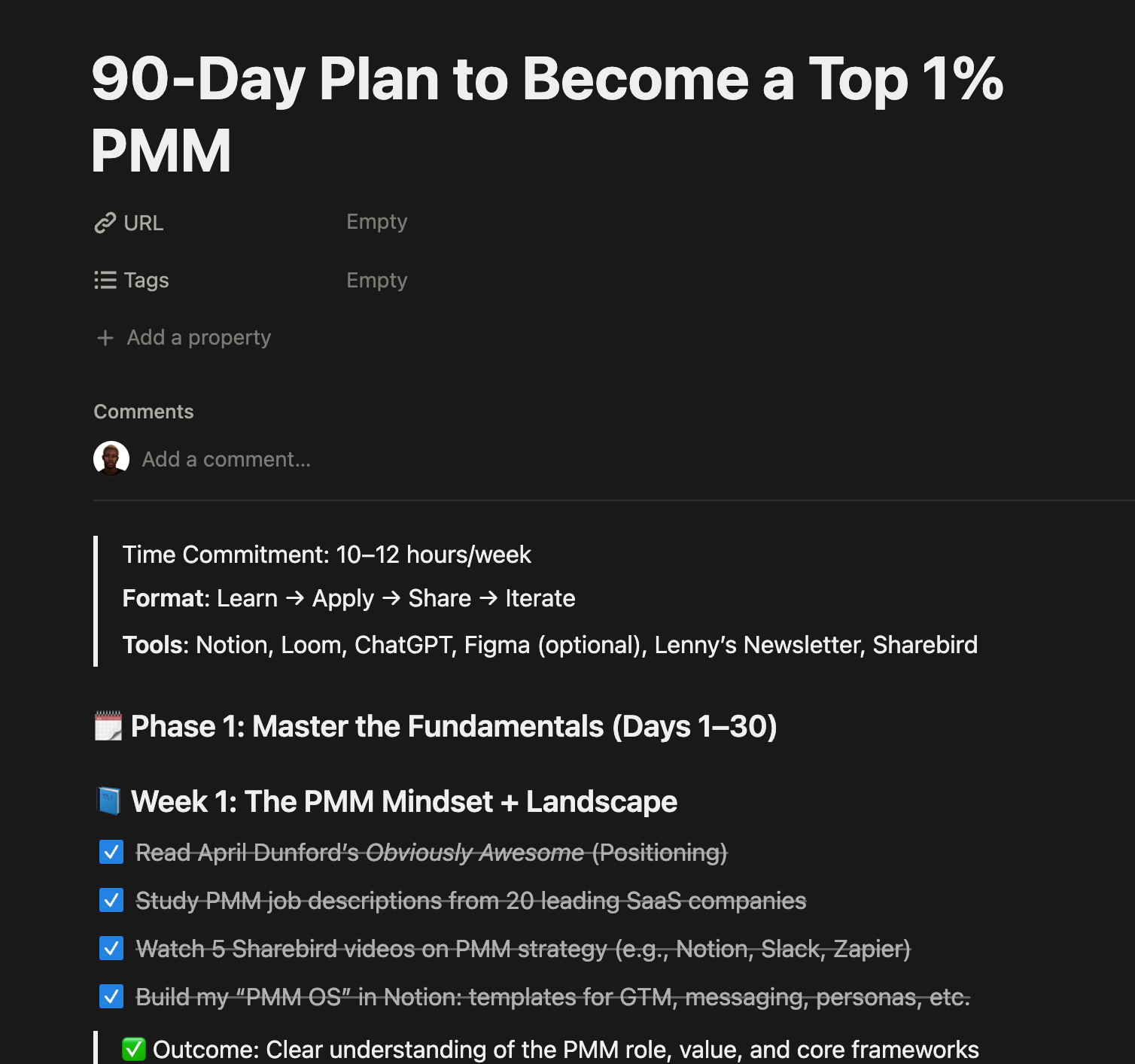
That roadmap became the foundation for everything that came after.
Pro tip: Build a “Skill Gap Grid”
Create a simple table with three columns:
- Skills required
- Your current level
- Evidence (or lack of evidence)
If you cannot provide an example for a skill, it is a gap and you need to fix it.
Say what you want so people can support you
Once I understood my gaps, the next step was making my intentions visible. I told my manager I wanted to grow into a PMM role.
This one conversation shifted everything.
Leadership and colleagues could finally see me through a PMM lens. I was invited into product discussions I had never been part of. I started joining roadmap reviews, understanding constraints and contributing to early positioning decisions. My responsibilities expanded from “creating assets” to “shaping the story and owning the launch.”
A clear moment was the Ask AI release, which was the company’s most complex product at the time. I was assigned to lead the GTM from start to finish. My manager even brought me into a meeting with the CEO so I could walk through the launch plan directly.
None of this would have happened if I had stayed silent.
Pro tip: Frame your ambition as value, not desire
Instead of saying “I want to move into PMM,” communicate: “I want to improve our GTM motion, strengthen sales enablement and support product earlier. Moving into PMM is how I can create more value.”
Managers respond better when they see how your goal helps the business.
Act the part long before your title catches up
After sharing my intentions, I made a conscious decision not to wait for the new title. I started working like a PMM immediately.
I took ownership of messaging. I wrote GTM briefs with more precision and thoughtfulness. I ran alignment calls. I handled feedback loops with Product and Sales. Instead of waiting for someone to hand me responsibility, I stepped into it.
Slowly, people began coming to me with PMM questions rather than content questions. Leaders trusted me with launches that required more coordination and clarity. When complex features were on the horizon, I was the person asked to shape the story and coordinate the rollout.
By the time the title eventually caught up, the transition was already complete. I had earned it through consistency, not wishful thinking.
Pro tip: Build a “Receipts Folder”
Keep a private file with:
- GTM briefs you led
- Launch plans you structured
- Messaging frameworks you created
- Stakeholder feedback you coordinated
This becomes your evidence during performance reviews and future job interviews
Switched from content-first to customer-first mindset
One of the biggest insights from my skill audit was realising how much of my thinking was still shaped by content performance. I was used to optimising for traffic, engagement and storytelling quality.
Useful, yes, but not enough for product marketing. PMM work demands a different mental model. It requires you to understand customers, anticipate objections, remove friction and identify the blockers that slow revenue down.
So I shifted my mindset by asking these vital questions:
- Where do prospects get confused?
- What objections slow deals down?
- Which parts of our story fail to land?
- What insights is Sales hearing that Marketing never sees?
This mindset shift was also what motivated me to connect ChatGPT to our CRM. This simple experiment surfaced insights that directly improved our revenue engine and even influenced our messaging.
Thinking like a PMM transformed how I planned launches, how I partnered with cross-functional teams and how I interpreted customer behaviour. It moved me from creating content to shaping commercial clarity.
Pro tip: Adopt a “Friction Log”
Document every recurring confusion or objection you uncover. Across 4 weeks, patterns will emerge that guide:
- Messaging updates
- Sales enablement
- Feature positioning
- GTM focus areas
PMMs who manage friction outperform PMMs who manage content volume.
Strengthen the three PMM muscles that mattered the most
A mindset shift was necessary, but it wasn’t enough on its own. To become a credible, indisputable PMM, I had to master three core skills that sit at the heart of go-to-market work.
Stakeholder alignment
PMMs don’t work in isolation; they operate at the intersection of Product, Sales, Customer Success and Marketing. And so, I had to become the connective tissue across those teams.
That meant running clear briefings, asking better questions, listening for tension points and ensuring everyone was rowing in the same direction. Over time, teams saw me as the person who could bring clarity to complex work.
 Charley Gale
Pro tip: Start every project with one question
“What decisions do we need to make together before we move forward?”
This prevents misalignment months later.
Roadmap visibility
Next, I made it a priority to join product syncs early. Not halfway through a feature. Not two days before a release. Early. Understanding context, constraints and trade-offs helped me shape narratives while the product was still forming.
At some point, the product team started looping me in proactively because I added value, not because someone told them to. That level of visibility strengthened every launch I touched.
Pro tip: Ask Product two questions in every sync
- “What problem are we solving?”
- “What would make a customer care about this?”
Sales enablement
Finally, I doubled down on helping Sales succeed. If Sales cannot explain a product confidently, the launch is incomplete. So I treated enablement like a sport. I built one-pagers, case studies, social angles, objection-handling guides and gated resources.
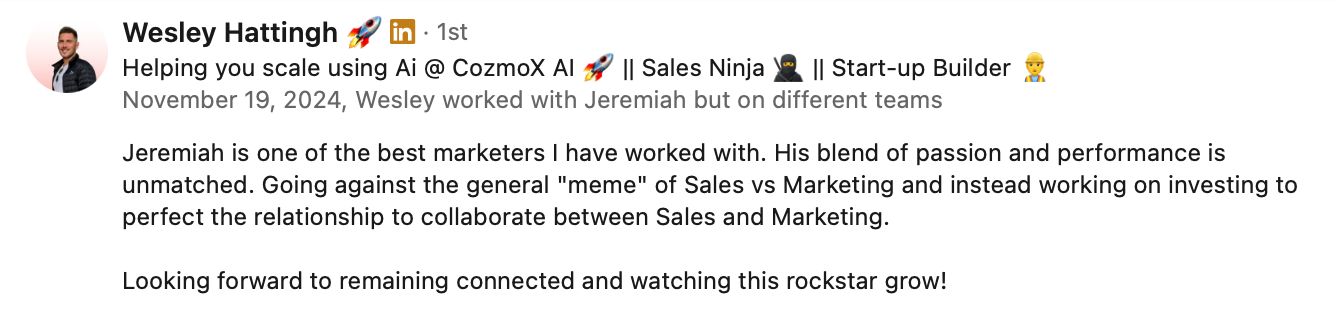
I created anything that would help them pitch faster and with clarity. It worked. I became the PMM Sales relied on, and even our Head of Sales, Wesley, would often call out how much smoother conversations became with stronger enablement.
Pro tip: Shadow at least one sales call a week
You will:
- Hear objections in real-time
- See where messaging fails
- Understand how prospects interpret your positioning
Nothing accelerates PMM intuition faster.
More than 15 launches later, these muscles became second nature. They were a big part of why I grew into a product marketer at RemotePass and why I’m trusted to support companies like Sokin and Builders Tribe today.
Your path to product marketing is closer than you think
If you’re coming from a content background, I’m living proof that a transition into product marketing is possible.
Take a moment to assess where you are. Maybe you need to make your intentions visible. Maybe you need to deepen customer insight. Maybe the next step is alignment, enablement, or simply doing the work before the title comes.
Whatever the gap is, you can close it with deliberate action. And as Chappell Roan said far more sassily than I ever could: “good luck, babe!”


Product marketing insider
Thank you for subscribing
Level up your product marketing career & network with product marketing experts.
An email has been successfully sent to confirm your subscription.
 Follow us on LinkedIn


.svg)
Start the conversation
Become a member of Product Marketing Alliance to start commenting.
Sign up now