












Every enterprise eventually builds a positioning workshop. A room fills with product marketers, a CMO, perhaps a CTO who agreed to attend, and a facilitator with a whiteboard covered in frameworks.
By the end of the session, something resembling a Unified Value Logic (UVL) has emerged. There is head-nodding. There is apparent alignment. There is a shared Google Doc. And then, with remarkable reliability, the UVL begins to disintegrate.
This article argues that UVL collapse is not accidental – it is structurally inevitable when the construction process is treated as a creative exercise rather than an architectural discipline.
Drawing from the Multi-Dimensional Trust Architecture (MDTA) framework, we identify five distinct breakdown mechanisms: COC Abstraction Failure, Value Expression Divergence, COC Over-Breadth, Vertical Translation Drift, and Governance Decay.
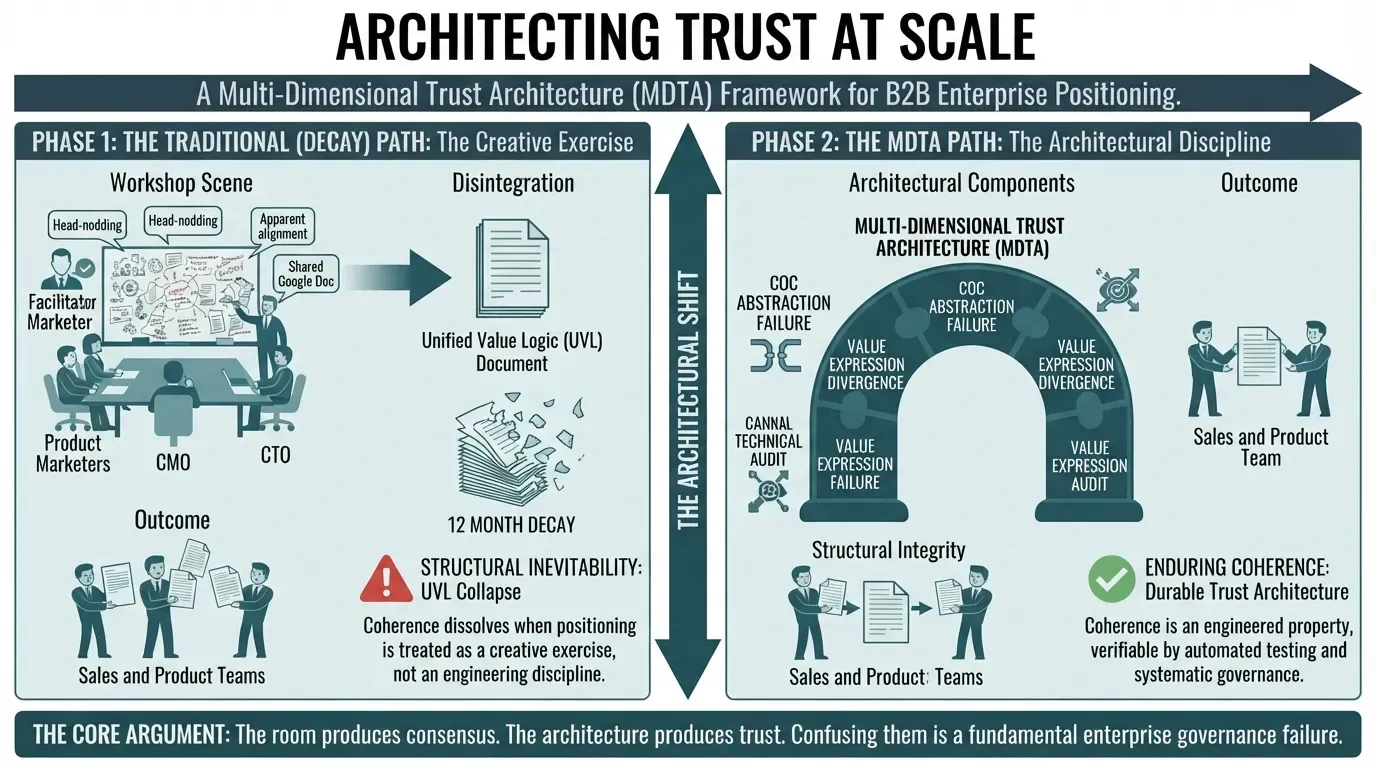
Each failure mode has a precise structural cause, a diagnostic signature, and a remediation architecture.
A note on the examples below: company names and figures are illustrative, chosen to show the mechanism rather than to report a result.
The room problem: Why consensus is not architecture
The workshop illusion
There is a specific moment in every UVL workshop that creates false confidence. It arrives when the group converges on a phrase – often something like “intelligent data orchestration” or “AI-powered operational continuity” – and everyone nods.
The nods feel like agreement. They are not. They are an aggregation of private interpretations that happen to coexist peacefully in the abstract.
The product marketing manager hears the COC as a messaging framework. The CMO hears it as a brand positioning statement. The VP of Sales hears it as a way to open enterprise conversations. The CTO hears it as a description of the engineering roadmap.
Each of these interpretations is defensible. Each is different. And the moment the workshop ends, each person returns to their function and operationalizes the COC through their own interpretive lens.
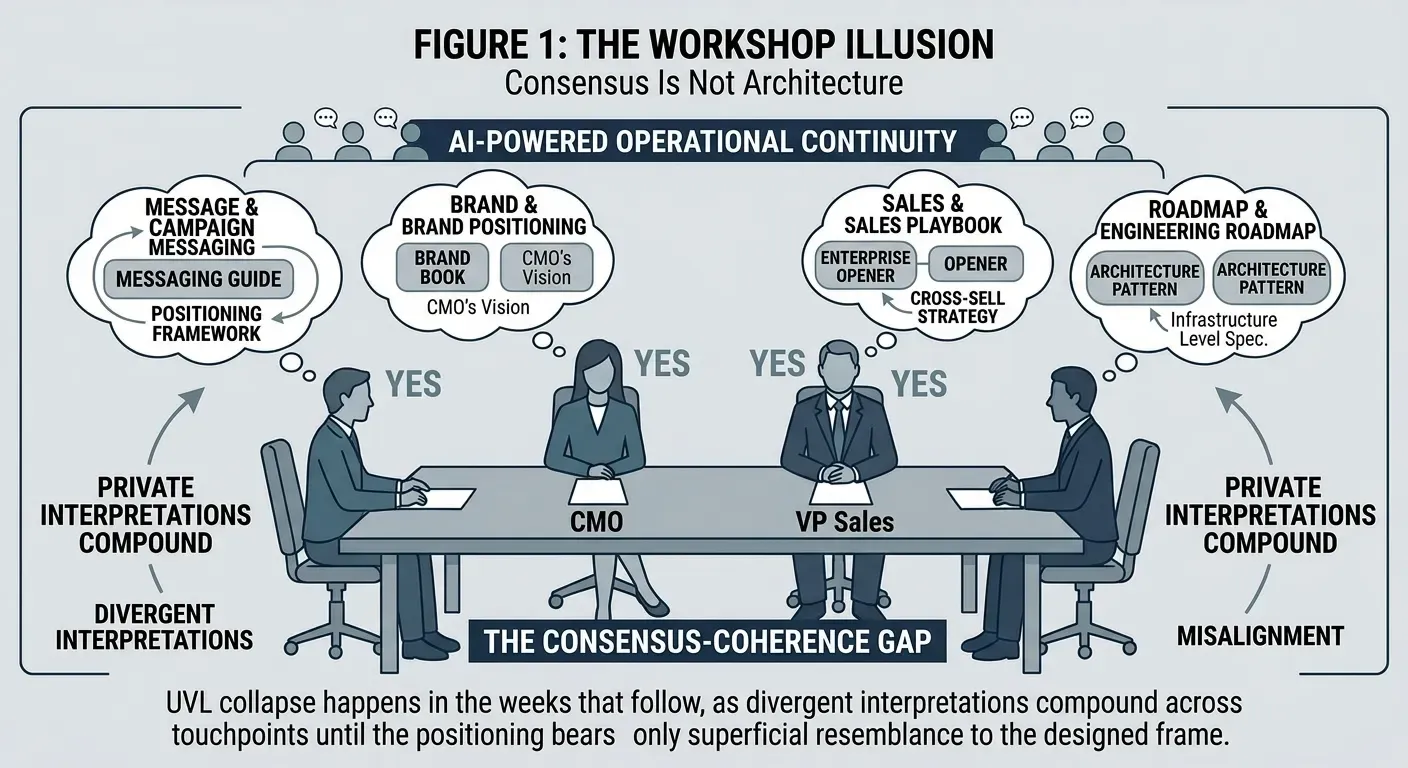
The result is what we might call the Consensus-Coherence Gap: the distance between surface agreement in the room and operational alignment in the field. UVL collapse does not happen during the workshop.
It happens in the weeks that follow, as divergent interpretations compound across touchpoints until the positioning your buyers encounter bears only superficial resemblance to the positioning you designed.
The Specificity Trap
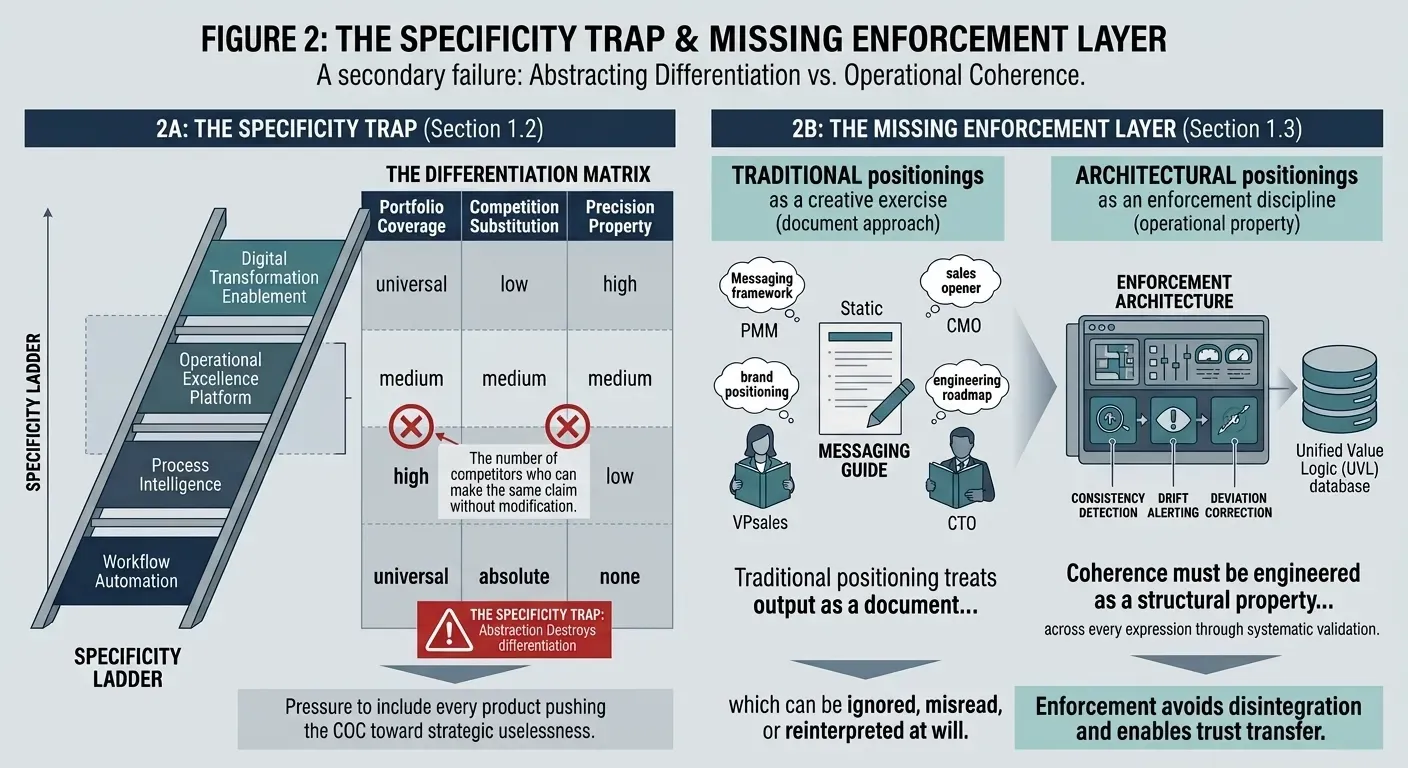
A secondary failure begins even before divergence takes hold: the COC is defined at the wrong level of abstraction. Under pressure to make the UVL inclusive of all products, teams naturally move toward higher levels of abstraction. The result is a COC that is technically accurate and strategically useless.
Consider the abstraction ladder for a company that builds workflow automation tools, data integration pipelines, and compliance management software.
The team might climb through: “workflow automation” → “process intelligence” → “operational excellence platform” → “digital transformation enablement.”
Each step up the ladder increases portfolio coverage. Each step also increases the number of competitors who can make the same claim without modification.
The Specificity Trap operates as follows: the pressure to include every product in the COC narrative pushes the COC toward abstraction, and abstraction destroys the precise property that makes a COC useful – differentiation.
When a buyer can substitute your competitor’s name into your COC statement without the statement becoming false, your COC has failed before anyone has left the room.
The missing enforcement layer
Both the Consensus-Coherence Gap and the Specificity Trap share a root cause: the absence of an enforcement architecture.
Traditional UVL development treats the output as a document – a messaging guide, a brand book, a positioning framework. Documents can be read, ignored, misread, or reinterpreted at will. They have no mechanisms for consistency detection, drift alerting, or deviation correction.
An architectural approach to UVL treats coherence as a structural property that must be actively maintained across every expression of the framework through systematic validation rather than periodic review.
The five failure modes documented in this article each represent a specific point at which the absence of architectural enforcement allows the UVL to degrade.
Failure mode one: COC Abstraction Failure (The Thesaurus Syndrome)
Mechanism
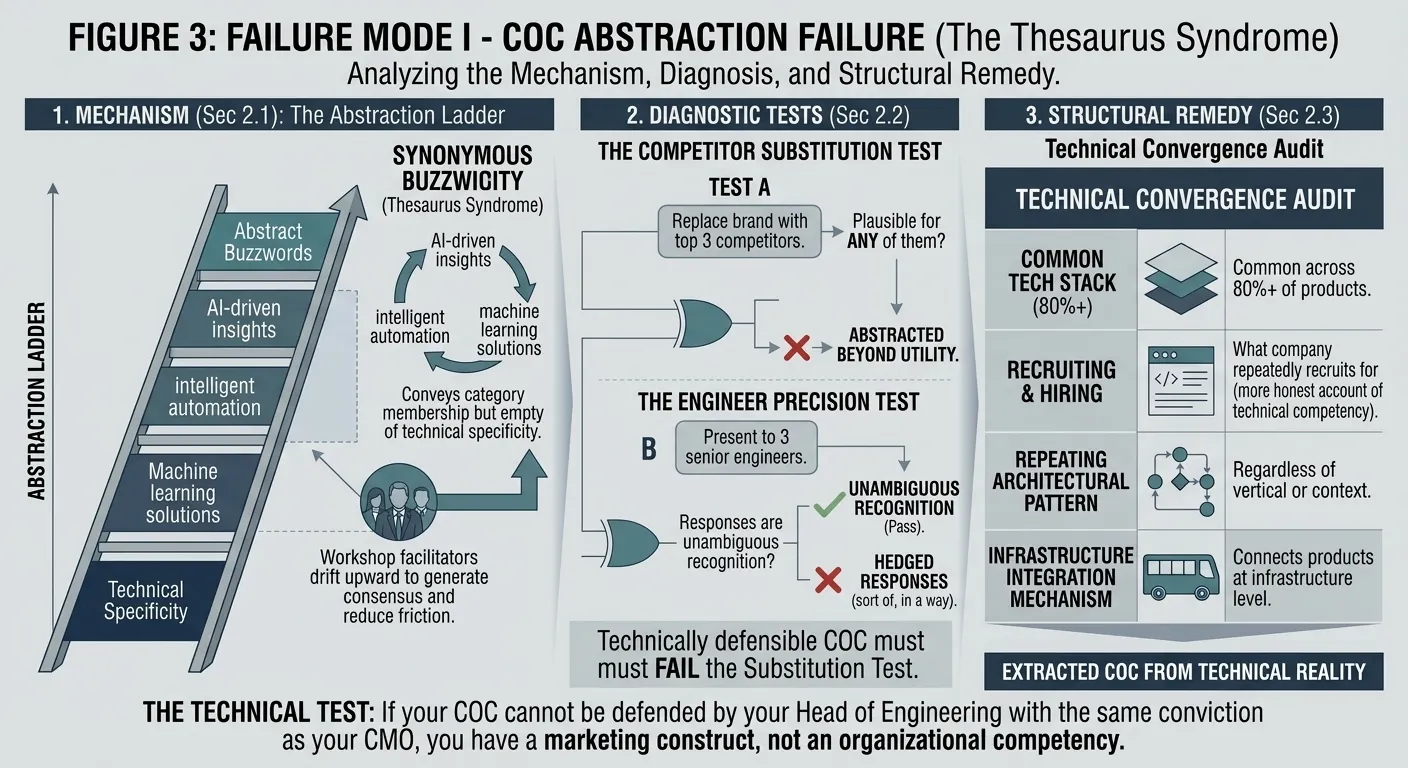
COC Abstraction Failure occurs when the Core Organizational Competency is expressed at a level of generality that eliminates differentiation. The symptom is linguistic: the COC becomes a rotation of synonymous buzzwords that convey category membership without technical specificity.
“AI-driven insights” becomes interchangeable with “intelligent automation,” which becomes interchangeable with “machine learning solutions.” None of these expressions describes what the organization actually does at the infrastructure level.
The mechanism is social as much as intellectual. Workshop facilitators, under pressure to generate consensus, frequently allow COC refinement to drift upward into abstraction because abstract language generates less friction.
Specific technical language creates debate – engineers disagree about architecture, and product managers dispute the scope of capabilities. Abstract language creates agreement because it is empty enough to accommodate any interpretation.
Diagnostic tests
The competitor substitution test: Replace your organization’s name with your top three competitors in the COC statement. If the statement remains plausible for any of them, your COC has abstracted beyond utility. A technically defensible COC must fail this test.
The engineer precision test: Present the COC to three senior engineers who work across different product lines. Vague COCs generate hedged responses – “sort of,” “in a way,” “it depends on which product.” A precise COC generates immediate, unambiguous recognition.
Structural remedy
The remedy for COC Abstraction Failure is the Technical Convergence Audit – a systematic process of extracting COC from technical reality rather than marketing aspiration. The audit identifies convergence across four dimensions:
- What underlying technology stack is common across 80%+ of products?
- What engineering capability does every product team recruit for?
- What architectural pattern repeats across solutions regardless of vertical or market context?
- What integration mechanism connects products at the infrastructure level?
The hiring specifications are the most underrated of these four. What a company repeatedly recruits for is a more honest account of what it is technically about than anything it has ever published, because job specifications are written by people who have to fill the role and are punished for describing it wrongly.
Failure mode two: Value Expression Divergence (The Sales Rewrite)
Mechanism
Value Expression Divergence is the most common and most destructive failure mode. It occurs when sales teams, under pressure to close deals, reframe the COC in ways that are locally effective but globally incoherent.
The individual salesperson is not acting irrationally – they are optimizing for the immediate conversation. But the cumulative effect of hundreds of localized rewrites is the complete dissolution of portfolio-level trust architecture.
The divergence follows a predictable pattern. The marketing team defines the COC as “real-time data orchestration across distributed enterprise systems.” The enterprise sales team translates it to “connecting your machines and your ERP.” The mid-market team simplifies it to “compliance data management.”
Each translation is contextually sensible. Collectively, they ensure that no buyer can form a portfolio-level perception.
Diagnostic tests
The message consistency score: Survey your sales team: “How would you explain what your organization fundamentally does to a buyer who knows nothing about your product?” Analyze for COC presence, specificity, and variance.
Set a threshold before you run it – 15% semantic variance is a reasonable starting point, and the number matters less than having agreed it in advance. Organizations running this for the first time are frequently surprised by how high the variance turns out to be.
The portfolio conversation test: Listen to ten recorded sales calls across product lines. Count how many times the COC appears in any recognizable form without prompting.
Again, set the bar in advance rather than after seeing the result. The useful finding is rarely the absolute number. It is the distribution: whether the COC surfaces evenly across the team, or whether a small group of representatives account for nearly all of it while the majority never introduce it at all. A bimodal distribution is a different problem from a uniformly low one, and it has a different remedy.
Structural remedy: The Product Instantiation Protocol
The remedy is a standardized syntax that makes UVL coherence the path of least resistance for sales conversations – rather than an additional cognitive load:
Example: “SupplyChain Pro instantiates our real-time data orchestration at the logistics planning layer by reconciling demand signals and inventory state in a single event stream, which is what makes predictive replenishment possible without a nightly batch.”
The verb is doing deliberate work. Applies and delivers are things any product does. Instantiates names the relationship between a single company-level claim and its expression in one product, which is precisely the relationship the protocol exists to enforce.
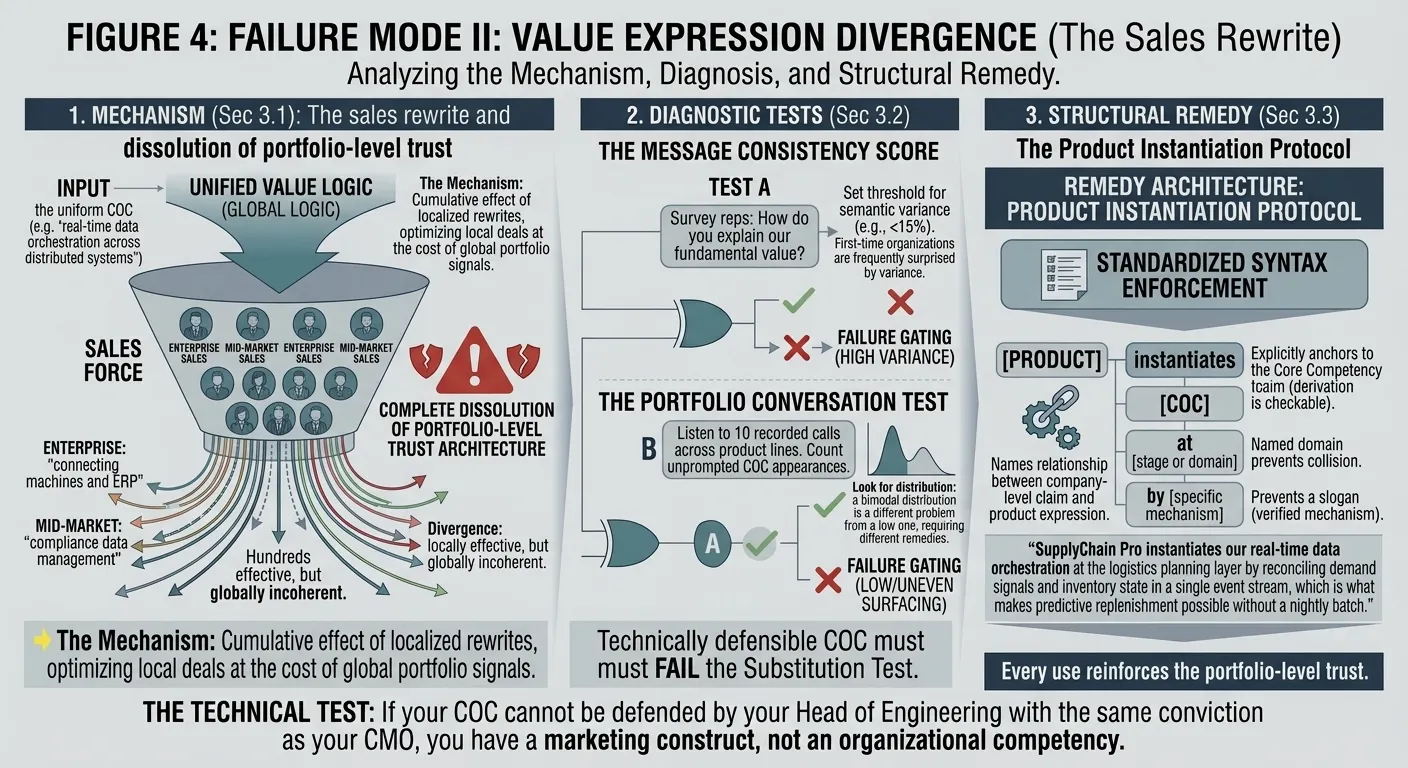
Three properties make the syntax function. It names the COC explicitly, which makes the derivation checkable by someone who was not in the room. It names the product’s specific domain, so two products never collide. And it identifies a mechanism, which is what stops the statement being a slogan — “our origination product embodies our commitment to transparency” names nothing and can be neither verified nor falsified.
The syntax cannot be completed without anchoring to the COC, which means every use reinforces rather than dilutes the portfolio-level trust signal.
Failure mode three: COC Over-Breadth (The Everything Problem)
Mechanism
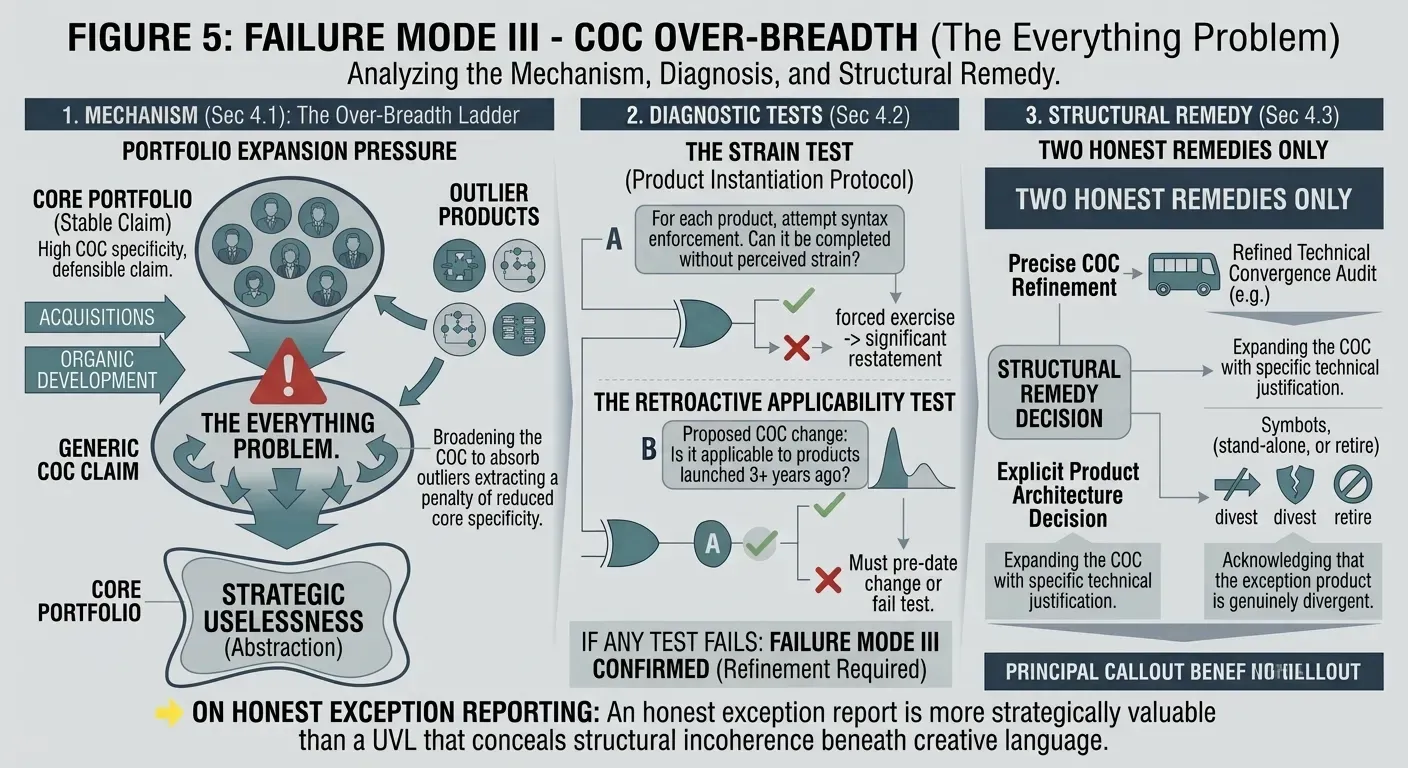
COC Over-Breadth emerges when portfolio expansion pressure forces the COC to stretch beyond its genuine technical scope.
As organizations add new product lines – sometimes through acquisition, sometimes through organic development – the temptation is to reframe the COC to absorb the new additions rather than acknowledge the architectural tension they create.
The symptom is the appearance of one product that “doesn’t quite fit.” Every portfolio has at least one. The instinctive response is to broaden the COC until the outlier fits within it – but each increment of COC expansion extracts a price from every other product. Each broadening reduces the specificity that makes the COC defensible for the core portfolio.
Diagnostic tests
The strain test: For each product, complete the Product Instantiation Protocol. The products where this exercise feels forced – where the COC must be significantly restated to accommodate the product’s actual mechanism – are diagnostic flags.
The exception report: Formally identify every product that cannot be described using COC language without perceptible strain. Do not rationalize. The exception report is more strategically valuable than a polished COC that conceals structural incoherence.
The retroactive applicability test: Any proposed COC evolution must be demonstrably applicable to products launched three or more years ago. This is the cheapest of the three and the hardest to argue with, because the products either predate the change or they do not. It catches over-breadth at the moment of proposal rather than two years later, when the consequences have already propagated into every vertical.
Structural remedy
COC Over-Breadth has two honest remedies and only two. The first is precise COC refinement – expanding the COC with specific technical justification when the exception represents a genuine capability gap.
The second is an explicit product architecture decision – acknowledging that the exception product is genuinely divergent, and deciding whether it should be divested, repositioned as a standalone offering, or retired.
Failure mode four: Vertical Translation Drift (The Localization Trap)
Mechanism
Vertical Translation Drift occurs when the process of adapting UVL for specific industry verticals gradually replaces the COC with vertical-specific language, rather than expressing the COC through vertical-specific language. The distinction is architectural, not semantic.
Consider a company with a COC built around “real-time data orchestration across distributed systems.” It correctly translates this for healthcare as “clinical data harmonization across care settings.”
But six months later, the healthcare messaging has evolved to “care coordination platform,” then to “population health enablement.” Each evolution was locally motivated. Collectively, they produced a healthcare position bearing no traceable relationship to the COC.
The Isomorphic Translation Requirement
The structural requirement that prevents Vertical Translation Drift is isomorphic translation – demonstrating that capabilities validated in one vertical are structurally applicable to another through underlying functional similarity, not surface analogy.
It operates through three mechanisms, and naming them is what makes the requirement usable rather than merely correct, because a practitioner staring at a vertical adaptation can ask which of the three they are claiming.
Process isomorphism: Structural similarity in operational processes. A predictive maintenance algorithm proven in manufacturing applies to healthcare equipment reliability through identical statistical process control principles – differing only in failure mode datasets, not analytical architecture.
Regulatory isomorphism: Compliance requirement structures map across verticals. A SOC 2 Type II audit trail architecture satisfies HIPAA requirements through identical immutable ledger principles. The regulatory expression differs; the underlying governance capability does not.
Economic isomorphism: Value creation mechanisms translate across economic models. Supply chain cost optimization in retail applies to healthcare supply expense management through identical inventory theory – differing SKUs, same mathematical optimization.
Diagnostic tests
The COC trace test: Take your most mature vertical adaptation and trace it back to the COC through explicit reasoning steps. If at any point the connection becomes “this is just what healthcare buyers want to hear” rather than “this is the COC expressed in healthcare terms,” you have found where the drift began.
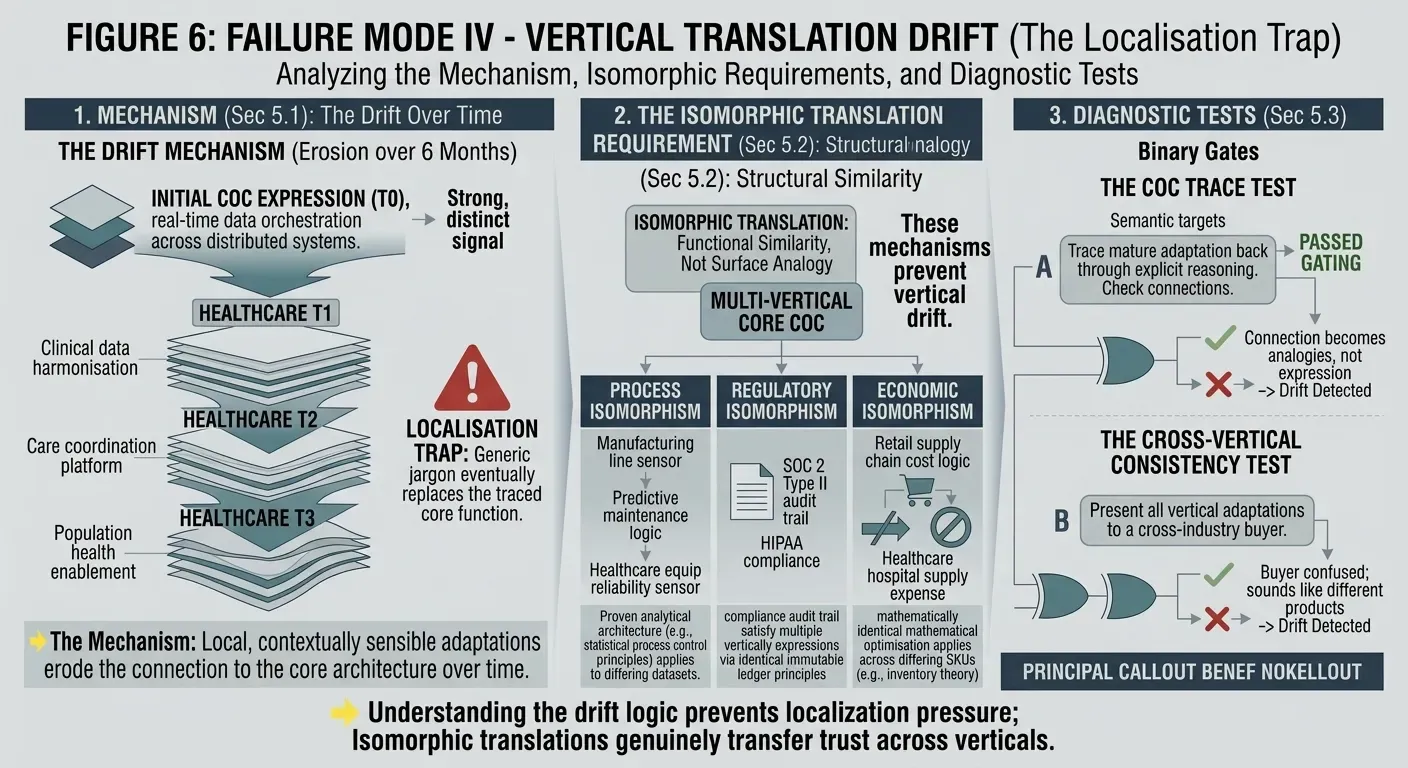
The cross-vertical consistency test: Present your vertical articulations to a sophisticated buyer who operates across multiple industries. Isomorphic translations produce recognition: “I can see how what you do in financial services maps to healthcare.” Drift produces confusion: “These sound like completely different products.”
Failure mode five: Governance Decay (The Static Document Problem)
Mechanism
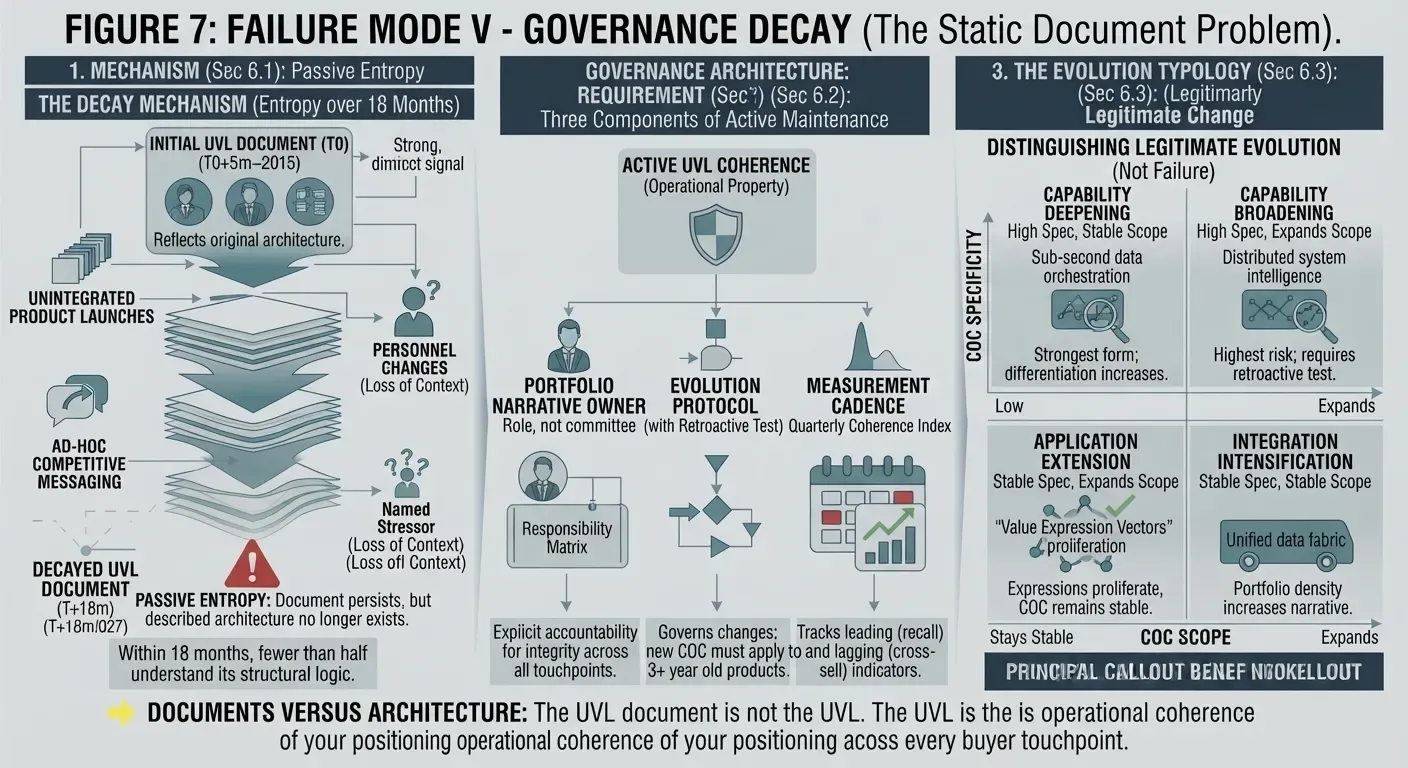
Governance Decay is the failure mode that eventually claims every UVL that has survived the first four. It occurs not through active misapplication but through passive entropy: the UVL becomes a historical artefact that no longer reflects the organization’s evolved capabilities, portfolio additions, or market learning. The document persists; the architecture it described no longer exists.
Three organizational dynamics accelerate the decay. Product launches introduce new capabilities that no one formally integrates into the UVL. Competitive responses generate messaging adaptations never evaluated for COC coherence.
Personnel changes bring team members who were absent from the original development and have no context for the architectural decisions embedded in it. Within eighteen months, fewer than half the team members who interact with the UVL daily understand its structural logic.
The Governance Architecture Requirement
Governance Decay cannot be addressed by better documentation or more emphatic brand guidelines. The structural response treats UVL coherence as an operational property requiring active maintenance through three components.
A designated Portfolio Narrative Owner – a role, not a committee – with explicit accountability for UVL coherence across all touchpoints. Committees produce UVL versions; a single owner maintains UVL integrity.
An evolution protocol that governs how UVL changes in response to portfolio expansion and market learning. The protocol must include a retroactive applicability test: any proposed COC evolution must be demonstrably applicable to products launched three or more years ago.
A measurement cadence – quarterly Portfolio Coherence Index reporting tracking leading indicators (message consistency scores, COC recall rates) and lagging indicators (cross-sell attach rates, portfolio NPS premium over individual product NPS).
The evolution typology
Not all UVL evolution represents governance failure. The governance architecture must distinguish between four types of legitimate evolution:
Capability deepening: Technical advancement increases COC specificity. “Data orchestration” → “Sub-second event-driven data orchestration.” Strongest form of evolution – differentiation increases without breaking coherence.
Capability broadening: New technical mechanisms expand COC scope. “Data orchestration” → “Distributed system intelligence.” Requires retroactive applicability testing – the highest-risk evolution type.
Application extension: New use case domains multiply Value Expression Vectors without changing the COC. The COC remains stable; its expressions proliferate.
Integration intensification: Portfolio density increases, strengthening the integration narrative. “Connects to” → “Unified data fabric across.”
The failure mode matrix: A diagnostic summary
The five failure modes are not independent. They interact in ways that compound their individual effects. COC Abstraction Failure makes Value Expression Divergence more likely, because vague COCs provide no enforcement constraint on sales reinterpretation.
Vertical Translation Drift accelerates COC Over-Breadth. Governance Decay allows all four preceding failure modes to regenerate after remediation.
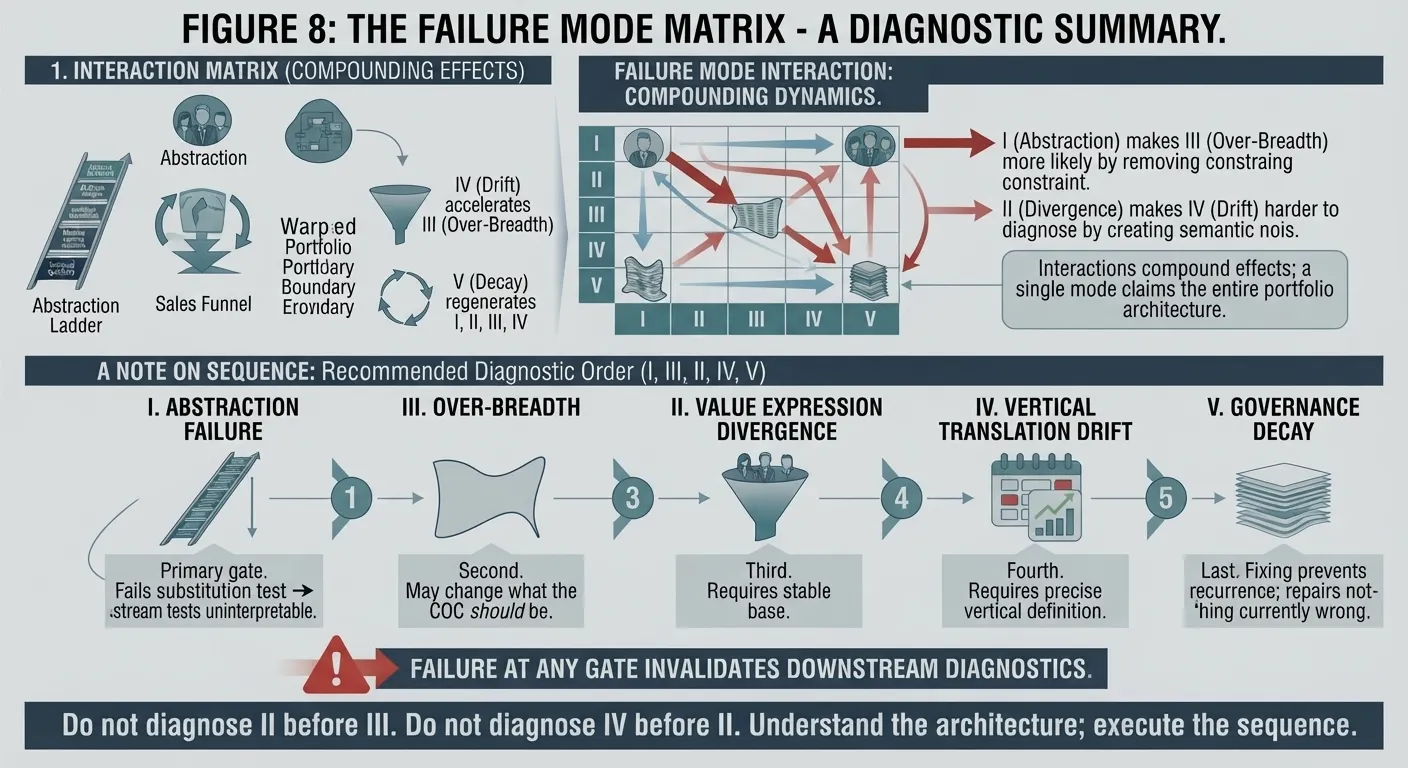
A note on sequence. Run the diagnostics in this order: I, III, II, IV, V. Abstraction first, because a COC that fails the substitution test makes every downstream test uninterpretable. Over-breadth second, because it may change what the COC should be. Governance last — fixing it prevents recurrence but repairs nothing currently wrong.
Toward structural prevention: The architectural imperative
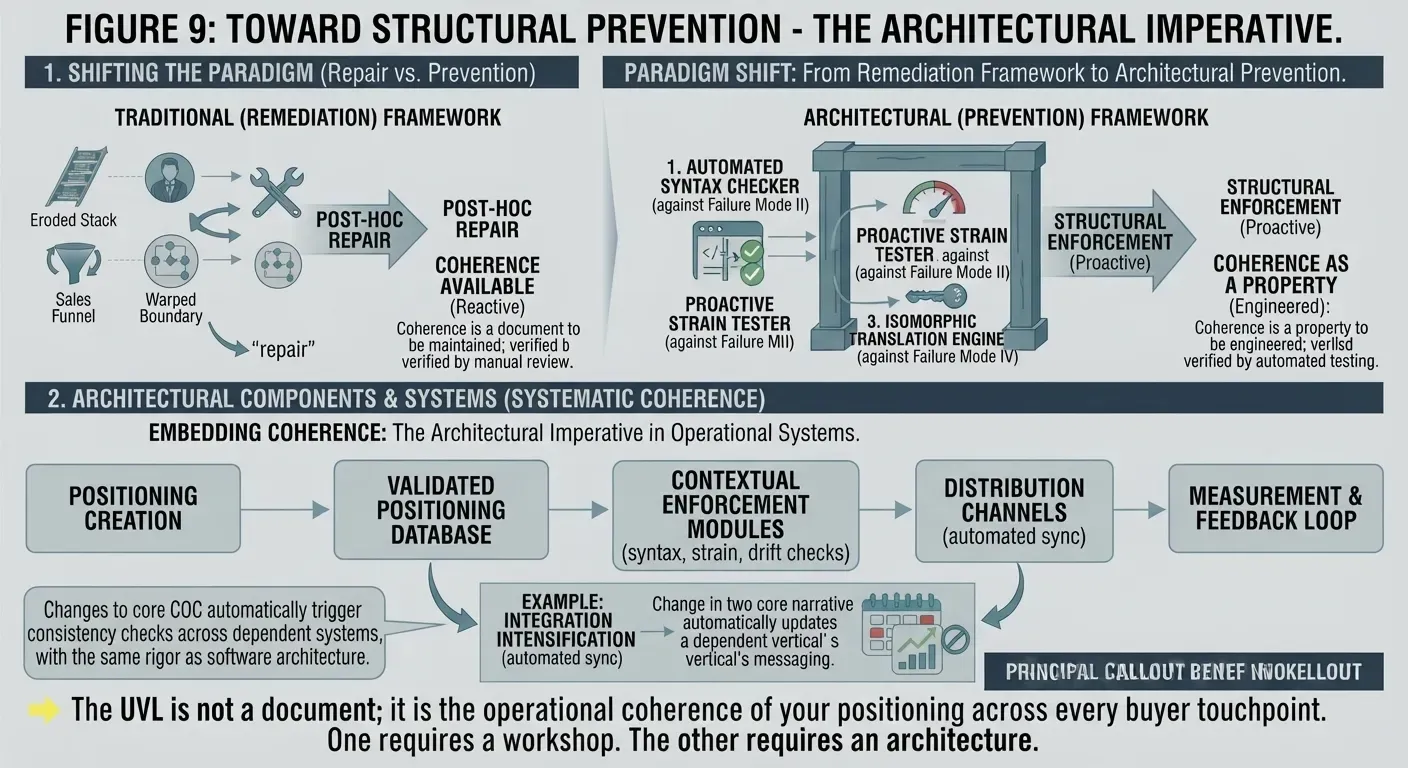
The diagnostic and remediation frameworks presented in this article point toward a single conclusion: UVL coherence cannot be achieved through better workshops or more detailed brand guidelines.
It requires an architectural approach that embeds coherence enforcement into the operational systems through which positioning is created, validated, distributed, and measured.
This means treating the UVL not as a document to be maintained but as a structural property to be engineered – with the same rigor applied to software architecture, where coherence is verified by automated testing rather than manual review, and where changes to core components trigger consistency checks across dependent systems.
What structural enforcement does not do
One honest limit, because the title of this article promises something the article delivers only part of.
Structural enforcement makes coherence available. It does not make coherence happen.
A representative who has the syntax, knows the COC, and sees the correct assembly in front of them will still, in the eleventh week after launch, meet a buyer who arrived with a competitor’s frame already installed and a quarter closing in nine days.
The decision to meet that buyer where they are is correct for the deal and corrosive to the system, and no amount of architecture prevents it, because the pressure producing it is not architectural.
That gap — between an architecture that could be used and one that is being used — is a distinct problem with its own mechanisms: the artefacts that govern sequence, the incentive asymmetry where a representative who abandons the frame and wins has simply won, and the measurement that reveals whether any of this reached a buyer at all. It is the subject of a different article.
What the architecture buys you is that the failure becomes detectable. Without it, the same decision is invisible, because it does not appear in a lost-deal analysis — the deal was won.
The reorientation
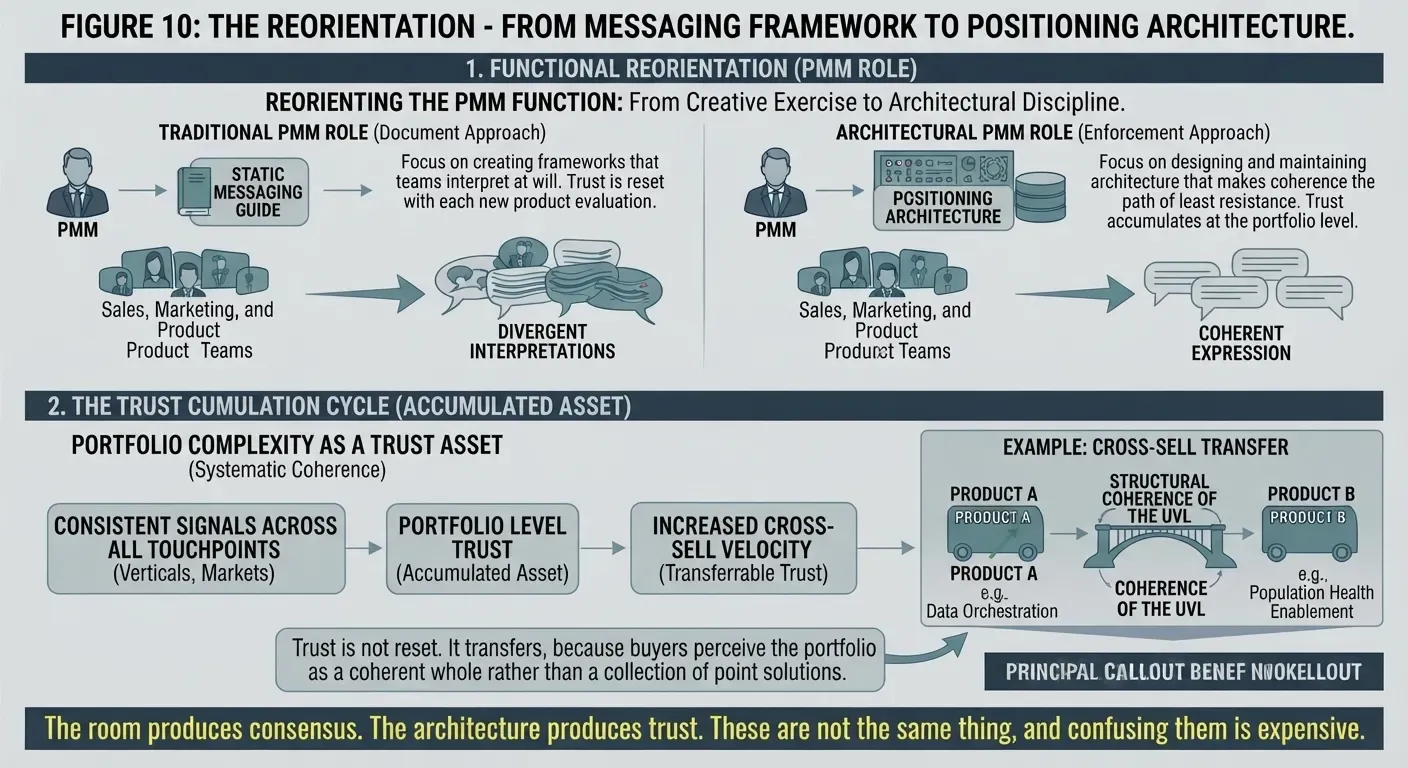
The practical implication for product marketing leadership is a reorientation of function. The PMM role in a UVL-mature organization is not the creation of messaging frameworks that teams interpret at will.
It is the design and maintenance of a positioning architecture that makes coherent expression the path of least resistance for every team member who touches a buyer interaction.
The enterprises that master this architecture transform portfolio complexity from a trust liability into a trust asset. Their buyers encounter consistent signals across every touchpoint, in every vertical, in every market.
Trust accumulates at the portfolio level rather than resetting to zero with each new product evaluation. Cross-sell velocity increases not because of better sales tactics but because the trust earned by Product A genuinely transfers to Product B through the structural coherence of the UVL.
The room produces consensus. The architecture produces trust. These are not the same thing, and confusing them is expensive.
The room produces consensus. The architecture produces trust. These are not the same thing, and confusing them is expensive.
A note on implementation
The failure modes documented in this article were identified through the development of a structured UVL construction framework designed to operationalize the Multi-Dimensional Trust Architecture.
The premise is straightforward: if the primary cause of UVL failure is the absence of structural enforcement mechanisms, then the solution is a system that embeds those mechanisms into the construction process itself – guiding COC extraction through technical convergence analysis, validating value expression vectors for cross-context consistency, and maintaining Portfolio Coherence Index as an operational metric rather than a retrospective assessment.
The workshop produces a starting point. The architecture produces a UVL that survives the room.


Product marketing insider
Thank you for subscribing
Level up your product marketing career & network with product marketing experts.
An email has been successfully sent to confirm your subscription.
 Follow us on LinkedIn



.svg)
Start the conversation
Become a member of Product Marketing Alliance to start commenting.
Sign up now