












Historically perceived as a support function – responsible for “making pretty content,” acting as a facilitator, and orchestrating launches – product marketing is increasingly being called upon to demonstrate tangible business impact.
In an era of tighter budgets and heightened scrutiny on operational efficiency, the ability to connect qualitative inputs (such as positioning and market intelligence) to business outcomes has become the defining characteristic of senior PMM.
This article presents a proprietary and innovative framework designed to bridge the gap between product development and commercial success.
Grounded in the theoretical foundations of product lifecycle management and reinforced by hypergrowth methodologies such as the T2D3 model (Triple, Triple, Double, Double, Double), this framework redefines the role of PMM. No longer a mere “feature launcher,” PMM emerges as the architect of the revenue engine and the voice of sustainable innovation.
We use a central analogy throughout this analysis to clarify the complexity of the role: that of constructing and operating a fine-dining restaurant.
This metaphor illustrates the distinct yet interconnected phases of the PMM lifecycle – from the culinary research that defines the menu concept (intelligence and strategy), through the grand opening that attracts customers (execution and go-to-market), to the impeccable service that ensures customer return (enablement and success).
By adhering strictly to this structured approach, PMM professionals can transcend tactical deliverables and prove their value as guardians of business strategy.
Chapter 1: The value crisis in product marketing and the need for a new vision
1.1 The “launch factory” trap
The nature of its own deliverables has obscured the real value of product marketing. Professionals are often judged by the volume of tactical output: the number of sales decks produced, blog posts written, or launch events organized.
This “output-over-outcome” mentality traps PMM in a “launch factory” mode, where success is defined by shipping features to market rather than capturing real value.
The fundamental challenge lies in attribution. Unlike sales, which closes deals, or engineering, which delivers code, product marketing operates in the connective tissue of the organization. Its influence is pervasive but often indirect.
Yet in a mature digital economy, indirect influence is no longer sufficient currency at the executive leadership table. Modern PMM must evolve from tactical executor to strategic orchestrator.
This shift requires a fundamental re-imagination of the function’s scope. It's no longer enough to craft a compelling message; PMM must ensure that the message accelerates the sales cycle.
It's not enough to define an ideal customer profile (ICP); PMM must ensure that targeting this ICP drives acquisition efficiency. The challenge is to connect positioning changes – intangible and cognitive – to pipeline and retention outcomes.
1.2 The restaurant analogy: a holistic view of value delivery
To contextualize the framework presented in this article, we employ the analogy of designing and operating a fine restaurant. This metaphor moves beyond the simplistic view of PMM as “the waiter” or “the menu designer,” positioning it instead as the strategic restaurateur overseeing the entire value delivery ecosystem.
Traditional models often treat product marketing only as the “Grand Opening” (go-to-market). The product is built in the kitchen (engineering/product management), often without input from the dining room, and PMM receives a finished dish with the instruction to “sell this.” This disconnected approach is a primary cause of product failures, resulting in high churn and low engagement.
The proposed framework envisions a different reality, broken down into three fundamental pillars:
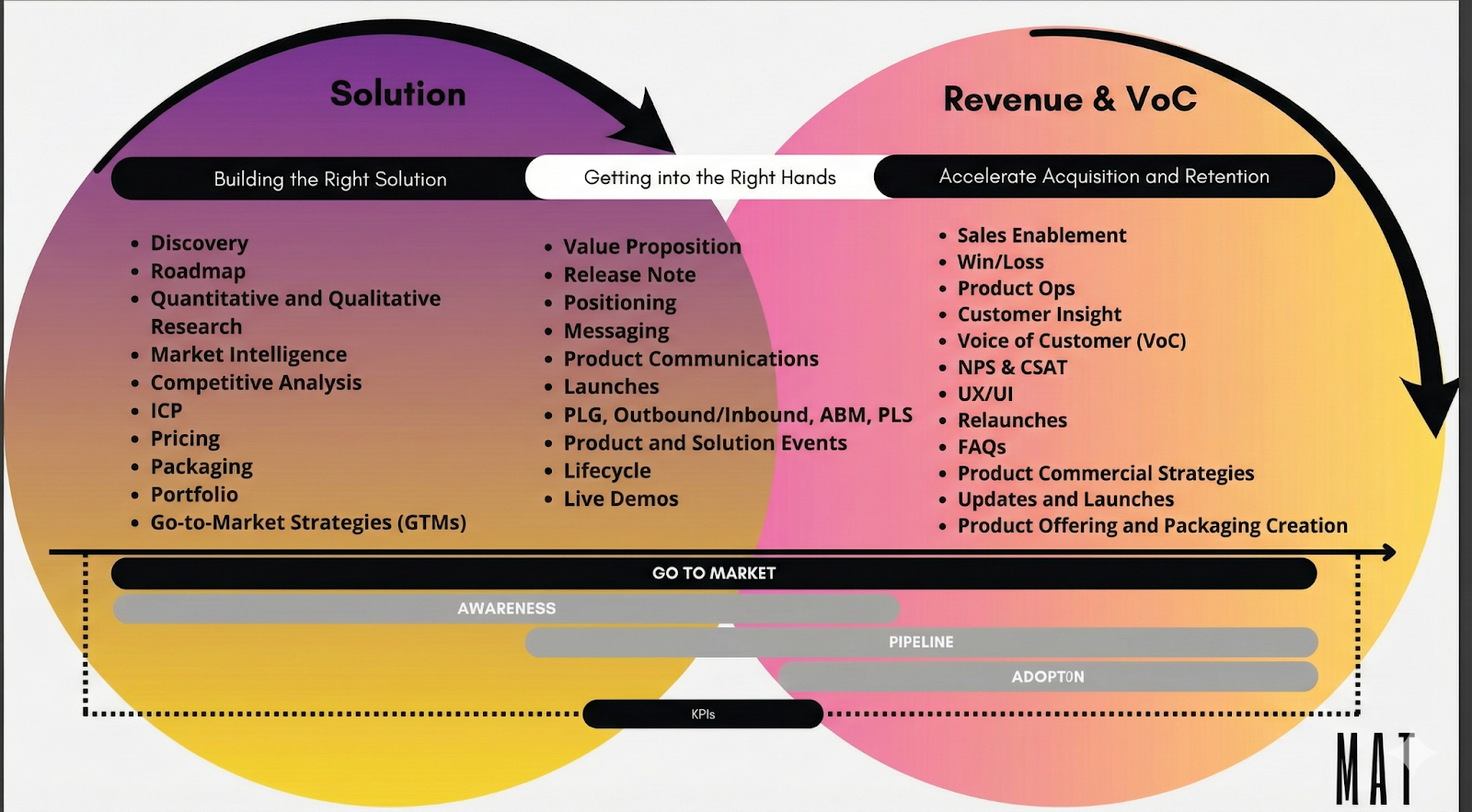
- Intelligence and strategy (discovery and solution) – The concept and research: Market research before buying a single ingredient. What do locals want to eat? Is the neighborhood saturated with Italian bistros? What price range will they tolerate? This ensures the kitchen prepares the right food for the right people.
- Execution and go-to-market (awareness and pipeline) – The design and grand opening: Attracting customers to the tables, promising a specific experience (value proposition) that resonates with their latent needs.
- Enablement and success (adoption and VoC) – Service and loyalty: Training waitstaff (sales enablement) to explain dishes perfectly, checking tables for satisfaction (voice of customer), and adjusting the menu based on feedback to ensure repeat visits.
By managing this entire lifecycle, PMM ensures not just a successful opening night but a thriving, profitable business sustained over years.
1.3 Integrating the T2D3 growth model
Central to proving PMM’s value is alignment with high-growth benchmarks. The T2D3 framework – Triple, Triple, Double, Double, Double – is the gold standard for SaaS and digital product growth. It outlines a trajectory where a company triples its annual recurring revenue (ARR) for two consecutive years, then doubles it for the next three.
Though often seen as a sales or financial target, T2D3 is fundamentally a product marketing and lifecycle management challenge.
- Triple (T2): Requires extreme product-market fit and messaging that instantly resonates with early adopters. This depends heavily on pillar 1 (intelligence) and pillar 2 (execution). Without the “right product” for the “right person,” initial scale is impossible or prohibitively expensive.
- Double (D3): Requires scalable processes, deep retention, and expansion within existing accounts (cross-sell/up-sell). This depends heavily on pillar 3 (enablement and success). Operational efficiency and customer satisfaction become the long-term revenue engines.
Without the strategic foundation provided by PMM, companies stagnate. They may triple once through brute-force sales, but hit a wall – the “churn abyss” – because the product fails to deliver or the initial niche is exhausted. The framework detailed here is the operational engine that makes T2D3 achievable.
Chapter 2: Pillar I – intelligence and strategy (building the right solution)
The first pillar of the framework is, without a doubt, the most critical area and, paradoxically, the most neglected in product marketing within many organizations. Frequently, the “discovery” phase is seen as the exclusive domain of product managers (PMs).
However, while PMs focus on technical feasibility and usability, PMMs must focus on marketability and commercial viability. This phase represents the “Kitchen Conceptualization” in our restaurant analogy.
2.1 Discovery and roadmap: The PMM as strategic architect
In this phase, PMM acts as the strategic brain. The central goal is to ensure the organization is solving a problem people are truly willing to pay for, avoiding the development of solutions based solely on internal desires.
- Grounding through research: PMM must lead the charge in data collection. This involves deep quantitative and qualitative research. It's not just about “user needs” (does the button work?) but about “purchase motivators” (does this solve a critical business problem?). This requires analyzing market trends, macroeconomic factors, and buying behaviors.
- Market intelligence and competitive analysis: PMMs provide the “outside-in” perspective. While engineering looks at code, PMM looks at the chessboard. Who are the competitors? Not only direct feature competitors, but also “status quo” competitors (Excel spreadsheets, manual processes, or simply “doing nothing”). The “Mystery Shopper” methodology is vital here to penetrate competitors’ sales processes and refine pitch and pricing.
- Defining the ICP: This is the most important strategic output. If you try to feed everyone, you become a generic cafeteria, not a restaurant with identity. PMM defines exactly who the “diners” are – their demographics, firmographics, and psychographics. Defining ICP correctly at the start is what enables efficiency in later phases.
2.2 Structuring the offering: pricing, packaging, and portfolio
Once the market is understood, PMM must structure the offering. In our analogy, this is the engineering of the menu. Do we sell à la carte or a tasting menu?
- Pricing and packaging: These are powerful levers for T2D3 growth. PMMs optimize packaging to reduce entry barriers (facilitating the “Triple” phase via acquisition) while creating upsell paths (facilitating the “Double” phase via expansion).
- Portfolio management: PMMs ensure new products don't cannibalize existing ones but complement them, increasing overall share of wallet within the customer base.
Second-order strategic insight:
The “intelligence” phase is where PMM acts as a business risk mitigator. By validating concepts and conducting market tests before full development, PMM prevents the organization from investing heavily in features that fail to generate engagement.
The value here is “cost avoidance” – saving engineering cycles and capital that would otherwise be wasted on dead-end products. This is critical to avoid the trap of being stuck in the MVP stage without ever achieving the necessary market fit for T2D3.
Chapter 3: Pillar II – execution and go-to-market (getting into the right hands)
If pillar I is the design of the menu and the concept, pillar II is the grand opening. This is where strategy turns into kinetic energy. It's the “execution and go-to-market” phase, focused on generating awareness and building the pipeline. It's where strategy gains voice and form.
3.1 The art of messaging and positioning
This is the classic domain of PMM, but in this framework, it's rigorously tied to the intelligence gathered in pillar I. It's not just about writing “beautifully,” it's about writing to convert.
- Value proposition and positioning: This is the central promise. It answers the diner’s question: “Why should I eat here and not at the restaurant next door?” Positioning defines the frame of reference. Is it a “fast food” tool for quick tasks or a “fine dining” platform for business transformation? Misalignment here is fatal; positioning a complex platform as a simple tool attracts the wrong ICP, leading to future frustration.
- Messaging and communication: The specific language used to communicate value. This includes release notes and product communications that translate technical features (“cooked at 60 degrees”) into business benefits (“perfectly tender and juicy meat”). Without this, the market does not understand the relevance of the innovation.
3.2 Channels and traction: The GTM engine
Execution involves selecting the right distribution channels to reach the defined ICP.
- PLG (product-led growth): The product sells itself (like a free appetizer that hooks the customer). PMMs design in-app messaging and “aha!” moments.
- Outbound / ABM (account-based marketing): For high-value items (the corporate tasting menu). PMMs orchestrate ABM campaigns, aligning sales and marketing around a target list of strategic accounts.
- Inbound: Creating content and thought leadership that attracts the market to the restaurant.
- Events and live demos: These are the “tastings.” They must be scripted not to show features, but to highlight differentiation and solve specific customer pains.
3.3 Orchestrating the launch lifecycle
The framework emphasizes that a “launch” is not a single day on the calendar. It involves:
- Pre-launch: Building anticipation and validating demand.
- Launch: The event that captures attention.
- Post-launch: Sustaining momentum and driving adoption.
PMMs manage this narrative as the product matures, shifting from “New and Exciting” to “Proven and Reliable” as traction builds.
Third-order strategic insight:
In the context of T2D3, this phase is the engine of “Triple.” It requires aggressive acquisition. PMMs prove value here by ensuring pipeline “velocity” – deals move quickly because buyers clearly understand the value proposition, removing friction from the sales process.
When positioning is clear, the sales cycle shortens, which is essential to hitting aggressive revenue tripling goals.
Chapter 4: Pillar III – enablement and success (accelerating acquisition and retention)
The third pillar represents the maturation of the PMM role and is where business sustainability is ensured. The focus shifts from “getting the customer” to “keeping and growing the customer.”
In the restaurant analogy, this is the excellence of service that transforms a first-time visitor into a regular customer who brings friends. This pillar is critical for the “Double” phases of the T2D3 model, where growth depends on healthy unit economics and retention.
4.1 Sales enablement: Empowering the frontline
it's useless to have a world-class menu if the waiter can't explain the ingredients or suggest a wine pairing. Sales enablement is the process of transferring market knowledge from PMM into the minds of the sales team.
- Tools and training: PMMs produce battle cards, pitch decks, and ROI calculators. But value is proven by the adoption of these tools and the confidence they generate in the sales team.
- Win/loss analysis: This is the vital feedback loop. PMMs interview buyers to understand why they bought (win) or why they did not (loss). This data is pure gold. It tells the kitchen (product) if the dish needs more salt, or the GTM team (marketing) if the pricing is misaligned.
4.2 Voice of the Customer (VoC) and user experience
The framework emphasizes the use of listening channels to feed insights back into the product. High retention is a direct byproduct of fulfilling the promise made at the point of sale.
- Customer insights: PMMs aggregate data from support tickets, reviews, and usage data to identify friction points.
- UX/UI optimization: PMMs advocate for interface changes not just for aesthetics, but to improve the time it takes for the user to perceive value (Time-to-Value). If the diner can't read the menu, they can’t order.
- Relaunches and updates: Products, like menus, become outdated. PMMs orchestrate “relaunches” of existing features that are underutilized, driving adoption without necessarily writing new code.
4.3 Accelerating retention and expansion
This is the “revenue” part of the pillar. The goal is to maximize value over time through satisfaction and account expansion.
- Cross-sell and up-sell strategies: PMMs create “expansion plays”–marketing campaigns targeted at the installed base (e.g., “You enjoyed the main course? Try the exclusive dessert”). This is essential to sustain growth in the later phases of T2D3, where acquiring new customers becomes more expensive than growing existing ones.
Third-order strategic insight:
The “enablement and success” pillar is where PMM acts as the “diplomat” or the “UN” of the organization. They mediate between sales (who want everything now), product (who want to build the perfect solution), and customer success (who want to fix bugs).
By aligning these teams around a shared understanding of the customer (ICP) and the value proposition, PMM orchestrates the operational efficiency needed to scale. Without this orchestration, the company suffers from silos, conflicting messages, and ultimately, customer loss.
Chapter 5: Integrating the framework for business impact
5.1 The feedback cycle: a continuous system
The framework is not linear; it's circular. The insights collected in pillar III (win/loss, VoC) must feed directly into pillar I (discovery).
- If win/loss analysis shows we are losing due to pricing, pillar I revisits pricing & packaging.
- If customer feedback shows users are confused, pillar II revisits messaging.
- If sales can't close the ICP, pillar III revisits enablement.
This continuous cycle is what allows companies to successfully navigate the T2D3 curve. PMM ensures the company learns faster than the competition.
5.2 PMM as the voice of business outcomes
Traditionally, PMMs reported on “activities” (e.g., “We launched three features”). Using this framework, the narrative changes. PMMs begin reporting on business health and strategic effectiveness.
This shift – from task executor to strategy guardian – is how PMMs prove their undeniable value. They become the owners of the business case, using qualitative and strategic insights to justify investments in the roadmap and go-to-market spend. With this, it becomes important to discuss PMM metrics that truly generate business value, which will be the subject of another article.
Final thoughts
The evolution of product marketing from a tactical support function to a strategic growth engine is not only desirable; it's essential for the survival and prosperity of modern digital companies. The framework presented in this article provides a rigorous structure for this evolution.
By adopting the mindset of the “restaurateur,” PMM assumes ownership of the entire customer experience, not just the impression of the menu.
They ensure the kitchen creates a solution the market wants (pillar I), they fill the tables with the right customers through precise segmentation and compelling narratives (pillar II), and they guarantee a service experience that converts visitors into loyal advocates (pillar III).
Integrating this with the T2D3 growth model ensures PMM efforts are calibrated to the aggressive scaling needs of the business. Whether tripling the business through efficient acquisition or doubling it through robust retention and expansion, PMM provides the strategic map.
Ultimately, proving PMM’s value is about connecting the dots. It's about drawing a straight line from market intelligence to product strategy; from positioning to sales velocity; from enablement to customer satisfaction.
This framework is the map for drawing those lines, transforming PMM from a cost center into the most critical growth investment in the company’s portfolio. PMM is no longer just the voice of the product; it's the voice of the business – and for that, we also need to discuss the metrics that govern this “voice of the business” in a qualitative way.


Product marketing insider
Thank you for subscribing
Level up your product marketing career & network with product marketing experts.
An email has been successfully sent to confirm your subscription.
 Follow us on LinkedIn



.svg)
Start the conversation
Become a member of Product Marketing Alliance to start commenting.
Sign up now