











Templates and frameworks to pair with this playbook
There's a version of product marketing that feels really exciting. You're the solo PMM, or maybe one of two, and you're involved in everything: messaging, launches, event marketing, sales enablement, email nurtures, the works. You're close to the CEO and your one trusted product manager. You can context-switch between tasks because all the information lives in a small group of people you talk to every day.
That version of PMM is fun, but it doesn't scale. And if you've been in product marketing long enough, you've probably felt the moment when it starts to crack.
I'm Matt Ziegler, Senior Director of Solutions Marketing at Claroty. I've been in product marketing for about 12 years. I joined Claroty in March 2020, right as the world was shutting down. Back then, we were a 100-person company at series A, with around $10 million ARR, a focused product, and a marketing team of eight people.
Six years later, we've over 20x'd our ARR, 700 employees, and a marketing team that's grown to include SDRs in a full blown Marketing organization that includes a sizable PMM function. We've gone from one product serving one sector to a full platform covering industrial environments, healthcare, data centers – anything where a physical process is controlled by a connected device.
Along the way, we've tried pretty much every PMM operating model you can imagine: PMM by solution, PMM by sector, and as of a few months ago, a new split between what I call platform PMMs and growth PMMs.
Today, I want to share what I've learned through all of that. Specifically, three steps that helped us scale without relying on heroics.
The PMM superhero phase is real, and it has an expiration date
In the early days, being the PMM who does everything works because the conditions support it.
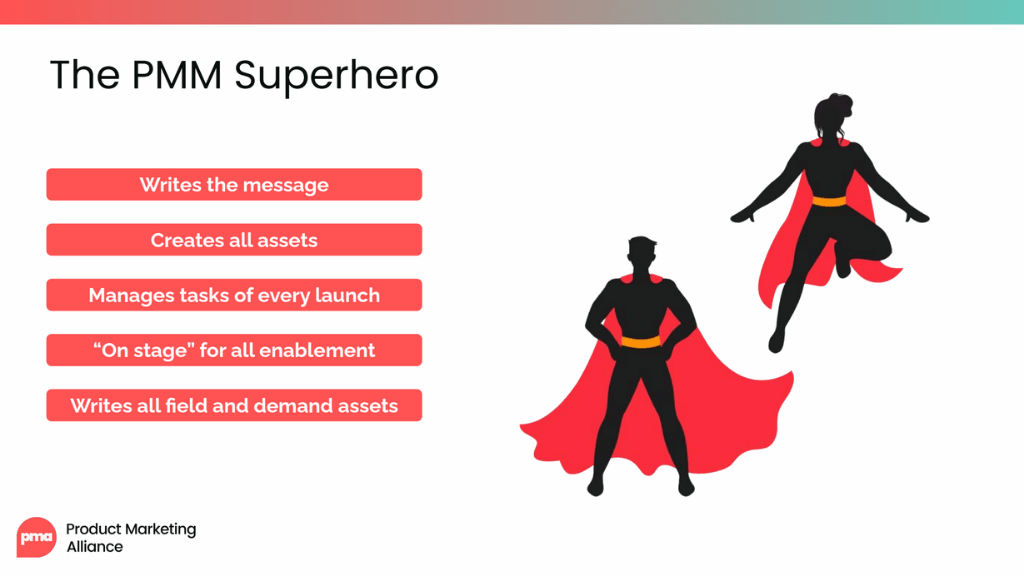
The product is changing fast, so there's a natural reason to stay close to it. The market is still being defined, so you're learning from customers in real time. Your salespeople are often practitioners themselves – former engineers and operators – so they can fill in gaps from their own experience. Plus, your campaigns are scrappy, so you can move quickly with little coordination.
You know everything about the product, the customer, the message, and the market because you're in constant contact with a small group of people who collectively hold all of that knowledge.
Then the company grows, and everything changes.
Your tight-knit sales team splits into a structured organization with customer success managers, solution consultants, project managers, and a RevOps function. The marketing team expands, and the things you used to own personally now have other hands on them. Then enablement shows up and tells you that you can't just walk into a sales call whenever you want.
Your go-to product manager becomes five product managers, and you have to navigate a whole team to get the information you used to get from one conversation.
You're still at the center of things. Your influence is still there, but it’s diluted. Plus, you’ve become a bottleneck.
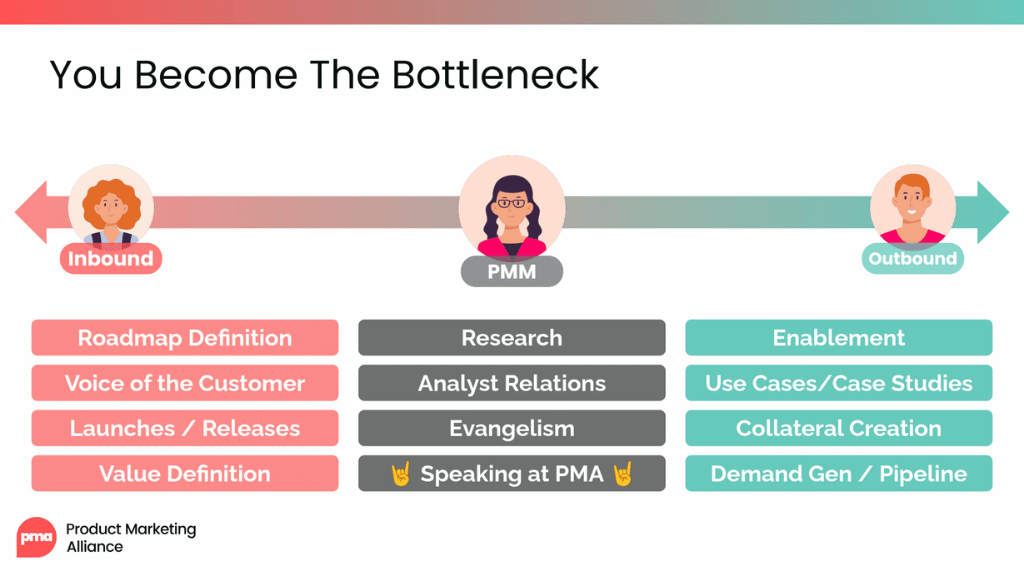
On the inbound side, you're less involved in the roadmap than you used to be. Launches start to feel like never-ending checklists rather than strategic moments. Your value messaging starts to drift toward generic territory; suddenly you're talking about speed, scale, and AI because, well, everyone is.
On the outbound side, enablement slows down because the product team is shipping faster than you can keep up with. Use cases and case studies pile up. You’ve got a backlog of collateral to produce.
You know you're not serving the field as well as you could be, and you also know you're not doing the things that would make you a better PMM – market research, analyst engagement, evangelism, and participating in product marketing events.
Something has to give. The question is what.
So, let me share three steps that helped me scale my organization out of this mess.
For expert insights like this, in full, every Friday, sign up for Pro+ membership.
You'll also get access to 30+ certifications, a complimentary Summit ticket every year, and 130+ product marketing templates.
So, what are you waiting for?
Step one: Assess your build
The first thing I'd encourage you to do is look inward at where your team sits today.
Ask yourself a few honest questions:
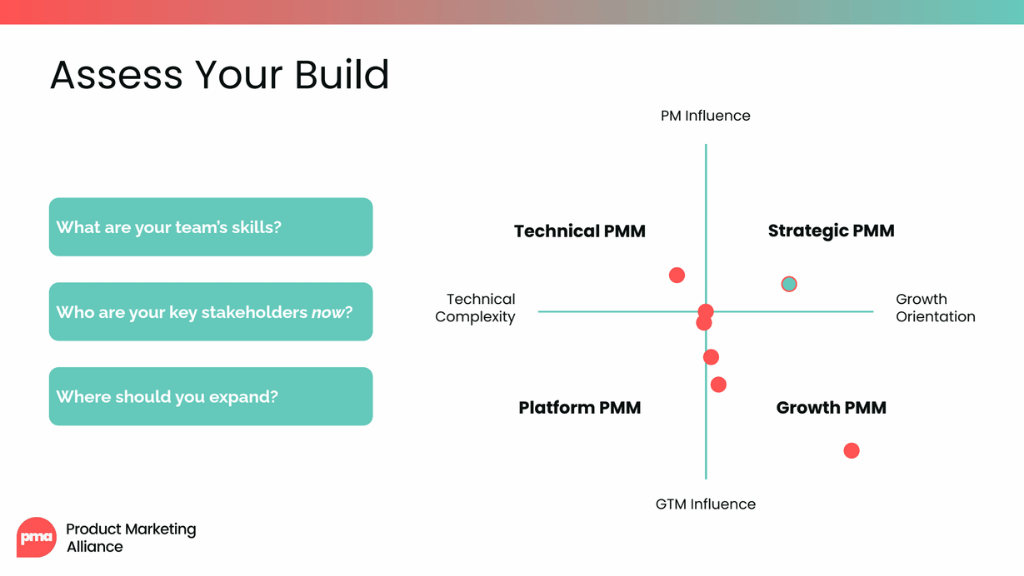
- What are your team's skills?
- Are you a technically deep PMM team, or are you more growth-oriented?
- Who are your main stakeholders now that the company has changed?
- Based on that, where should you be expanding your influence?
It helps to think about this across two axes. One is the technical depth of your team. The other is where your influence lands; does it flow more toward product, or more toward go-to-market motions?


Product marketing insider
Thank you for subscribing
Level up your product marketing career & network with product marketing experts.
An email has been successfully sent to confirm your subscription.
 Follow us on LinkedIn



.svg)