














Templates and frameworks to pair with this playbook
I've spent over a decade preaching the importance of punchy messaging. I've written copy that connects with buyers, positioned tech products so they land, and trained thousands of marketers at companies like Salesforce, Microsoft, Atlassian, and Oracle. Messaging is my thing. I even wrote a book about it!
But today, I want to talk about a different kind of message. It's not the one you put on a landing page or in a pitch deck. It's the one running on a loop inside your head every single day. That message might be the most powerful one you'll ever write.
Here's what we'll cover:
- The two-step process that turns your inner critic into an inner champion
- The writing exercise that lets you shake off impostor syndrome for good
- The letter-writing trick that helps you show up at your best in big moments
The night before everything changed
Back in 2017, I was just starting out in my business. I'd been working with small startups, early-stage founders, people just getting off the ground. Then I landed what felt like a big break: a messaging project with a hot new sales tech startup that everyone was talking about. I was thrilled.
I'd run these sessions many times before. My deck was ready. I knew the material. But something strange happened. Alone in my hotel room the night before the workshop, I started freaking out. I was changing my slides, deleting exercises I'd used a dozen times, second-guessing everything. I kept looking at my own work, thinking, “Does this make me look like an amateur?” I could barely sleep.
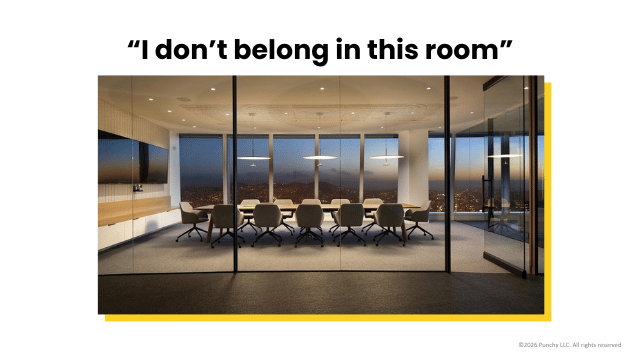
The next morning, I walked into their headquarters, saw the leadership team gathered in the boardroom, and I froze. Standing outside that door, I thought, “I can't go in there. This is above me. I don't belong in this room.” But of course, I couldn’t just walk out, so I powered through and ran the messaging workshop. It went brilliantly.
That experience woke me up to something I'd been ignoring: my mindset was quietly working against everything I was trying to build. I had big goals, but my internal monologue was sabotaging my ability to reach them. If I ever wanted to achieve the goals on my vision board, I had to change the messages I was telling myself.
That was the beginning of my journey into mindset work, and it's what I want to share with you today.
For expert insights like this, in full, every Friday, sign up for Pro+ membership.
You'll also get access to 30+ certifications, a complimentary Summit ticket every year, and 130+ product marketing templates.
So, what are you waiting for?
Everything starts with your mindset
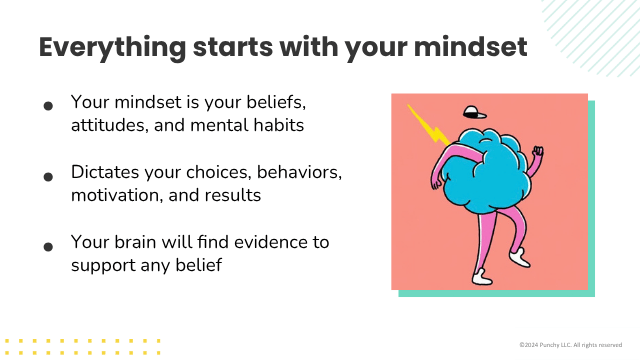
Your mindset is your usual way of thinking. It's made up of your beliefs, attitudes, mental patterns, and internal scripts. It influences the behaviors you exhibit and the actions you take, which in turn influence the results you get. Everything starts with mindset, whether you realize it or not.
Your internal thoughts – the things you say to yourself inside your head - function like direct commands to your subconscious mind. Whatever you say in there, your subconscious is listening and acting on it.
Say to yourself, “Everything today sucks,” and your subconscious mind is like, “Got it,” and it goes looking for proof. It will find those damned traffic lights you keep hitting on the way to work, the gross-tasting coffee, the weird undertone in a meeting with your boss, and the huge to-do list. Your mind will surface all of it because it's always searching for evidence of whatever you believe – whether that belief is true or not.
We have thousands of thoughts every day. Unfortunately, our brains lean toward the negative. That means many of those thoughts are repetitive worries and doubts, cycling through your mind day after day, often below the level of conscious awareness.
We default to the negative because of evolution. Thousands of years ago, scanning for threats kept us alive. Today, that same wiring just creates a near-constant stream of self-doubt, worry, and limitation. And those thoughts shape your behaviors, actions, and results, even when you're not paying attention to them.
Now layer in the fact that we are working in the tech industry in 2026. If you've felt existential dread, burnout, pressure to do more with less, or uncertainty about what tomorrow looks like, you're not alone. Every marketer and leader I speak to is feeling it.
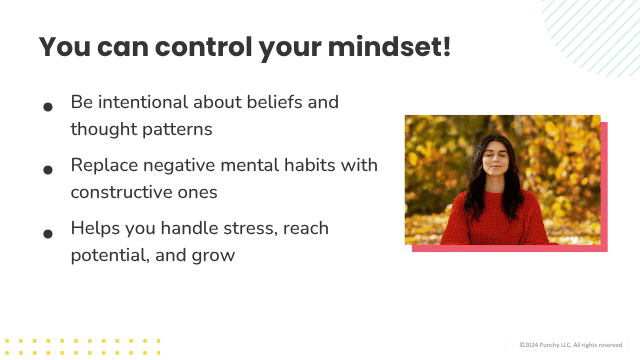
The external challenges are real, and we can't always control them. However, we can control how we show up inside them. That's what mindset work is about: learning to manage your thoughts so they work for you instead of against you.
I've been working with tech clients on mindset for the past year and a half, alongside my messaging work. What follows are three of my favorite techniques to help you quiet your inner critic, build lasting confidence, and perform at your best in the moments that matter. Each one takes just a pen and a few minutes, so you can put them to work right away.
Technique 1: Turn your inner critic into an inner champion
A client of mine, a solo product marketing manager, showed up to a coaching call visibly flustered. She'd just come out of a meeting with her CMO about a product launch that didn’t go how she wanted it to.
When I asked her what went wrong, she told me that she’d said what she wanted to say, got her next steps, and felt heard. But during the whole thing, she kept thinking, “No one's taking me seriously in here.”
That's the inner critic. We all have one.
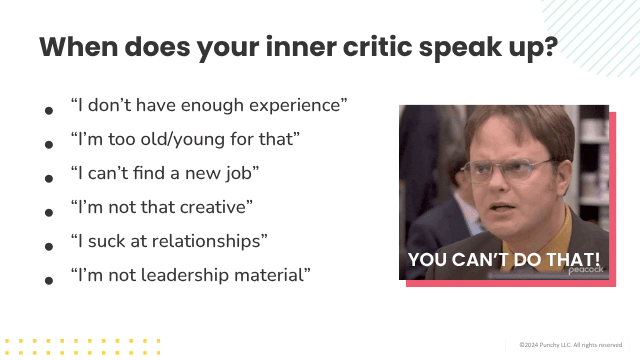
The inner critic loves to throw a wet blanket over any new idea, possibility, or moment where you're trying to step up. And the sneaky thing about it is that it speaks in the language of facts. It sounds like the truth – but the inner critic doesn’t deal in truths. It deals in limiting beliefs.
A limiting belief is a conscious or unconscious negative thought or assumption that stops you from doing something you're completely capable of doing. Things like I'm not creative, or I'm not leadership material, or I don't know enough. These feel like facts. They aren't. They're false truths we've picked up from childhood, from negative past experiences, and from societal messages we absorbed without questioning.
The good news is that beliefs can change. That's neuroplasticity at work: the brain's ability to adapt and form new neural pathways based on experience. The key driver of any change in your neurology is emotion. Strong emotional experiences wire beliefs into place, which is why you probably have vivid memories of both your most embarrassing moments and your greatest wins. Emotion makes things stick.
We can use this same mechanism to deliberately rewire negative beliefs. Here's the two-step process I use with clients.
Step 1: Cut the power to the negative belief


Product marketing insider
Thank you for subscribing
Level up your product marketing career & network with product marketing experts.
An email has been successfully sent to confirm your subscription.
 Follow us on LinkedIn



.svg)