









Most AI product positioning right now is centered around phrases like "AI-powered," "insights," "automation," or "at scale."
We have reached a point of total market saturation where the sheer volume of AI claims has diluted the perceived value of even the most sophisticated features.
For buyers, the noise has made it nearly impossible to discern actual value from marketing fluff, leaving PMMs feeling like they are shouting into a void where every unique innovation sounds like more of the same.
To cut through this static, we need a repeatable framework – a systematic way to move positioning from capability-led to outcome-based. The key insight: you can't get there by starting with your product. You have to start with your buyer.
The capability trap is worse in AI markets
Standard product positioning advice assumes you can differentiate on what your product does. Find a capability your competitors don't have, articulate it clearly, and own that space. That worked when AI capabilities were meaningfully scarce. It stopped working when AI became the default feature that every product ships.
Now every vendor claims "intelligent," "predictive," "automated," and "scalable." The claims aren't wrong; they're just undifferentiated. When every competitor makes the same capability claim, the claim collapses into noise.
A catchy messaging copy can’t fix it. That's treating a strategy problem as a messaging problem. It doesn't work.
The real solution is outcome inversion: instead of positioning around what your AI does, you position around what changes for your buyer when they use it. Here's what that looks like in practice:
The left side is where most AI product positioning lives. The right side is where differentiation actually exists. But you can't get there by rewriting your copy. You have to earn your way there by doing the upstream work.
Positioning has to start with the buyer, not the product
Most positioning processes start internally. You assess what you've built, identify the strongest capabilities, and figure out who to tell about them. That sequence makes sense from a product perspective, but it's completely backwards from the buyer's.
That sequence needs to be reversed entirely. Before you look at your product, you need to ask two foundational questions.
1. Who, exactly, are you positioning for?
Not a persona archetype – a real, named buyer role with a specific business goal and a specific way they're measured at year-end. If you can't answer those questions precisely, every subsequent positioning decision is a guess. Defining your ideal customer profile is critical. You need to go one step further and rank which buyer outcomes matter most to them before you look at what you can offer.
2. What's genuinely broken in their world right now?
Not what your product fixes – what buyers are actually struggling with before they've ever heard of you. The best positioning doesn't describe your product. It describes the buyer's problem so accurately that they feel understood. When you get that right, the product almost sells itself. When you get it wrong, no amount of messaging refinement will save you.
This isn't just philosophical – it changes what you look for when you start auditing your positioning.
Auditing what you're actually claiming
Take every statement from your website, pitch deck, one-pager, and sales deck. Plot each one on a simple spectrum from capability on the left (what your AI does) to outcome on the right (what changes for the buyer).
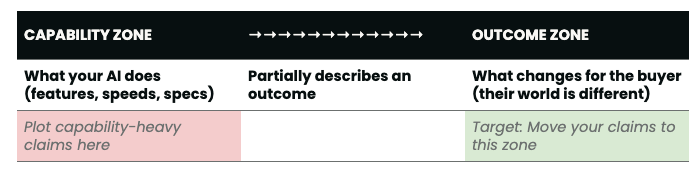
Most teams that go through this exercise discover two things simultaneously.
First, most of their claims cluster on the capability side – describing features, architecture, or processing speed, not buyer impact. Second, the few claims that sit in outcome territory tend to be the vaguest ones: "drive business growth," "make better decisions" – outcome-sounding language but far too generic to be credible or defensible.
Finding your positioning white space
After auditing your own claims, map what every competitor is claiming across the same outcome categories. This isn't a feature comparison matrix; it's a saturation analysis. And when you run it, you start to see the market differently.
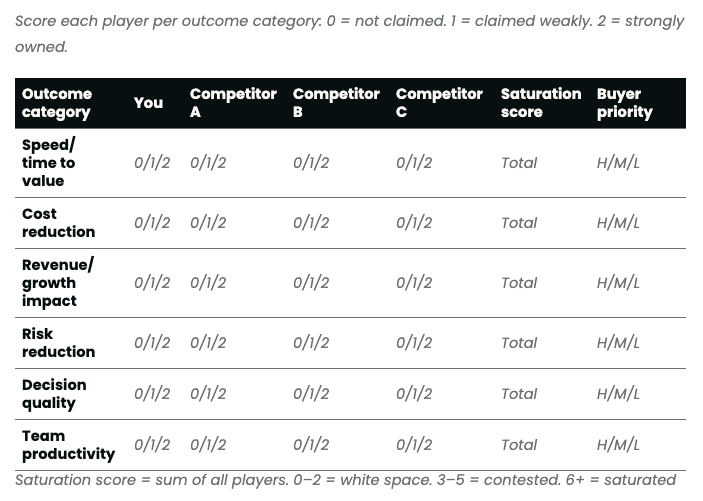
The goal is to identify an outcome territory that is both unclaimed by competitors and actively valued by your buyer. Low saturation alone isn't enough – plenty of outcome territory goes unclaimed because buyers don't actually care about it. Only outcomes your buyer ranks as a high priority qualify as genuine white space.
Outcome inversion in practice
Once you have a clear picture of buyer pain and competitive white space, outcome inversion becomes systematic rather than creative. For each capability claim in your current positioning, you do three things:
- Translate it into a specific buyer outcome
- Identify the proof you need to make that outcome claim credible
- Check whether a competitor could make the same claim without the same evidence
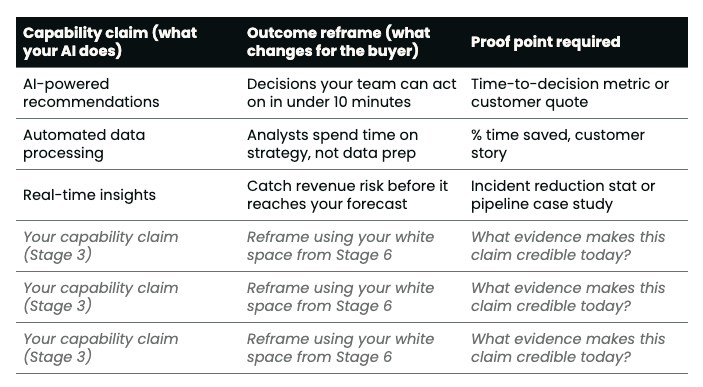
That third check is the one most teams skip, and it's the most important. A strong outcome reframe is one that only you can credibly own, because it requires evidence your competitors cannot replicate. Without that test, you're not differentiating – you're writing better copy on a position that anyone can copy next quarter.
You can't get internal alignment on a position that doesn't hold up to scrutiny. The evidence requirement in this stage is what makes the position defensible in both directions, externally to skeptical buyers and internally to executives who will push back.
Bringing it together: The AI positioning canvas
All of the work feeds into a single deliverable: a six-cell canvas that forces the positioning decisions most teams leave comfortably vague.
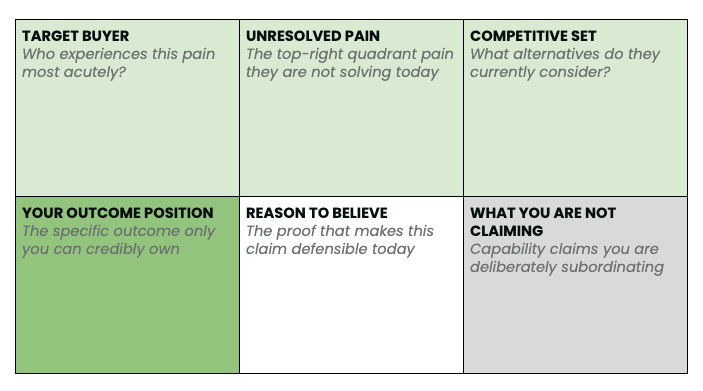
The canvas names your target buyer, their unresolved pain, and the competitive alternatives they're actually choosing between. It asks you to define the specific outcome you own, the proof that makes it credible, and (this is the cell most teams skip entirely) what you are deliberately not claiming.
That last cell does the most strategic work. Positioning that tries to own every outcome owns nothing. Naming what you're choosing to subordinate forces the clarity that produces a position that actually sticks, with buyers in the room and with your own sales team between calls. Without it, your position will get diluted the moment a sales rep adds, "and we also do X" to every conversation.
Stress testing before you ship
Run your completed position through a six-check scorecard before you take it to market. The questions are deliberately uncomfortable:
- Is this grounded in real buyer pain?
- Can a direct competitor claim the same outcome without the same evidence?
- Is the outcome specific enough that a buyer could actually verify it?
- Do you have proof, not on the roadmap, today?
A position that fails two or more checks isn't ready to ship, no matter how well it lands internally. Specific market signals tell you when to return to the process: a competitor credibly claiming your outcome, buyer research that isn't landing, or a product capability shift that changes your proof point.
Getting started
If you're positioning an AI product, download the AI product positioning framework. It’s a complete, fill-in-ready template of nine stages, with ICP profile, pain inventory, saturation matrix, outcome translation table, positioning canvas, and stress test scorecard.


Product marketing insider
Thank you for subscribing
Level up your product marketing career & network with product marketing experts.
An email has been successfully sent to confirm your subscription.
 Follow us on LinkedIn



.svg)
Start the conversation
Become a member of Product Marketing Alliance to start commenting.
Sign up now