








One of the most frustrating things I’ve noticed, both from my own experience and from talking to aspiring product marketers, is that even a lot of entry-level/early mid-career PMM roles still expect you to have done the job before.
You open a job description, and it asks for positioning, messaging, customer research, go-to-market strategy, sales enablement, launches, competitive intelligence, and sometimes two or three years of direct product marketing experience.
At the same time, there are not that many structured Associate Product Marketing Manager programs out there other than Google. Big Tech has created fairly established entry points for Product Managers through APM and RPM-style programs, but the path into product marketing still feels much less obvious. I hope they do soon!
So if you are trying to pivot into PMM, it can feel like a strange loop. You need experience to get the job, but you need the job to get the experience. I found myself in that situation more than once.
Before I started exploring product marketing seriously, I was a software engineer. I later moved into product management, and somewhere during that transition I began to notice that a lot of the work I naturally enjoyed sat very close to product marketing.
That became even more obvious while I was working on Neutrify, a climate-tech startup we were building from zero to one. I liked talking to users, understanding why they were using the product, where they were getting stuck, what language they used to describe the problem, and what made one solution feel more compelling than another.
At startups, the lines between functions were rarely clean, and I slowly realized that some of the work I enjoyed most was already overlapping with product marketing. I did not have the PMM title yet, but I had started getting exposure to the work, which became the starting point for my transition.
Finding your strengths
Before applying for another course or sending another hundred applications, I would first look backward. Go through your previous roles and projects and ask yourself where product marketing may have already shown up, even if nobody called it that at the time.
Did you:
- Interview users?
- Study competitors?
- Help explain a feature to customers?
- Support a launch?
- Write copy?
Those pieces may look small in isolation, but together they can tell you how close you already are to the work.
That exercise was especially useful for me because my path into PMM was not direct. I started in engineering at Keysight Technologies, which gave me the technical depth to understand how products were actually built and to work comfortably with technical teams.
Then, in my first formal product role at Airtel, I started getting much closer to the customer side of the business. I worked with enterprise customers, looked at large volumes of feedback, spoke with users, and helped improve a B2B product where the goal was not just to ship something but to make it easier for customers to understand and use.
That role taught me a lot about adoption, customer pain points, prioritization, and how product decisions eventually show up in the customer experience.
My startup work added another layer. In an early-stage environment, there is usually no clean boundary between product and product marketing. You are forced to think from first principles. Who actually has this problem? Why should they care about what we are building? What language makes sense to them? How are we different from the alternative they already use?
I found myself doing customer interviews, writing copy, thinking through social media growth, and figuring out how to explain the product in a way that made sense to people outside the team. Those were not side tasks. They were often the difference between having a product and having a product people actually understood.
Looking back, I realized I did not have “zero PMM experience.” I had pieces of it spread across engineering, product, and GTM work. What I lacked was a clear way to connect those pieces and understand where I still needed deeper experience. That reframing helped me stop thinking of myself as someone starting from scratch.
Instead, I started asking a more useful question: “Which PMM muscles have I already built, and which ones do I still need to strengthen?” In a way, it was a positioning exercise on myself: understand what I already brought to the table, be honest about the gaps, and build from there.
2. Building proof of work through PMA
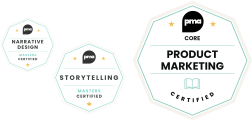
A major turning point for me was getting into the PMA Scholar Program in October 2023. By then, I had already started touching parts of product marketing through product and startup work, but I still needed a stronger structure around what I was doing.
I understood some of the pieces individually, like customer research, messaging, and positioning, but I had not yet connected them into a complete product marketing way of thinking.
PMA helped me organize that with my mentor Div Manickam, who I will always be grateful for. Every week with my cohort and mentor gave me a clearer view of how positioning connects to messaging, how customer research informs GTM, how competitive intelligence supports sales, and how all of those pieces come together around a product.
But the biggest value for me was not simply saying that I had completed a PMA program. It was being able to turn the learning into something visible. I started thinking less about the certificate and more about proof of work.
If I was learning positioning, I wanted to actually position something. If I was learning competitive intelligence, I wanted to build a battlecard. If I was learning personas, I wanted to base them on real conversations rather than assumptions. That is where the PMA assignments became really useful.
Week by week, I could apply what I was learning and improve one step at a time. This is something I would recommend to anyone trying to move into PMM. Do not treat a structured program as the end goal. The real value comes from what you do with the learning afterward.
I started documenting my work and doing my assignments seriously every week, asking for feedback during office hours, and sharing some of the same learning publicly through my Medium articles. That helped me sharpen my thinking and gave me something concrete to show in interviews and conversations.
That is where learning starts turning into credibility. For me, PMA helped give me the language and structure, but the real value came when I started using that structure to build things I could actually point to.
3. Finding an internship
Another major part of my transition was internships at ABC Fitness and Yudi J Academy as a PMM. I know that for someone who has already worked full-time, doing an internship can feel a little strange. I had already worked as a software engineer and in product, so technically I was not at the beginning of my career. But I started looking at internships differently.
For me, they were less about the title and more about getting real repetitions in a new function. There is a big difference between reading about a product launch and actually being involved in one. There is a big difference between understanding sales enablement in theory and creating something that a sales team really needs. That is where you start building judgment, not just knowledge.
I also had the chance to work across different environments, from larger organizations like ABC Fitness as my first PMM role to very early-stage startups, i.e., Yudi J Academy, and that contrast taught me a lot.
In a larger organization, there may already be established processes, research systems, brand guidelines, launch frameworks, and teams you can learn from. At an early-stage startup, sometimes none of that exists yet.
At Yudi J Academy, for example, I had the chance to operate almost like a founding product marketer, working from zero on things like messaging, sales materials, user understanding, and shaping the ICP. I had the chance to operate almost like a founding product marketer, working on different pieces from zero. That taught me something very different: how to create structure when there is no existing playbook.
That is why, if you are considering an internship as a way into PMM, I would not look only at the title or the size of the company. I would look at the work itself.
- Will you get to speak with customers?
- Will you work with the product?
- Will you touch messaging or positioning?
- Will you support a launch?
- Will you work with sales?
- Will you own something meaningful enough that you can explain later in an interview?
For me, that is the real value of an internship. It gives you the chance to work on the function in a real environment and also figure out whether PMM is something you genuinely want to commit to.
4. Volunteer with non-profits
Another way to build PMM experience is by working with nonprofits and mission-driven organizations, which I did before my first PMM internship. I think this is one of the most underrated paths because it gives you a chance to build useful experience while contributing to a mission you care about.
I did this with Connected to Culture as a PMM, helping them define the GTM for the C2C travel mobile app.
Platforms and communities exist where nonprofits need support with marketing, product, research, communications, and technology. Some of the places I have come across include Catchafire.com, Develop for Good, Hack for LA, DemocracyLab, and similar communities.
What makes these opportunities useful is that the problems are usually not hypothetical. A nonprofit may have built a product but struggle to explain what it actually does. It may have multiple audiences but use the same messaging for everyone. It may have strong impact but poor adoption.
Maybe onboarding is confusing, or maybe they are launching something new but do not have anyone thinking through positioning and communication. Those are all real product marketing problems.
Once you find one of those problems, keep your contribution scoped. I would not recommend volunteering to become an unpaid marketing department. Pick one problem and solve it well.
Maybe that means conducting five user interviews and synthesizing the themes. Maybe it means creating messaging for two different audience segments, reviewing similar organizations to understand differentiation, or helping with a launch brief or onboarding communication.
The goal is to create something useful for the organization while also giving yourself exposure to a problem you can later talk about with confidence.
That changes the way you describe your experience, too. Instead of saying, “I am passionate about product marketing,” you can say, “The organization was struggling to explain its product to two different user groups, so I interviewed users, reviewed competitor messaging, and helped create separate value propositions.”
That is much more specific, and more importantly, it is something you actually did. That gives you something much more specific to talk about in an interview than simply saying you are interested in product marketing.
5. Find an early-stage startup and solve one problem before asking for a job
The last approach I would recommend is finding an early-stage startup and studying it closely. You can find companies through Y Combinator, TechCrunch, accelerator portfolios, LinkedIn, or recent funding announcements. I would not choose a company simply because it raised money.
Pick something you understand or are curious enough about to spend a few hours learning properly. The key is to keep the problem narrow.
You probably do not have access to the company’s internal data, roadmap, pipeline, or customer research, so do not try to build an entire GTM strategy.
Maybe the messaging is unclear, competitors all sound similar, technical and business buyers are being spoken to in the same way, or customer reviews reveal a pain point that is not being addressed clearly. Pick one question and go deep.
Then research it properly. Look at the company website, competitor pages, founder interviews, customer reviews, Reddit discussions, case studies, and job postings. Turn what you find into something useful, such as a short positioning deck, messaging teardown, revised landing page, battlecard, or prototype. AI can help you organize the research, but the thinking and recommendation should still be yours.
Once you have something solid, reach out to the founder, marketing leader, or product leader and ask for feedback rather than asking for a job.
A simple message like, “I spent some time studying your positioning and competitors and put together a short analysis around one area I found interesting. I am sure I am missing internal context, but I would really value 15 minutes of feedback," which can open a much better conversation.
Not everyone will respond, and that is okay. You still learn more about the market, and sometimes that conversation can lead to a project, internship, or role.
Final thoughts
Looking back, I think the biggest shift for me was becoming comfortable with not having a perfectly linear path.
At the time, moving from engineering to product and then into product marketing sometimes felt scattered. Still, each experience gave me a different way of looking at customers, products, and markets.
What matters most to me now is not knowing every framework or using the right terminology. It is being able to understand the customer, make sense of ambiguity, communicate clearly, and explain why a product should matter to the people it is built for. I am still learning, building, and asking for feedback with every project.
If you are trying to make the same transition, you do not need to have everything figured out before you begin. Sometimes the path only starts making sense after you have already taken a few steps on it.
If you loved this, connect with me on LinkedIn 😄. Here, rooting for you!


Product marketing insider
Thank you for subscribing
Level up your product marketing career & network with product marketing experts.
An email has been successfully sent to confirm your subscription.
 Follow us on LinkedIn



.svg)
Start the conversation
Become a member of Product Marketing Alliance to start commenting.
Sign up now