






What is a go-to-market (GTM) strategy?
A go-to-market strategy is a comprehensive plan that outlines how a product or service will be positioned, priced, promoted, and distributed to a target audience.
It fuses together a range of business functions – including product, marketing, sales, and customer intel – to form a fully aligned value proposition and action plan for launching and scaling a new product.
A strong GTM strategy will detail the competitive positioning, ideal customer profile, distribution channels, promotional tactics, and sales enablement practices that will be used to not only commercialize the product, but also accelerate its adoption in the marketplace.
In this sense, a go-to-market strategy should heighten your market awareness and ensure the organization doesn’t waste money, time, and resources releasing a product to the market that lacks sufficient demand. It should also help you launch your product into a new market, reposition/relaunch your brand, or improve existing product sales.
The five essential elements of a go-to-market strategy
- Market definition: Which markets will you be targeting when selling the product or service?
- Customers: Who is the target audience/target market, and what do the demographics look like within these markets?
- Distribution model: How do you intend on delivering the product or service to the customer?
- Product messaging and positioning: What is being sold and what is its unique value or primary difference when compared to other products or services in the market?
- Price: How much should the product or service cost for each customer group?
 James Shaw
GTM strategy frameworks and approaches
Once you know your five elements, you need a structure to organize them around. Most GTM strategies borrow from one (or a mix) of the following.
The funnel model
The classic top-to-bottom structure: awareness, consideration, decision. Marketing owns the top, sales owns the bottom, and a prospect moves through stages (MQL to SQL to opportunity) before they close.
Example: Most enterprise SaaS companies, Salesforce included, still run their core pipeline on a funnel model, tracking prospects from marketing-qualified lead through to closed-won.
The flywheel model
HubSpot introduced the flywheel in 2018 as a direct replacement for its own funnel.
Instead of customers falling out the bottom once they buy, the model puts them at the center, with marketing, sales, and service working together to turn happy customers into referrals that feed new growth.
Example: HubSpot itself, whose flywheel model reoriented go-to-market planning around customer retention and referral rather than pure top-of-funnel acquisition.
Product-led growth (PLG)
The product does the selling. Users try it for free, get value fast, and either upgrade themselves or pull in colleagues who then become paying accounts.
Example: Slack grew inside companies one team at a time. Someone signed up for free, invited a few colleagues, and the account expanded into a paid enterprise deal without a single cold call.
Account-based marketing (ABM)
Instead of casting wide, ABM treats a small list of high-value target accounts as individual markets, with research and messaging built for that one account (sometimes that one buyer).
Example: GumGum learned that T-Mobile's then-CEO, John Legere, was a Batman fan. It commissioned a custom comic book, "T-Man and Gums," starring him, mailed it directly to T-Mobile's decision-makers, and landed the account after Legere shared it on social himself.
Most GTM strategies end up as a hybrid: a PLG motion for self-serve customers, layered with an ABM push for the accounts big enough to justify a sales team.
Go-to-market strategies unpacked
More often than not, product marketers own the go-to-market process, since it depends heavily on cross-functional management, extensive knowledge of the product, and analysis of the market.
But what exactly is a go-to-market strategy and why do you desperately need one?
GTM strategy vs. marketing strategy
These two get confused constantly, and the short version is: a GTM strategy is what you do to launch something specific into a market; a marketing strategy is the ongoing plan for how you reach and grow within that market.
A GTM strategy usually sits inside a marketing strategy, not next to it. You'll run several GTM strategies (one per launch) over the life of a single, longer-running marketing strategy.
B2B vs. B2C go-to-market strategies
A GTM strategy for a B2B software company and a GTM strategy for a B2C skincare brand share a structure, not a playbook. The buyer is different, the sales cycle is different, and the channels that actually move product are different too.
Here's how the two typically compare:
The line blurs in categories like B2B2C (a payments platform selling to businesses whose customers then use the product) or product-led SaaS with a self-serve, almost consumer-style signup flow. When that's the case, build your GTM strategy around whoever is actually making the buying decision, not just who ends up using the product.
Who needs a go-to-market strategy?
Anyone who is looking to launch a new product in an existing market, an existing product in a new market, or testing a new product's market for growth should consider creating a Go-to-Market strategy.
What is the go-to-market model?
The go-to-market model is a plan that details how a company can promote a product to gain the interest of customers and gain a competitive advantage over other companies in their market.
Why are go-to-market strategies important?
So what's the point of a GTM strategy? The next few sections will break down the importance of a go-to-marketplan by discussing the benefits and driving factors of the strategy.
Benefits of a go-to-market Strategy
Prioritizing a go-to-market strategy can massively improve your organization, products, and customer relationships, here are just a few benefits:
- Reduces the time it takes to get a product to market
- Reduces the financial risk of a failed launch
- Delivers the best experience to customers
- Sets out a clear plan and direction for all teams
- Sets out a clear path for growth
Developing an effective GTM strategy can be daunting, but trust us it’s more than worth the time and effort you’ll put in.
How to build a go-to-market team
Jeff Thompson, President and Co-Founder at Aventi Group, sat down with Helen Dwight, Global VP and Head of Marketing Intelligent Enterprise and Industries at SAP, for an #AventiLive Chat on best practices for go-to-market launches. Sasha Mostofi-Jorgensen, Partner at Aventi Group, captured what they said about GTM teams.
"Having the right team of people around you makes all the difference in planning and implementing a successful product launch. You’re going to be working under a lot of pressure, so collaboration and communication are key.
"One good strategy is to start small. Choose a core set of people that need to know the intricacies of the process, then reinforce the roles, responsibilities, and timeline with them.
"Be sure to keep all of your stakeholders informed of the plan to avoid any surprises down the road, and expand the active team slowly and strategically by bringing others on board at the right point in time."
The role of go-to-market strategy in product marketing
There's no disputing that go-to-market strategies play a pivotal role in the product marketing world.
Susan "Spark" Park, Head of Gaming Ads Product Marketing at Facebook & Kevin Bailey, go-to-market strategist outlined why it's the bread and butter of product marketing.
Who is responsible for a go-to-market strategy?
Typically, a product marketer or GTM owner is responsible for the go-to-market strategy, and these teams tend to work best when reporting to marketing while being backed by executive teams.
What are go-to-market roles?
Your GTM team should include representatives from:
- Product
- Product marketing
- Sales or sales enablement
- Customer success
- Pricing
And you may want to consider also having a GTM manager or owner to help coordinate the team and track the project’s progress.
Christine Friscic
How to create a GTM strategy: Go-to-market checklist
Step 1: Identify your buyer and the buying center
Figure out who's actually making the purchasing decision, and why.
According to Harvard Business Review, the average B2B purchase involves 6.8 people, known as the buying center. Some titles below can overlap in smaller organizations:
Initiator: Shows initial interest or starts the buying process
User: The person who'll be using your product
Influencer: Convinces other members of the org they need the product
Decision maker: Gives the final purchase approval
Buyer: Owns the budget
Approver: Usually someone in the C-suite who gives final, final approval
Gatekeeper: Gets in the way of a product being approved for purchase
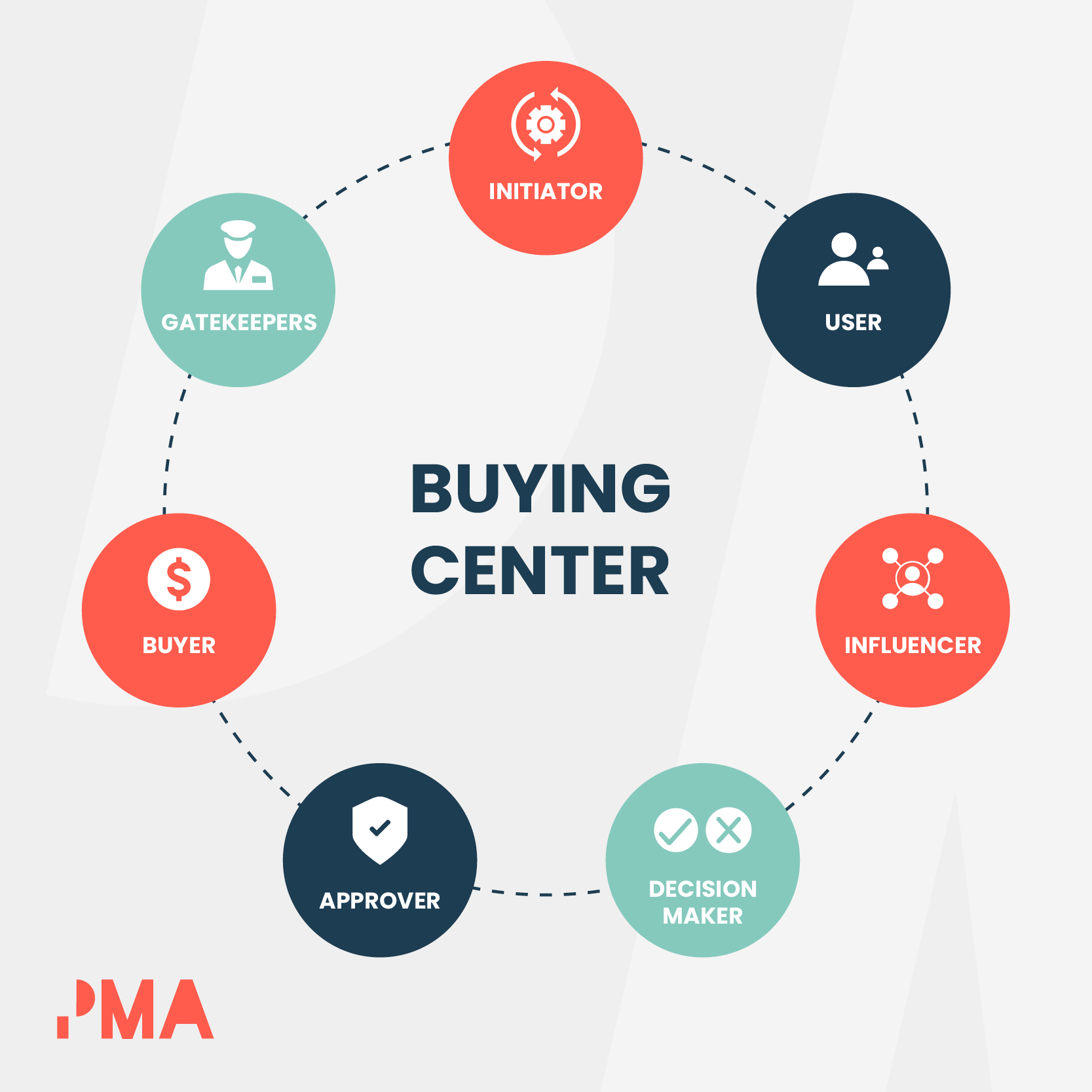
Once you've mapped the titles, dig into each person's objectives and pain points. This is what turns a generic pitch into a GTM strategy that actually addresses what each buyer in the room cares about.
Step 2: Build personas and messaging
Turn your buying-center research into buyer personas, then translate those personas into messaging for each role. A message that lands with your economic buyer (cost, ROI) won't land the same way with your end user (day-to-day usability).
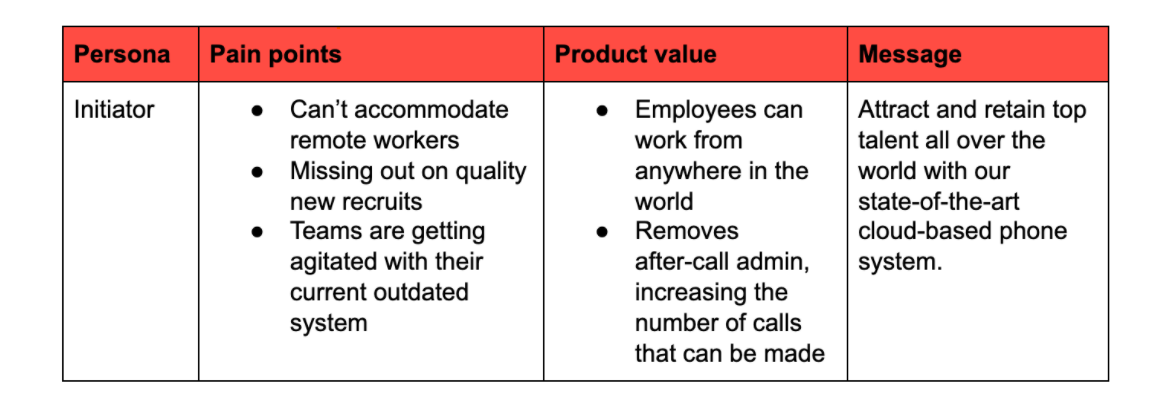
Repeat this for every title in your buying center: gatekeeper, influencer, decision-maker, and so on.
Step 3: Test your messaging
Take your messaging for a test run before you commit budget to it. Figure out where your audience actually spends time; LinkedIn will outperform Instagram for most B2B buyers, for example, but that's not universal.
Watch where conversions are weak and reallocate. If a channel isn't gaining traction after a fair test, move the budget somewhere it will.
Step 4: Map the buyer's journey
With personas and messaging in place, map the journey from both sides: what the buyer experiences and what your team needs to deliver at each stage.
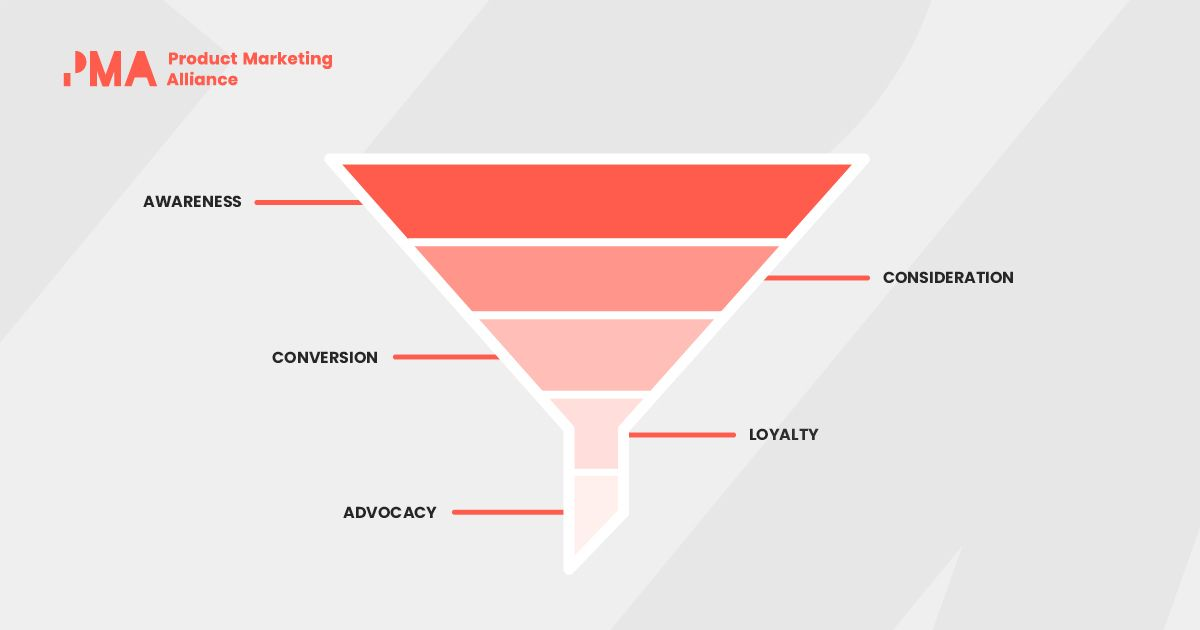
- Awareness: The buyer knows a little about your product but isn't close to committing. Content here needs to grab attention fast: a strong blog post, video, or whitepaper.
- Consideration: The buyer has a defined problem and is actively weighing your product as a solution, often after downloading a resource like an eBook.
- Decision: The buyer is close. A free trial or a well-timed sales conversation is usually what closes the gap.
Ownership typically splits by stage: marketing owns awareness, and sales takes over once a lead reaches the decision stage.
Step 5: Build the strategy
Bring the pieces together. Your budget, market size, and sales cycle will all shape the final shape of the plan.
Before finalizing, answer:
- Which channel performed best in testing?
- Which messages landed, and which fell flat?
- At what point does a prospect qualify as a lead?
- How do prospects want to be communicated with?
- What can you do to help sales close faster?
- What assets does each funnel stage still need?
Your answers should tell you which channels to prioritize, what to say on each one, who you're targeting, and what your sales team needs in place to convert. Set a timeline so nothing slips.
Step 6: Create your content
Build the content bank your GTM plan depends on, whether that content lives with product marketing or with marketing more broadly.
Step 7: Set success metrics
Before you launch, define what success looks like. Set targets that are ambitious but realistic, and track them consistently once the strategy is live.
If something isn't working, go back and adjust. Ignore the numbers and a promising product turns into a launch that quietly underperforms.
How to improve your go-to-market strategy
Metrics play a fundamental role in improving your go-to-market strategy and refining your sales process; implementing a suitable system will improve your sales team’s performance.
Key performance indicators (KPIs) like conversation rate, sales volume, and time can help you establish whether you're hitting your goals, and assess where your sales team needs to improve.
Moreover, metrics will also enable you to analyze ways to lower your customer acquisition cost to optimize your profit earned per customer and reduce your sales cycle.
The shorter the sales cycle, the quicker you can nurture buyers through the sales funnel, keeping existing buyers happy, and attracting new customers to supplement your inbound figures. This approach has all the makings of an effective business model, as customer retention is maintained, whilst churn is kept under control.
Also, seek input from your buyers when improving your GTM strategy. For example, case studies are often used to provide insights into your unique value proposition from a buyer’s perspective.
This not only serves as a powerful tool for your salespeople, but you can also distribute words of endorsement across your marketing channels, improving your SEO and visibility in search engines in the process.
Download now for transferable takeaways that’ll help you and your team launch your product into a new market, reposition/relaunch your brand, and improve existing product sales.
How to optimize a go-to-market strategy for a scale-up business
A scale-up business is just one step up from a start-up. So, you’re still very much in the beginning stages of your organization.
One of the most important things you must do when you’re in this position is to just continue working on and refining your product marketing strategies depending on the data and feedback you receive from your previous launches.
One of the biggest goals you must always be aiming towards is to enhance the customer experience (CX) with your product. Some factors affecting CX that you may look to refine and improve are:
- Product design/quality,
- Accessibility,
- Reducing cognitive load,
- Pricing (discounts, freebies, etc.),
- Convenience, and
- Availability.
In order to do this, ensure that you’re carrying out accurate and appropriate testing. One of the simpler tests you can carry out is A/B testing, which many PMMs argue is one of the most important tests to implement, especially when just starting out.
Siddhartha Kathpalia, Associate Director (Marketing, Americas + Product) at VWO said:
“A/B testing is a great methodology for making incremental changes and being sure of impact but it isn't great when a strategy needs to be deployed. It’s great when there is sizable data available, but not when there isn't enough traffic. A/B testing is great to ensure metrics maintain at the same level or grow, but not to disrupt the market.
“Everything can be A/B tested, but not everything should be. I've been able to demonstrate two changes that led to 150% growth for two organizations that have helped me grow too.”
Lawrence Chapman
How to optimize a go-to-market strategy for an enterprise business
Perhaps one of the most common misconceptions for enterprise businesses- and a big pain point for PMMs- is that they believe because their organization is so well established, they no longer need to make the effort to continue improving and refining their product marketing strategies. But, this couldn’t be further from the truth.
If anything, in an enterprise organization, you should be continuing to fight for the lead you have, with the help of your larger team size, budget, and resources, and putting them to good use by consistently researching and implementing new and improved strategies. The goal should always be to try and improve the customer experience, reduce churn, and always win the market.
Because you’re an enterprise business and likely have done multiple product launches, you can use these to your advantage. Carrying out research like win/loss analysis and Customer Advisory Boards (CABs) is a great way to see how you can further improve and refine your products. And, as always, ensure the focus for this is always on your customers, as their opinion is the most important when it comes to your product.
One of the biggest challenges that enterprise businesses face, and that start-ups probably don't, is that of busier processes. If your company is large and you're marketing multiple products, you might be given a bigger project with unrealistic timelines, for example.
When we asked Jeremy Castile, Senior Director of Product and Alliance Marketing at Docker the advice he’d give to those struggling with this challenge, he said:
“Try and work as early as you can with the product and engineering team.
“But beyond that, let's say you have 30 days to go launch a major project or product that you just got told about. The number one thing is to stay focused, don't panic, but see if you can create an MVP, a minimum viable product, if you will, for this launch.
“Ask yourself: What are the must-haves? What are the things that you can trim to do post-launch? Because if you look at a launch list of all the things that you need to do for a launch, some things can be pushed, and other things are absolute must-haves for a go-to-market launch.
“So I would say that's one of the ways that I've been able to overcome the challenge of not having enough time. I’ve told myself: "Okay, we have this long list of things that we need to do. Let's organize this by what's must-have, what's nice to have, and what can be pushed to post-launch".
“All of a sudden, you start finding all these things that you could go "Okay, we don't have to have that in 30 days", or whatever the short timeline is. So that's been super helpful.”
Go-to-market strategy challenges and resolutions
Jeremy Castile, Senior Director of Product and Alliance Marketing at Docker, is a GTM expert, and shared advice for overcoming common challenges and mistakes.
Here's what he had to say:
Q: What challenges have you previously faced when putting together a go-to-market strategy or working on a product launch? And more importantly, how did you overcome these obstacles to eventually achieve your desired goal?
A: “Working as a product marketing person, I think you're always in a little bit of a state of chaos. There are always new products, always new features, always new campaigns, new content, and things that need to be cooked. But one of the challenges I think, that I've run into a lot, I'm sure other PMMs have, is just not having enough time.
“In the tech space, the pace of innovation is so fast, and we're constantly trying to come out with new features and new capabilities to meet users’ demands.
“There is another set of challenges that I could go into but with regards to not having enough time, because this one is so common, I think, for folks that run into this often, again, getting back to my earlier point, try and work as early as you can with the product and engineering team.
“But beyond that, let's say you have 30 days to go launch a major project or product that you just got told about. The number one thing is to stay focused, don't panic, but see if you can create an MVP, a minimum viable product, if you will, for this launch.
“Ask yourself: What are the must-haves? What are the things that you can trim to do post-launch? Because if you look at a launch list of all the things that you need to do for a launch, some things can be pushed, and other things are absolute must-haves for a go-to-market launch.
“So I would say that's one of the ways that I've been able to overcome the challenge of not having enough time. I’ve told myself: "Okay, we have this long list of things that we need to do. Let's organize this by what's must-have, what's nice to have, and what can be pushed to post-launch".
“All of a sudden, you start finding all these things that you could go "Okay, we don't have to have that in 30 days", or whatever the short timeline is. So that's been super helpful.”
Q: Everyone needs to make mistakes to learn and develop. What are some of the common mistakes that you've seen product marketers make when putting together a strategy? And what advice would you give product marketers to help them avoid the same pitfalls?”
A: “I think one of the easiest traps to fall into as a product marketer, and I've fallen into this trap myself, is where your product, feature, brand, or company becomes the hero of your product launch’s narrative instead of the user or the customer.
“It’s a common pitfall where you see PMMs launching new products or features, and starting the story with, "here's a new feature, and here are all the capabilities" or "here's what makes this feature cool". would say instead flip that.
“Instead of placing an emphasis on the product or company, go user in, and answer questions such as: what are the challenges that your user faces? What are their aspirations? What are their goals? Make the customer the hero of the story. Who is that person? What are their goals? What do they want to achieve? How are they growing their business?
“This makes your narrative much stronger and more compelling. That's just one of the common pitfalls I've seen with PMMs, and it's easy to fall into because as a PMM, we are product marketing people. We're focused on the product, we buy into the story of the product, and we know everything about the product.
“We sometimes assume that our users already know all the background of this product and the story and the features behind it. But I think there's some education you have to do there in pulling your user back to the middle of the story, I think it's super important.”
Go-to-market strategy examples
Oatly's US market entry
Oatly entered the US market in 2017 facing a real problem: oat milk was a niche product in a market dominated by dairy and already-established alternatives like almond and soy milk. Here's how its GTM strategy mapped to the five elements covered earlier in this guide.
Market definition: Rather than launch nationwide, Oatly picked four cities: New York, Los Angeles, Chicago, and San Francisco. All four had dense, influential specialty coffee scenes.
Customers: Instead of targeting grocery shoppers first, Oatly targeted baristas and independent coffee shop owners. This group had outsized influence over what home coffee drinkers would go on to try and trust.
Distribution model: Oatly seeded product directly into independent cafés before chasing retail shelf space. Café presence became the trial mechanism; retail came after.
Product messaging and positioning: The "Hey Barista" campaign spoke directly to coffee professionals, not end consumers, reinforcing Oatly as the oat milk built for espresso rather than a general dairy substitute.
Price: Oatly's Barista Edition was formulated specifically to froth and behave like steamed dairy milk, letting cafés charge the same up-charge they already charged for other milk alternatives, with no retraining or new equipment required.
The result: Oatly built a reputation among coffee professionals before it ever needed a mass-market ad campaign. It listed on Nasdaq in 2021, and by 2023 had grown net revenue to roughly $785 million. The GTM strategy didn't chase every customer at once; it won the smallest, most influential audience first and let that audience do the convincing.
Fitbit Smart Coach
You know FitBit, the manufacturer of those activity trackers that look like smartwatches, well a few years ago the company launched Smart Coach, a premium service and personal training app, that integrates with the user’s FitBit.
Their GTM strategy started with simple, attainable objectives, including:
- Building brand awareness
- Increasing subscription revenue
- Improving the subscription attach rate
Launching the “Get More With FitBit” campaign which involved using both paid and owned channels to reach the target audience (FitBit’s users).
Paid channels included retargeting display ads that directed potential customers to a landing page.
They also used push notifications, social media accounts, and newsletters to reach their target customers.
The result: The company earned $192 million in revenue.
Upscope
Upscope is an interactive screen-sharing service.
They could have easily been just another standard screen-sharing program, targeting the usual suspects. But with a solid GTM strategy, they leveraged the live chat wave, targeting those who would need it the most - customer service advisors, technical support, and onboarding specialists. They focused on one universal pain point - the annoyance of setting up screen sharing.
Lawrence Chapman
Learn more in our complete GTM guide
Whether you're bringing a product to market this quarter or next year, learn from the best for when the time does come with this selection of presentations, templates, and guides to help you through your next GTM project.
Part 1: presentations
- Insight to installs: How art.com leveraged customer insights to deliver stellar go-to-market results
- Disruptive go-to-market strategies for exponential growth
- Go-to-market strategies: the bread and butter of product marketing
- The challenges of global go-to-market strategies
- Enterprise go-to-market for AI-driven automation
- A go-to-market strategy to win in the market
- 4 steps to sharpen your go-to-market focus with customer segmentation
- Go-to-market best practices and strategies
Part 2: templates
- Product launch tier framework
- New product project planner
- Internal roadmap template
- Launch checklist
- Product roadmap framework
Part 3: Go-to-market guides
- Product launch and land: answering the what, why, when, and how
- Using your product to accelerate growth: A product marketers guide to product-led growth
- How to incorporate the voice of the customer into your product marketing strategy
- How to improve your conversion funnel without changing your product
- The art of not launching a product
There's plenty more where this came from. 👆
Unlock it all in here. 👇
 Product Marketing Alliance
Learn more about GTM Strategies and access a range of resources, templates, and frameworks, like the one below in our member’s area. Already a member?! Awesome! Everything you’ll need is all in one place, at your fingertips.
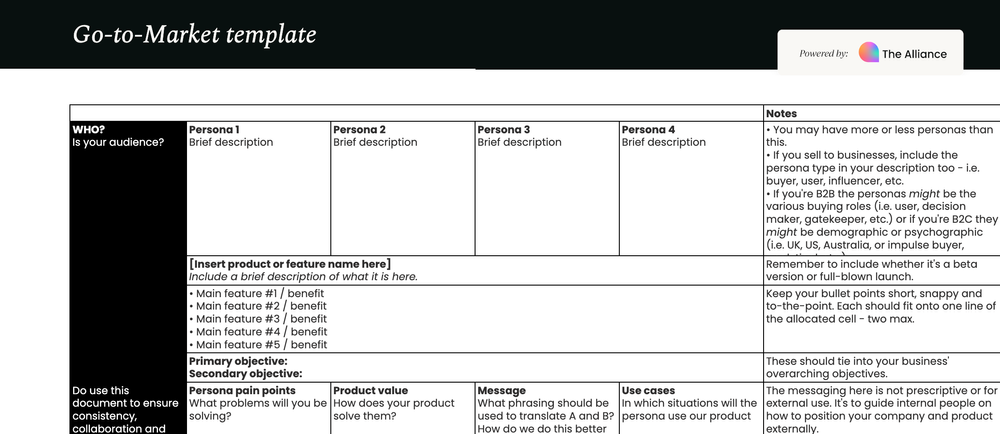
Access this complete toolkit – and more – right here. 👇
 Product Marketing Alliance
Learn the fundamentals of go-to-market strategy
Go-to-Market Certified: Masters features everything you need to consolidate your knowledge of key GTM principles and understand how this bread-and-butter deliverable works.
Completing this course will help you:
🚀 Execute successful product/feature/market launches
🏢 Own GTM strategies at companies large and small
🎯 Understand GTM tactics during pre-launch, hard-launch, and post-launch phases
🤝 Keep products on the market by effectively owning the full customer cycle
📝 Confidently and effectively project manage the whole GTM cycle cross-functionally


Product marketing insider
Thank you for subscribing
Level up your product marketing career & network with product marketing experts.
An email has been successfully sent to confirm your subscription.
 Follow us on LinkedIn


.svg)
Start the conversation
Become a member of Product Marketing Alliance to start commenting.
Sign up now