








What is product marketing? (The 2026 definition)
At its core, product marketing is the process of bringing a product to market and overseeing its ongoing success. It is the intersection of product, sales, and marketing.
While traditional marketing focuses on lead generation, product marketing focuses on demand, adoption, and retention. PMMs are responsible for:
- Market intelligence: Understanding the customer and the competition.
- Positioning and messaging: Defining how the product solves a specific problem.
- Sales enablement: Equipping teams with the tools to close deals.
- Product launches: Coordinating the Go-To-Market (GTM) execution.
In this guide, we'll dive deeper into the roles and responsibilities of a product marketer in 2026.
The role of product marketing [Infographic]
In six very simple circles, the role looks a bit like this:
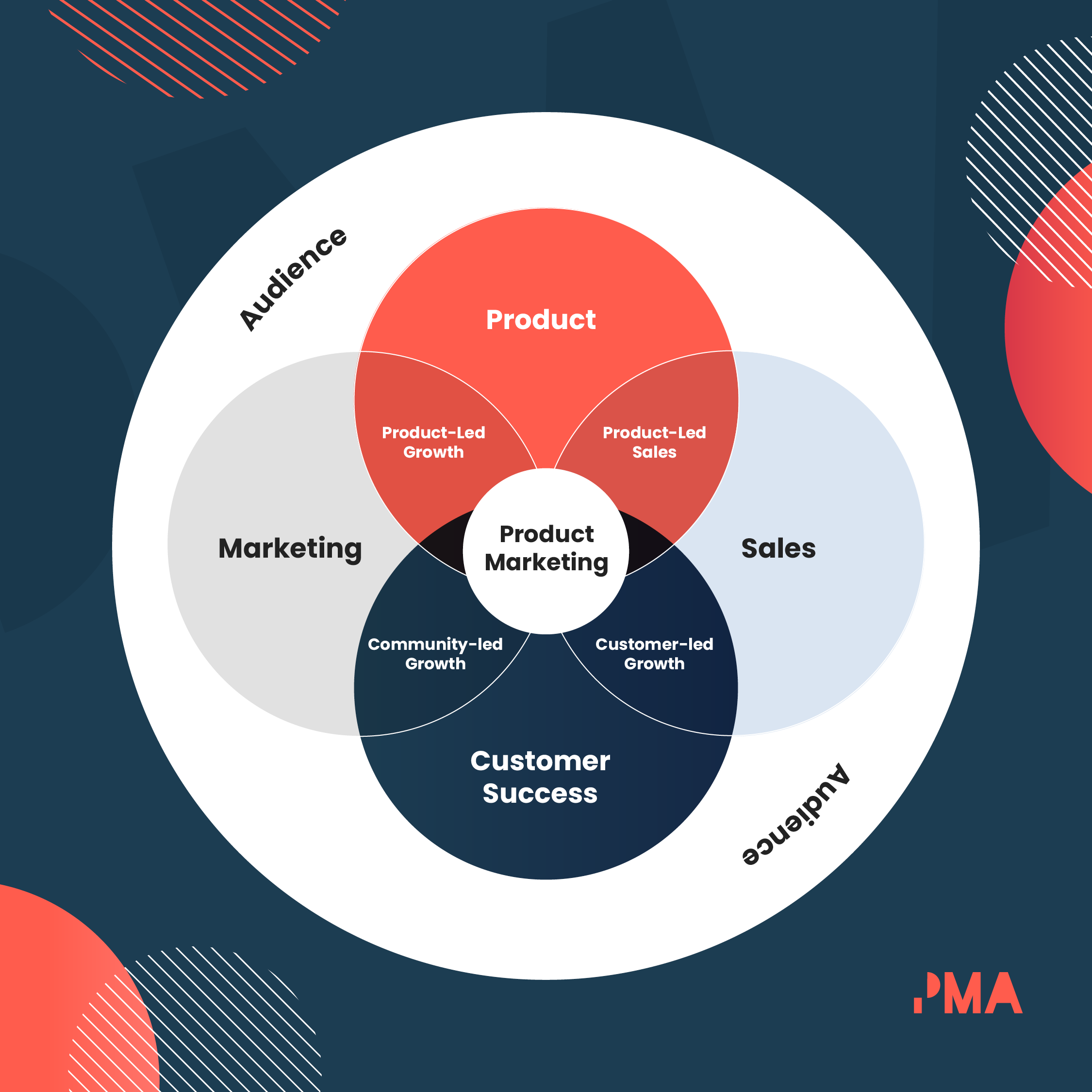
The Product Marketing Framework: A blueprint for success
Product marketing sits at the heart, the intersection, and the core of all successful companies. PMMs collaborate with key teams such as the marketing team, sales, customer success, and plays a critical role in helping the business achieve its goals.
It's vital and exciting - but it can be a little complicated, but this is where the Product Marketing Framework comes in:
Our Product Marketing Framework covers all the necessary areas required to navigate the product marketing journey, from A to B to C to D... the list goes on.
The framework defines five fundamental phases of product marketing: discover, strategize, define, get set, and grow. We recommend familiarizing yourself with the full framework to really get to grips with each of the moving parts.
But in the meantime, here's a whistle-stop tour:
Discover - This is the stage in which you gather the info and insight to turn your assumptions into an educated hypothesis. Customer feedback and sussing out the competition are just two of the key elements involved - and they're both product marketing gold dust. ✨
Strategize - Whether it's product-market fit, your GTM plan, or your pricing, strong product marketing always comes with a strategy.
Define - This is all about identifying your personas and applying what you garnered from your discovery stage to shape customer journey and communications.
Get set - Here, it's time to harness all your hard work thus far with training, sales enablement sessions, and marketing campaigns so your team is equipped to take the GTM by the horns and run with it.
Grow - This is where your post-launch process needs to kick in, to ensure your product continues to flourish and evolve in its market.
Why is product marketing critical in a crowded market?
In an era where the barrier to entry for building software is lower than ever, having a "great product" is no longer enough. The market is saturated with "me-too" solutions, and buyers are suffering from feature fatigue.
Without product marketing, even the most innovative technology risks becoming a "two-billion-dollar faux pas." The role is critical because it acts as the insurance policy for your product’s success.
1. Solving the "product-market fit" crisis
Studies consistently show that the #1 reason startups and new product lines fail isn't bad technology; it’s a lack of market need.
Founders and engineers often fall in love with a "shiny" new feature and then go hunting for a problem to solve with it. Product marketing flips the script.
By bringing customer empathy and market intelligence into the development process early, PMMs de-risk the investment. They ensure that what is being built has an acute pain point waiting for it on the other side.
2. Cutting through "AI washing" and feature noise
In 2025 and 2026, we’ve seen a massive surge in "AI washing" – companies slapping AI labels on every feature without explaining the value.
Take the contrast in how companies approach new tech:
- The feature trap: A company launches an "AI-powered dashboard" because everyone else has one. Users are confused, adoption is low, and the product feels like "generic hype."
- The PMM approach: A company like Loom recognizes that users hate the friction of summarizing long videos. Instead of marketing "AI," they market the outcome: "Edit videos by deleting text" and "Instant summaries."
Product marketing translates "what it is" (AI) into "what it does for you" (saves 20 minutes a day).
3. Creating strategic differentiation
In a crowded market, your competitors can copy your features in weeks. What they cannot copy easily is your positioning.
Product marketing identifies the "white space" in the market – the specific corner that your brand can own.
Whether you are the "easiest to use" (like Notion) or the "most secure for enterprise" (like Salesforce), the PMM defines the narrative that makes a customer choose you over a 10% cheaper rival.
4. Maximizing revenue velocity (Sales enablement)
A product can’t stay in the market if it doesn't sell. When the market is crowded, Sales teams face "analysis paralysis" from prospects. Product marketing provides the Battlecards, Proof Points, and Storytelling that help sales reps move deals through the pipeline faster.
As our 2025 State of Product Marketing report highlighted, the massive jump in Sales Enablement as a core responsibility (up to 78.7%) proves that PMMs are now the primary engine behind revenue velocity in competitive landscapes.
Product marketing vs product management: What’s the difference?
There’s a lot of ambiguity around both roles, so you can be forgiven for confusing Product Managers (PM) with Product Marketing Managers (PMM), as many, many people do.
There are certainly some similarities, PMs and PMMs are all-rounders, who can effectively work across product, marketing, and sales. Both are responsible for product launches and both roles need to coordinate different teams within an organization to ensure that the product release is successful.
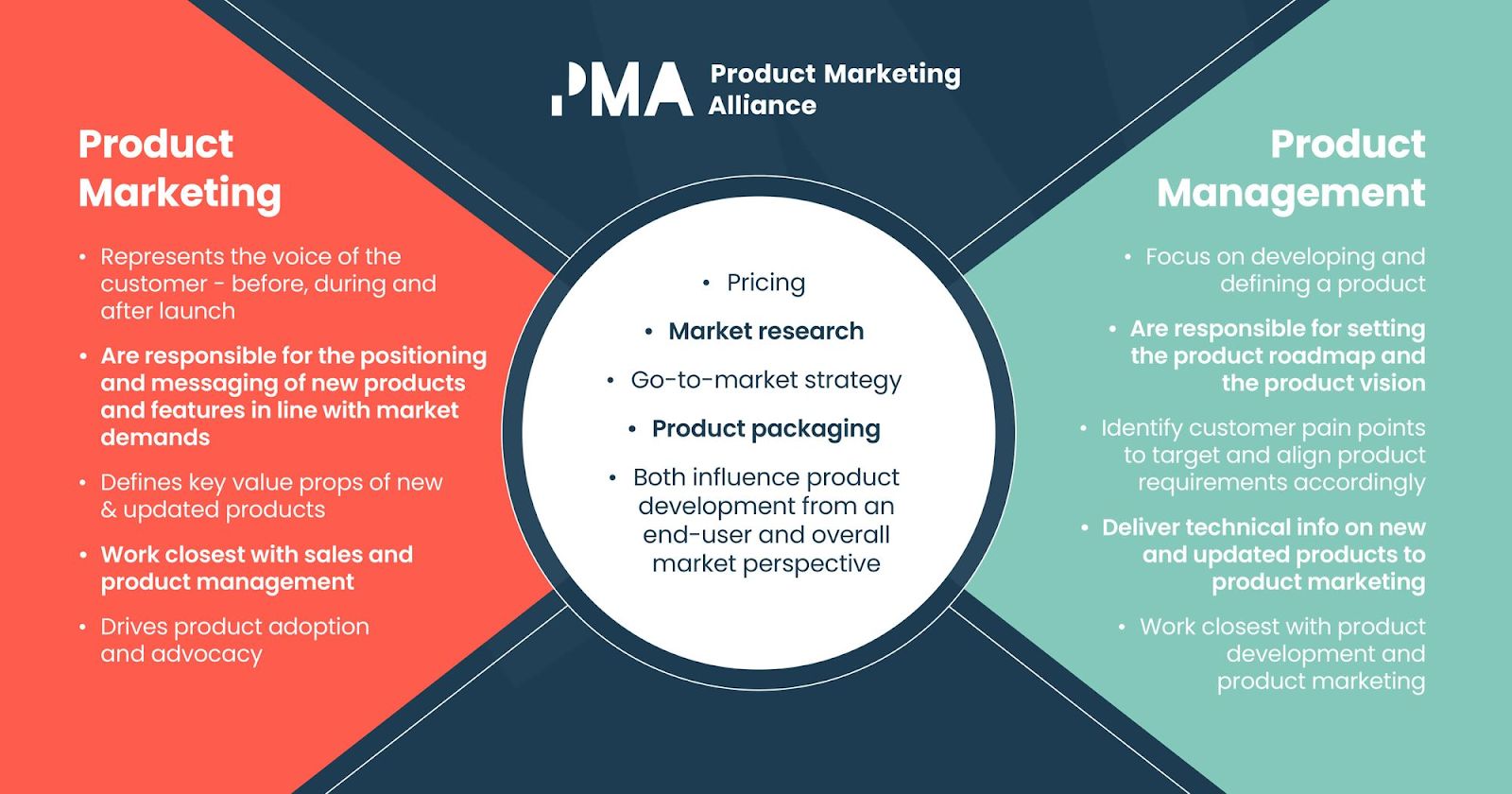
Check out the article below for more information:
 Emma Bilardi
What is product marketing actually responsible for?
The role of a product marketer is notoriously fluid, but our State of Product Marketing 2025 report reveals a clear trend: the role is becoming more strategic, more technical, and more deeply embedded in the revenue engine.
While the "Foundational Four" (Positioning, Messaging, Launches, and Research) remain, we are seeing a significant surge in Sales Enablement and Website Management, signaling that PMMs are now expected to own the customer experience across more touchpoints than ever before.
1. Product positioning and messaging (91%)
The bread and butter of the role. Today, this isn't just about catchy headlines; it’s about defining the product’s unique value proposition in a crowded, AI-heavy market. It remains the #1 responsibility for nearly every PMM.
 Bryony Pearce
 Bryony Pearce
2. Managing product launches (80.9%)
Launches have seen a rebound since 2024. Today’s PMMs coordinate the "big bang" new product launches as well as the continuous stream of feature updates that keep a product competitive.
 Stevie Langford
3. Sales enablement and collateral (80.9% & 78.7%)
This is the fastest-growing area of impact. Sales Enablement rose from 64% in 2024 to nearly 79% in 2025. PMMs are no longer just "making decks"; they are strategic partners to the sales org, building battlecards, training teams on competitive shifts, and directly influencing win rates.
 Bryony Pearce
4. Customer and market research (69.7%)
Market intelligence is the PMM’s "superpower." By diving deep into customer pain points and market trends, PMMs ensure the company isn't building in a vacuum. This has seen a steady climb as companies prioritize "Customer Obsession" to avoid product failure.
 Bryony Pearce
5. Competitive intelligence (65.2%)
With the barrier to entry for new software lowering, staying on top of rivals is critical. PMMs are now the "internal detectives," using AI-driven tools to track competitor pricing, messaging shifts, and feature releases in real-time.
 Bryony Pearce
6. Managing the website and digital touchpoints (65.2%)
The website is often the first "product experience" a customer has. PMMs are increasingly taking the lead on website messaging and customer-facing docs to ensure the value proposition described by Sales matches the one seen on the home page.
 Bianca Stanescu
Emerging trends to watch
- Customer onboarding (37.5%): This responsibility nearly doubled since 2024. PMMs are getting more involved in the "post-purchase" journey, ensuring that the value promised during the sale is actually realized during the first 90 days of use.
- Product roadmap planning (28.1%): While still lower than other tasks, this is on a consistent three-year upward trend. PMMs are successfully moving "upstream," using their market intel to influence what the engineering team builds next.
- The content shift: Interestingly, content marketing (48.3%) has seen a slight decline. This suggests that as generic content becomes easier to produce via AI, PMMs are shifting their focus away from "blogging" and toward high-value strategic tasks like positioning and enablement.
The shift from product to solutions marketing
In 2026, the most sophisticated B2B organizations are moving away from "Product Marketing" in the traditional sense and toward solutions marketing. The difference is subtle but profound.
Product marketing often focuses on a specific tool or SKU – its features, its UI, and its specific price point. Solutions marketing groups products, services, and integrations together to solve a high-level business challenge.
- The product focus: "Our project management tool has Gantt charts and time-tracking."
- The solutions focus: "Our 'Productivity Suite for Creative Agencies' helps you reduce project overruns and increase billable hours."
Why this matters for your GTM
As buyers become more risk-averse, they aren't looking for "another tool"; they are looking for a business outcome. By shifting to a solutions-based narrative, PMMs can capture higher-intent search traffic from executives who are searching for solutions to "revenue leakage" or "operational efficiency" rather than just looking for software features.
How to measure success: Modern PMM KPIs
"What does a successful PMM look like?" Historically, this has been a grey area. However, as the role becomes more data-driven, three key metrics have emerged as the gold standards for measuring impact:
1. Win/loss ratios
This is the ultimate test of positioning. By analyzing why deals were won or lost (specifically looking at "Competitive Reason" codes), PMMs can see if their messaging is resonating or if the competition is out-positioning them. A healthy PMM function should see a measurable increase in win rates against key rivals.
2. Feature adoption rate
A launch isn't successful just because the email was sent. Success is measured by how many users are actually using the new feature 30, 60, and 90 days later. This metric proves that the PMM successfully identified a real pain point and communicated the value clearly.
3. Sales confidence score
Often measured via a quarterly internal survey, this KPI tracks how confident the sales team feels in pitching the product and handling objections. If the Sales Confidence Score is high, it means the PMM’s "Sales Enablement" efforts are working.
Pro-Tip: In 2026, forward-thinking teams are also tracking "Messaging Consistency." Using AI tools to analyze sales calls (Gong/Chorus), PMMs can measure how often sales reps actually use the "official" talk tracks and value pillars in live conversations.
 Charley Gale
How is product marketing different from other marketing roles?
Product marketing vs marketing communications
A marketing team focuses on customer acquisition and converting prospects into fully-fledged customers.
They also promote a company, an existing or new product, or a brand and ensure the consistency of the marketing message.
Product marketing, on the other hand, focuses on marketing to customers, driving demand and adoption, all with the goal of creating happy, successful customers.
Product marketing is the process of bringing a product to market and overseeing its overall success.
Product marketers are focused on understanding and marketing to customers. They drive demand and usage of the product, focusing on processes such as product positioning, sales enablement, product messaging, buyer personas, metrics, meeting customer needs, and product demos.
A product marketing team is integral to creating a deep understanding of a product’s value to the target audience and generating brand awareness.
Product marketing vs brand marketing
Brand marketing looks more at building brand awareness for a company, and ensuring that its reputation remains positive.
Though, of course, this is still a responsibility of most roles in any given organization, product marketing focuses more on driving sales of specific products that an organization has.
In short, while both roles ensure sales are carried out, product marketers look directly at what they’re selling, not who’s selling it.
Product marketing vs demand generation
Farhan Manjiyani, Product Marketing Manager at Grafana Labs, outlines the difference between product marketing and demand generation in 2 short sentences:
“If we oversimplify the marketing funnel into three stages – attract, consider, and close – demand gen focuses on stage one (attract) and product marketing focuses on stage three (close). Product marketing should inform both attracting and informing buyers through their consideration stages but should ultimately be responsible for the ‘closing’ stage.”
Product marketing vs field marketing
Kimberly Kaminski, Chief Marketing Officer at NS1 gave her two cents on the difference between product marketing and field marketing in her article:
“It’s your product marketing and field marketing teams that are in the best position to be the headlights on your road to effective demand generation. Both teams contribute valuable market-facing insights that are critical to the successful planning, development, and execution of demand generation programs and activities."
How to start a career in product marketing
The beauty of product marketing is there’s no such thing as one, set path and this is something we’ve been asking as part of our Product Marketing Life podcast. Without fail, this is how the conversation goes…
Us: “What did your journey into product marketing look like?”
PMM: “Oh, I had quite a windy route into the role.”
Although by no means a prerequisite or requirement, some of the most common backgrounds we hear are:
- Product
- Marketing
- Sales
- Customer Success
- Project Management
- Engineering.
If you’re looking to transition into product marketing and you’re currently at a company that has the function built-in, our advice would be to try and shadow some of their work and get as much practical experience as possible - as well as reading up on some industry resources too, of course.
Product marketing resources
Shameless but obligatory plug: our podcasts, resources, and blog are full of lots of info for newbies and experts alike.
Elsewhere, here are a few really in-depth reading materials to get you going:
- The ultimate guide to getting a job in product marketing
- How to get a career in product marketing
- What skills do I need to be a product marketer?
- Product marketing 101: Templates, strategies, and examples
FAQs
1. What is the core difference between a Product Manager (PM) and a Product Marketing Manager (PMM)?
While both roles focus on the product’s success, their "centers of gravity" differ. A Product Manager is responsible for the product's development—deciding what to build based on user needs and technical feasibility. A Product Marketing Manager is responsible for the market's response—deciding who the product is for, how to position its value, and how to drive adoption.
2. How has AI changed the role of product marketing in 2026?
AI has shifted PMM from a "static" role to a "dynamic" one. Modern PMMs use AI for real-time competitive intelligence, sentiment analysis of customer calls, and hyper-personalized messaging at scale. The focus has moved from manual content production to AI-driven strategic orchestration.
3. What is "Solutions Marketing" and how does it differ from Product Marketing?
Product marketing typically focuses on the features and benefits of a single tool. Solutions Marketing groups multiple products or services together to solve a high-level business problem (e.g., "Securing Remote Workforces" instead of just "Selling VPN Software"). It is a more strategic approach that aligns with how executive buyers make decisions.
4. What are the most important KPIs for a Product Marketer?
Common PMM metrics include feature adoption rates, win/loss ratios (specifically looking at competitive reasons), sales confidence (measured via internal surveys), and pipeline influence (how much revenue can be traced back to PMM-led launches).
5. Do I need a technical background to be a PMM in SaaS?
Not necessarily, but you must be "technically curious." A PMM needs to translate complex technical features into human value. While you don't need to write code, you must understand the "architectural case" for your product to build a credible narrative against competitors.
6. What is a Go-To-Market (GTM) strategy?
A GTM strategy is a comprehensive plan that outlines how a company will launch a new product or reach a new segment. It includes the target audience (ICPs), pricing and packaging, distribution channels, and the core messaging pillars that differentiate the offering from the status quo.
7. How does Product Marketing support the Sales team?
PMMs provide "Sales Enablement." This includes creating battlecards to handle competitor objections, drafting pitch decks that tell a cohesive story, and training reps on how to position new features effectively to different buyer personas.
8. What is "Competitive Intelligence" in Product Marketing?
It is the ongoing process of monitoring competitors' product updates, pricing shifts, and messaging changes. In 2026, this is often automated with AI tools to ensure that sales teams always have the most up-to-date "talk tracks" to win against rivals.
9. How do you identify a "Target Persona"?
PMMs identify personas through a mix of qualitative interviews, quantitative surveys, and CRM data analysis. A strong persona goes beyond demographics (age/title) to focus on "Jobs to be Done," pain points, and the emotional triggers that drive a purchase decision.
10. What is the typical career path for a Product Marketer?
Many start as Associate PMMs or transition from Sales/Product roles. The path usually leads to Senior PMM, Director of Product Marketing, and eventually VP of GTM or Chief Marketing Officer (CMO), as the role provides a unique 360-degree view of the business.


Product marketing insider
Thank you for subscribing
Level up your product marketing career & network with product marketing experts.
An email has been successfully sent to confirm your subscription.
 Follow us on LinkedIn



.svg)
Start the conversation
Become a member of Product Marketing Alliance to start commenting.
Sign up now