











What is a product marketing manager?
With product marketing being the driving force behind getting products to market – and keeping them there, PMMs handle a wide range of strategic planning and tactical execution related to product launches.
They’re the overarching voices of the customer, masterminds of messaging, enablers of sales, and accelerators of adoption.
What does a product marketing manager do?
PMMs bridge the gap between product development and market success. They ensure sales and marketing are aligned on what problem the product solves and how to articulate its benefits.
A PMM is responsible for:
- Positioning and messaging for new products and features
- Conducting competitor analysis and market research
- Empowering the sales team with clear value propositions
- Setting up marketing campaigns for demand generation
- Being the internal voice of the customer
- Outlining the benefits of product features using customer-facing messaging
- Developing a deep understanding of the market and competitors
- Crafting compelling content like blogs, guides, and case studies that attract and educate potential buyers
- Defining pricing strategies to optimize sales volume and market share
- Planning events and webinars to generate buzz and pipeline
- Leveraging channels like analyst relations and partnerships to expand reach
- Monitoring buyer sentiment, product feedback, and market trends
- Collaborating with cross-functional teams on launch readiness
What a PMM does day to day
The responsibility list above tells you what a PMM owns. But what does that actually look like in practice?
The honest answer is that it depends heavily on where you are in the launch cycle and what stage company you're at.
A PMM at a Series A startup might spend Monday morning on customer interviews, Tuesday afternoon writing positioning docs, and Wednesday in a sales call providing live support. A PMM at an enterprise company might have a more structured rhythm with dedicated blocks for cross-functional syncs, analyst briefings, and campaign reviews.
That said, certain activities tend to recur weekly for most PMMs. You'll likely spend time in customer research activities, whether that's reviewing call recordings, analyzing survey data, or sitting in on sales conversations.
Messaging work happens constantly, from refining value propositions to reviewing campaign copy to updating battlecards. Cross-functional meetings with product, sales, and demand gen teams fill a meaningful portion of the calendar.
And launch coordination intensifies as release dates approach, pulling you into readiness reviews, enablement sessions, and go-to-market checklist management.
As Jeremy Wood, Head of Product Marketing (APAC) at Adobe, notes, PMM calendars and rhythms change based on team structure, scope, and company scale. There's no universal daily template that applies everywhere.
Common PMM deliverables
The tangible outputs of PMM work tend to fall into a few categories.
- Messaging frameworks and positioning documents form the strategic foundation.
- GTM plans and launch briefs translate strategy into execution.
- Sales enablement assets like battlecards, competitive one-pagers, and objection-handling guides equip your revenue teams.
- Customer research summaries synthesize insights for product and leadership.
- Pricing recommendations document your analysis and rationale.
- And event or webinar briefs outline the narrative and logistics for demand generation activities.
Richard Doherty, Senior Director of PMM EMEA at Workday, emphasizes that outbound PMM work centers on concrete execution assets, launch materials, and enablement deliverables.
These outputs are how PMMs create measurable impact across the organization.
Product marketing manager skills
The responsibilities and deliverables above point to a specific mix of skills. PMMs need both the analytical, research-driven side of marketing and the more human, persuasive side, often in the same afternoon.
Hard skills
- Market research. Running and synthesizing customer interviews, surveys, and win/loss analysis into findings the rest of the business can act on.
- Competitive intelligence. Tracking competitor moves, translating them into battlecards, and knowing when a competitive shift is significant enough to change your own positioning.
- Positioning and messaging. Turning product capabilities into a clear, differentiated story for a specific target segment.
- Pricing strategy. Understanding willingness to pay, packaging, and how pricing decisions affect both sales velocity and perceived value.
- Data analysis. Reading product usage data, campaign performance, and pipeline metrics well enough to know what's actually working.
Soft skills
- Storytelling. Turning a feature list into a narrative that sales, customers, and press all find compelling for different reasons.
- Empathy. Genuinely understanding a customer's problem well enough to represent their voice accurately in rooms they're not in.
- Cross-functional collaboration. Working effectively with product, sales, and demand gen teams that each have their own priorities and incentives.
- Stakeholder management. Getting alignment from leadership, sales, and product on a launch plan or positioning decision, often without direct authority over any of them.
- Adaptability. Shifting between strategic planning and hands-on execution within the same week, sometimes the same day, as covered in the "day to day" section above.
The PMMs who progress fastest tend to be strong across both lists, not just excellent at one side. A brilliant researcher who can't tell a compelling story struggles just as much as a great storyteller working from weak research.
Product marketing manager tools
The specific stack varies by company and budget, but most PMMs work across a similar set of tool categories.
Research and customer insight
Tools like Typeform and SurveyMonkey for structured customer surveys, and Amplitude or Mixpanel for understanding how customers actually use the product once they're in it.
Competitive intelligence
Tools like Klue or Crayon for tracking competitor moves and centralizing battlecards, particularly useful once you're tracking more than a handful of competitors by hand.
Project and launch management
Tools like Asana or Productboard for coordinating launch timelines, tracking readiness across teams, and keeping the roadmap-to-launch handoff visible to everyone involved.
Content and creative
Tools like Canva for quick campaign assets and one-pagers, and Wistia for hosting and tracking engagement on product videos and demos.
Marketing automation and CRM
Tools like HubSpot for running and measuring demand gen campaigns, often alongside a CRM like Salesforce for visibility into how positioning and messaging are actually performing in live deals.
Most PMMs don't own every tool in this list personally. It's common to share ownership of the CRM and marketing automation platform with demand gen or sales ops, while owning the research and competitive intelligence tools more directly.
What is a product manager?
Product managers are masters at organization, strategy ninjas, and roadmapping wizards. Their roles often include marketing, forecasting, and profit and loss.
What does a product manager do?
The product manager owns the strategy and roadmap for a product. They set goals based on customer needs, market analysis, and business objectives. As the subject matter expert, the product manager guides engineering teams to build solutions that solve customer problems.
Their main responsibilities include:
- Setting the product roadmap
- Identifying customer pain points to target
- Defining features to build through user stories or jobs-to-be-done.
- Developing a deep understanding of competing products and technologies
- Making sure the company ships the right product
What a product manager does day to day
Product management is one of those roles that’s easier to define by outcomes than by a fixed daily routine.
At a high level, product managers are responsible for identifying the problems the team should solve and ensuring that those solutions are actually built and delivered. In practice, this means spending a significant amount of time connecting the dots between customer needs, business goals, and engineering realities.
A typical week might include digging into product data to understand user behavior, speaking with customers to uncover new problems, and working with design to shape potential solutions.
PMs also spend a significant amount of time with engineering teams – clarifying requirements, making trade-off decisions, and helping unblock development work.
The role naturally shifts depending on where the product is in its lifecycle. During discovery phases, more time goes into research, problem definition, and validating ideas. Once a feature is in development, the focus moves toward coordination – keeping teams aligned, managing scope, and ensuring the work ships on time.
Communication is a constant throughout. Product managers regularly translate between teams: helping engineers understand customer context, helping leadership understand product trade-offs, and helping go-to-market teams understand what’s coming next.
Because of this, the PM role often ends up sitting at the center of many conversations rather than owning a single type of task.
Common product manager deliverables
While much of product management happens through conversations and decisions, PMs still produce several key artifacts that help teams stay aligned.
- Product strategies and roadmaps outline the direction of the product and the problems the team plans to solve over time.
- Feature briefs or requirement documents capture what’s being built and the reasoning behind it.
- Customer and discovery insights summarize research findings and help teams stay grounded in real user problems.
- Prioritization frameworks or opportunity assessments help explain why certain work is moving forward while other ideas are deferred.
- Experiment plans and product performance reviews document how the team evaluates whether a feature or initiative is working.
Together, these outputs help turn ambiguous customer problems into clear, coordinated product work.
What's the difference between product management and product marketing?
There’s a fairly well-known saying that “product managers put products on the shelf and product marketers get products off the shelf,” and it rubs a lot of product marketers up the wrong way. Why? Simply, because it's inaccurate.
Product management and product marketing focus on different parts of a product’s success.
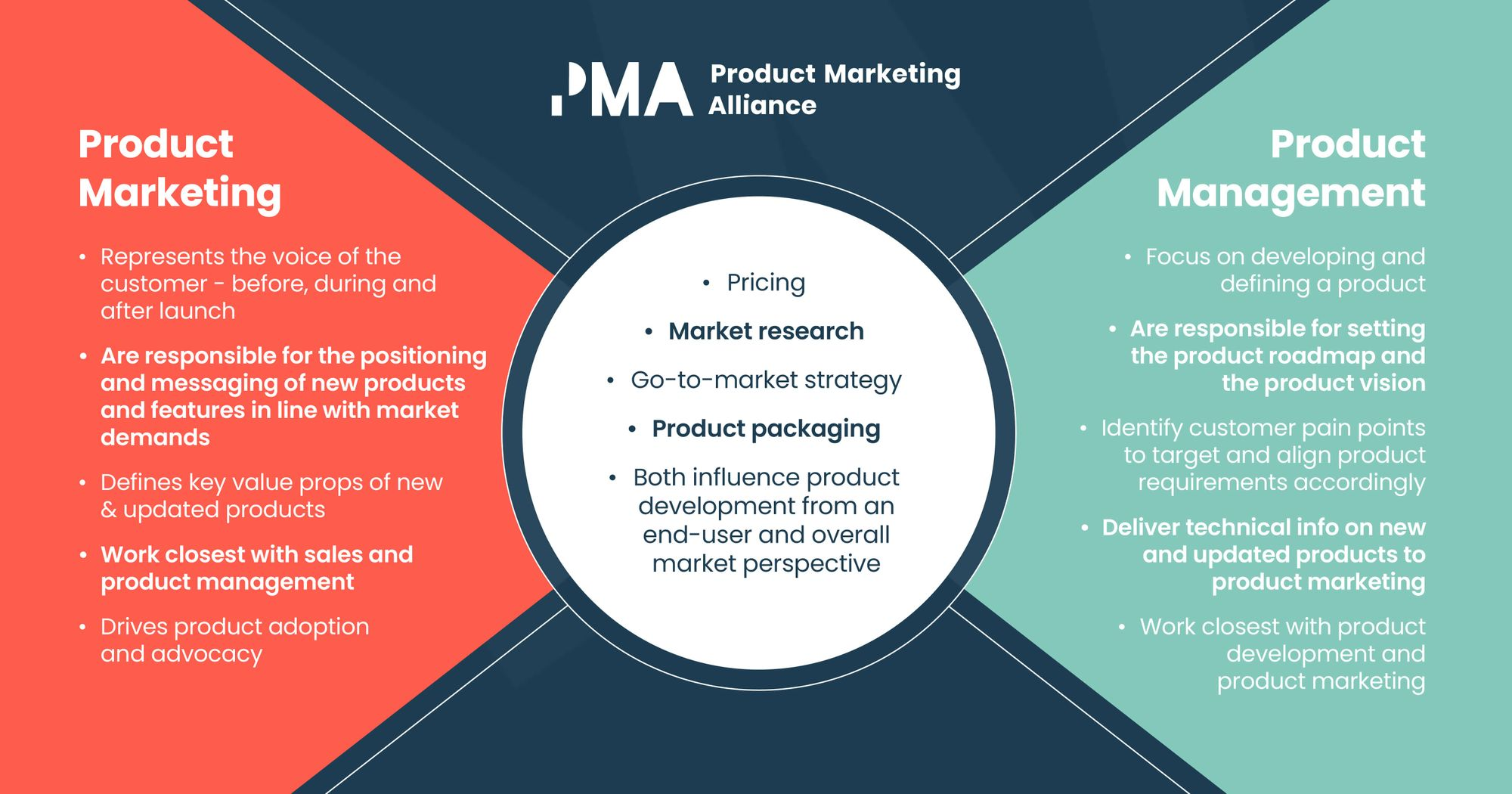
Product managers are responsible for building the product – defining what gets built, prioritizing the roadmap, and working with engineering to deliver features.
Product marketers, on the other hand, focus on bringing the product to market successfully – understanding the customer, shaping positioning and messaging, and ensuring the product resonates with the right audience.
Importantly, product marketing shouldn’t start only at launch. Their work begins much earlier, acting as the pulse of the customer and feeding insights into the product roadmap.
Without that input, companies risk building features customers don’t actually want – and if there isn’t real demand, even the best-built product won’t succeed in the market.
Here's a little table to help you visualize the difference a bit better:
PM vs. PMM RACI: Who owns what?
The descriptions above paint a useful picture, but when you're actually building a team or defining handoffs, you need something more operational.
Here's the core principle: the product manager owns product definition and delivery, while the product marketing manager owns market readiness, narrative, and commercialization. Everything else flows from that division.
The following RACI framework maps out ownership across the activities where PM and PMM collaboration matters most:
As Lindsay Boyajian, PMM at Conductor, explains, product roadmaps benefit significantly from PMM influence, even when the PM retains final ownership. The PMM brings market context and customer voice into roadmap discussions, which shape prioritization without shifting accountability.
A few nuances worth noting: pricing ownership can shift depending on the company's stage.
At early-stage startups, the PM or even the founder might own pricing decisions, while at larger organizations, PMM typically leads pricing strategy with input from finance and product.
Market research often becomes a shared responsibility, with PMs focusing on product-usage data and PMMs concentrating on competitive intelligence and buyer behavior. Launch leadership almost always sits with PMM, though the PM remains accountable for product readiness and feature completeness.
Raman Sharma offers a useful frame for thinking about these boundaries: product marketers need to recognize when to lead and when to adopt a support role.
The RACI above provides a starting point, but your specific org design, company maturity, and launch cadence will determine where those lines flex.
Use this as a working model, then adapt it based on what actually creates clarity and reduces friction between your PM and PMM teams.
How to become a product marketing manager
If you’re keen to venture into the world of PMMs, here are some tips on how you can get started.
Get a relevant educational background
Degrees like marketing, business, and communications provide a strong foundation. Coursework focused on marketing fundamentals, consumer behavior, competitive analysis, market research, and data analytics are extremely useful.
Complement with certifications
Specialized certifications can help you stand out. Options like the Product Marketing Alliance certification validate your expertise.
Gain early experience
Internships and entry-level roles in areas like marketing, sales operations, content writing, or product management allow you to develop relevant hard and soft skills.
Understand your target industry
It’s valuable to gain some early experience in your chosen technology sector or target industry. Build knowledge of the competitive landscape, buyers, and business challenges.
Hone your skills
Sharpen abilities like positioning, strategic planning, market analysis, communication, and cross-functional collaboration. These will serve you well as a product marketing manager.
Show impact
Highlight program successes, campaign results, sales enablement wins, and launches you contributed to. Demonstrate that you can strategize and execute product launches skillfully.
Network internally
Connect with product marketing managers in your company. Offer to assist with launches and projects to gain hands-on experience.
By following these tips, and gaining relevant, valuable skills, you’ll be well on your way to transitioning into an engaging, rewarding career in product marketing. The role leverages marketing savvy, strategic orientation, and cross-functional collaboration to successfully bring new products to market.
Product marketing manager career path and seniority levels
Getting your first PMM role is the first step. Here's how the career ladder typically progresses from there.
Associate or junior PMM
Usually 0 to 2 years into the role. Focused on execution: supporting launches, drafting sales enablement assets, and running customer research under the direction of a more senior PMM.
Product marketing manager
Usually 2 to 5 years in. Owns positioning and messaging for a specific product area, leads launches independently, and works directly with sales and product without heavy oversight.
Senior product marketing manager
Usually 5 to 8 years in. Owns a larger or more strategically important product area, mentors junior PMMs, and starts contributing to broader go-to-market strategy rather than just executing within it.
Director of product marketing
Usually 8 to 12 years in, though this varies significantly by company size. Manages a team of PMMs, owns GTM strategy across a full product line, and sits closer to the executive team when it comes to launch and pricing decisions.
VP of product marketing
Typically a company-wide or business-unit-wide remit. Sets the overall product marketing function's strategy, owns its budget and headcount, and represents product marketing at the executive leadership level.
The timelines above are rough guides, not guarantees. Moving between companies, taking on a broader remit early, or specializing deeply in a high-demand area like pricing or competitive intelligence can all speed up progression, and smaller companies in particular often compress these stages compared to the ranges listed here.
Product marketing manager salary
Compensation varies significantly by level, company size, and industry. The most reliable figures here come from the 2025 Product Marketing Salary Survey, since it's built specifically from PMM respondents rather than a broader "product and project management" category the way general salary sites often categorize this role.
Globally, the median base salary for product marketing in 2025 is $119,000, up 13% year-on-year. Once bonus and stock are factored in, average total compensation reaches $144,681, up 12%. By seniority, median base salary breaks down like this:
The US premium is steepest at the associate level, where US-based PMMs earn 68% more than the global median, and narrows to almost nothing by the senior director level, suggesting executive-level PMM pay has become more globally consistent than entry-level pay. Location matters heavily too.
North America leads all regions in total compensation at $184,563 on average, with Boston now the single highest-paying city globally at a $229,000 median, ahead of San Francisco.
Company size matters at the extremes more than in the middle: PMMs at companies with 10,000+ employees earn 22% above the median, while those at companies with 11 to 50 employees earn 24% below it, but salaries in the 200 to 5,000 employee range barely move regardless of headcount.
For comparison, general salary aggregators tend to show lower or more compressed numbers because they blend product marketing in with broader "product and project management" roles.
Glassdoor's cross-category average base salary for the title sits closer to $120,000 to $141,000 depending on how the query is scoped, and Payscale reports an all-levels blended base salary average of roughly $106,000.
Pay isn't just widening by level. The same 2025 survey found the global gender pay gap widened to 17.1% (from 1.6% in 2024), and certified PMMs earn a 9% premium over non-certified peers.
For the full breakdown, including salary by industry, region, company growth stage, and equity participation, see the 2025 Product Marketing Salary Survey and try the salary calculator to benchmark your own number.


Product marketing insider
Thank you for subscribing
Level up your product marketing career & network with product marketing experts.
An email has been successfully sent to confirm your subscription.
 Follow us on LinkedIn



.svg)
Start the conversation
Become a member of Product Marketing Alliance to start commenting.
Sign up now